Sign In



 Free Newsletter


Another day in ‘Paradise’: Surprise card room owner says Department of Gaming approves his club
Debra Utacia Krol, Arizona Capitol Times correspondent//February 7, 2011//
Another day in ‘Paradise’: Surprise card room owner says Department of Gaming approves his club
Debra Utacia Krol, Arizona Capitol Times correspondent//February 7, 2011//


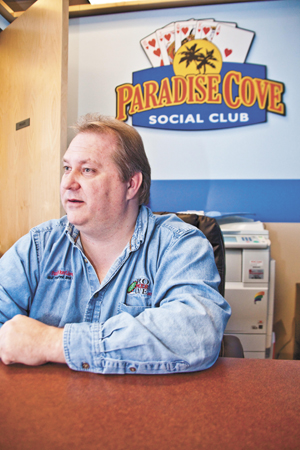
With slot machines, blackjack tables, alcohol and six poker-style card tables, the set-up at Paradise Cove Social Club in Surprise definitely gives off a casino vibe. The set-up was enough to make at least one state official question exactly what type of operation the Department of Liquor Licenses and Control was considering licensing.
“When Liquor Control came out to see us, the inspector had to kick our application upstairs,” says Paradise Cove owner Brian Johnson. “He said, ‘What is this, a casino?’”
Johnson, who opened Paradise Cove in June 2010, says he and his attorney have painstakingly made sure that his operation functions under the state’s exemption for social gambling as defined by statute. “We didn’t want to try and get around the law,” he says. “My attorney met with the Arizona Department of Gaming to get their input before we put a dime into the club.”
ARS 13-3301 describes social gambling as: “gambling that is not conducted as a business and that involves players who compete on equal terms with each other in a gamble.”
Other conditions must be met, including no person other than the players who are playing benefit directly or indirectly from the game and all players must be at least 21 years old. Section 13-3302 lists social gambling under activities that are “not unlawful” and Section 13-3304 states: “benefiting from social gambling as a player is not unlawful under this section.”
This exemption for social gambling is the heart of Johnson’s contention that his place is legal.
Paradise Cove, an Arizona nonprofit 501(c)(7) organization, charges players a $20 yearly fee and $10 per month to be members of the club. All members must be at least 21 years old. If a tournament has 20 players who each buy-in for $20, then a total of $400 is paid out to the players by the end of the tournament. The house doesn’t take any of the money. Johnson says he doesn’t charge for anything related to gambling at Paradise Cove. He says the membership dues all go back into the club, stressing that he does not profit directly or indirectly from the gambling activities or dues.
“If I even went out and got pizzas for the club members and took home the leftovers to feed my kids, I have just benefited from the gambling activities here,” he says. “All this could be shut down, and my investment is down the tubes.”
Johnson, a poker aficionado who has “Mr. Poker” on his license plate, says even if he were trying to make money from Paradise Cove, it would be a losing proposition. He says he has invested $250,000 of his own money into planning, implementation and operations to date, while also supplementing the monthly dues of his 600 members just to keep the place running.
And the last thing Johnson wants is to have his establishment shut down. He touts a close relationship with the Department of Gaming and says the agency gave his card room a clean bill of health. However, Rick Medina, assistant director of the Department of Gaming, says the agency does not “provide a blessing, endorsement or seal of approval for anybody.”
Medina confirmed that the agency has visited Paradise Cove and that Johnson has solicited input from the department. “Our agents have to walk a fine line there because our agents are not lawyers, they are representatives of the state, they can’t give legal advice,” Medina says. “They can give public information, but what they can’t do is be your consultant to teach you how to open up a business and thwart the law or anything of that nature.”
Johnson says his operation is always open to gaming and law enforcement officials for inspection.
His apparent success has attracted attention from other card room operators.
He says he warns them that the first step to ruin is to view card rooms as money-making enterprises. “I keep telling the other guys that when they come to me for advice on how to set up a card room legally: Once you make a dime (off gambling), you’ve just broken the law,” he says.
Johnson also contends that he doesn’t need to make money — legally or illegally — from his club. He says he is a successful business man and his wife manages several dental offices.
On a recent Sunday evening, Paradise Cove had three tables full of people playing poker, with a few players waiting to start a game of gin at another table. The club’s two blackjack tables and five slot machines were idle. Some poker players had bottles of beer, but there was no bar or bartender visible.
Johnson says he has a liquor license from the state that allows members of his social club — the card players — only to bring their own liquor for consumption. He says he will apply for a full liquor license after the year waiting period with his current BYOB license.
As for the slot machines, which cannot accept money or dispense currency or tickets, Johnson says they operate only on a promotional basis. Players try to accumulate the highest point total to win something like a restaurant gift certificate.
For Johnson, who plays regularly in high-stakes poker games at Commerce Casino in Los Angeles and has competed multiple times in the main event of the World Series of Poker’s $10,000 buy-in Main Event, Paradise Cove really is an escape.
“My wife calls this my man cave,” he says. “I’m in this purely for love of the game.”