Sign In



 Free Newsletter


SB1070 supporters laud high court’s ruling on key provision of law
Luige del Puerto//June 25, 2012//
SB1070 supporters laud high court’s ruling on key provision of law
Luige del Puerto//June 25, 2012//


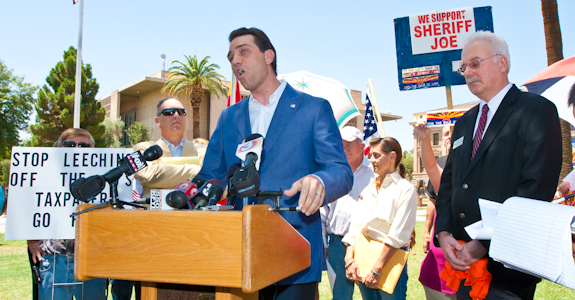
Supporters of Arizona’s SB1070 commended the U.S. Supreme Court today for upholding a key provision in the immigration law that they say is its most important section.
In their 5-3 ruling, the justices didn’t strike down the law’s requirement that police inquire into people’s legal status if they suspect they’re here illegally.
Supporters said that provision, along with another section that wasn’t at issue before the high court, form the core of SB1070.
That other provision prohibits governments from adopting policies that limit the enforcement of illegal immigration to less than the full extent permitted by federal law, otherwise known as “sanctuary city” policies.
“SB1070 remains largely intact. In fact, the very core and essence of it were two provisions — the sanctuary city policy, which remains intact today, and this,” said Senate Majority Leader Andy Biggs, referring to the requirement that law enforcers ask about people’s immigration status during routine stops if there’s a suspicion they’re here illegally.
“It’s true that today we lost three subsections of the law, and we could have used those subsections,” said Rep. John Kavanagh, R-Fountain Hills. “But the heart and soul, the main part of SB1070, is alive and well.”
The pro-SB1070 media briefing took place on the same Senate lawn shortly after critics of the law held their own news conference.
Supporters also found vindication in the court decision, noting that Justice Anthony Kennedy, who delivered the majority decision, discussed Arizona’s woes that result from illegal immigration.
They also agreed with the dissenting opinion of Justice Antonin Scalia, who argued that states have a right to enact immigration policies because the federal government’s uniform rule of naturalization didn’t abrogate their right to exclude people who shouldn’t be in their territories.
Rep. John Fillmore, R-Apache Junction, said now that the court has clarified the law, other states should take advantage of it and use it as a “building block” to enact state-level immigration policies.
But both critics and supporters agree that the legal battle is far from over.
In their majority opinion, the justices left open the door to challenge the provision it upheld today on other constitutional or preemption grounds.
Biggs said he isn’t too surprised by this, adding that the court merely laid out what typically happens with issues that deal with the Fourth Amendment, which gives people the right against unreasonable searches and seizures.