Sign In
Upcoming Event
 Free Newsletter

Phoenix ranked top in the nation for build-to-rent homes
Jamar Younger Arizona Capitol Times//August 15, 2025//
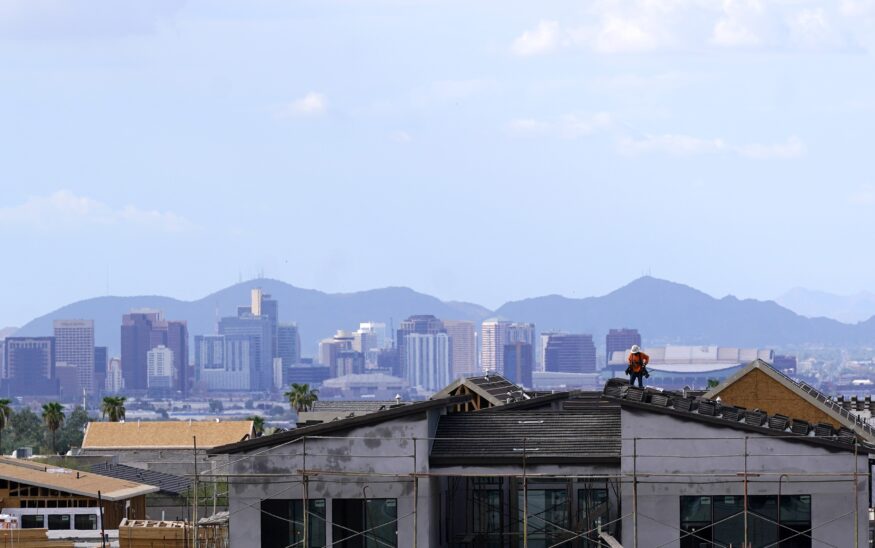
In this Aug. 12, 2021, file photo with the downtown skyline in the background, a roofer works on a new home being built in a new housing development as expansive urban sprawl continues in Phoenix. (AP Photo/Ross D. Franklin, File)
Phoenix ranked top in the nation for build-to-rent homes
Jamar Younger Arizona Capitol Times//August 15, 2025//


Key Points:
- Phoenix is the leading market for build-to-rent homes
- Some legislators are concerned the homes benefit from loopholes in water policy
- Supporters say the homes fill a niche in the housing market
Phoenix has emerged as one of the top markets for build-to-rent homes, which has caught the attention of lawmakers who are concerned the communities are benefiting from loopholes in water policy.
The greater Phoenix area ranked as the top market in the country with more than 20,000 build-to-rent homes built, including more than 5,000 constructed in 2024, according to numbers provided by CoStar Group. This company provides commercial real estate data and operates homes.com and apartments.com.
So far, 1,900 homes have been built this year, according to the CoStar Group.
The number of build-to-rent homes in Arizona has increased within the past decade. The development is part of a multi-decade wave of apartment construction, said Connor Devereux, director of market analytics for CoStar Group in Phoenix.
Build-to-rent homes have grown in popularity because the communities tend to attract a variety of renters, ranging from families who seek a single family home but can’t afford to pay a mortgage to people who may want to continue to rent but have outgrown traditional apartments.
The homes are similar to other single family housing that are detached with yards, but still have amenities found in apartments, such as maintenance services, community swimming pools and fitness centers.
The rents are usually cheaper than most mortgage payments, said Kimberly Winson-Geideman, a clinical professor and director of the division of real estate at Arizona State University’s W. P. Carey School of Business.
“Because they’re cheaper, they actually open up opportunities for people to live in communities they couldn’t necessarily afford before,” Winson-Geideman said.
Despite the growth and popularity, some of the state’s lawmakers have expressed concern that build-to-rent developers have an advantage over single family home builders who have to meet assured water supply requirements in order to construct homes.
“I do think that it does put the single family housing folks at a disadvantage when you can’t build a single family home in a Buckeye or Queen Creek,” said Sen. T. J. Shope, R-Coolidge, referring to restrictions on housing development in those two cities because of groundwater shortage concerns.
Shope has engaged in some preliminary discussions with Sen. Priya Sundareshan, D-Tucson, and Sen. Jake Hoffman, R-Queen Creek, to explore potential water policy legislation focusing on build-to-rent communities and other multifamily housing.
Build-to-rent communities are regulated similarly to other apartment complexes that don’t follow the same assured water supply requirements since the units are leased and not subdivided into more than five lots, according to the Arizona Department of Water Resources.
“My concern is from the water perspective. Build-to-rent homes are a loophole in our water management laws, even in our urban areas, where we have Active Management Areas that are supposed to be robustly managing the water,” Sundareshan said.
Sundareshan has previously introduced a bill that would close the loophole for all types of multifamily housing that doesn’t fall under assured water supply requirements.
While Sundareshan and Shope haven’t expressed any opposition to the existence of the homes, Hoffman has staunchly opposed the communities.
In an X post on July 27, Hoffman referred to build-to-rent homes as “communism” and expressed concern that the increase of these communities could interfere with the ability for people to own for-sale homes.
“The American people do not want to be a nation of serfs destined to forever rent from the mega corporations acting as your landlord,” Hoffman said in a text message. “Senator Shope and I are collaborating in the interim and will see what sensible legislation might make sense to address this concerning trend.”
Housing experts and supporters of build-to-rent homes say the communities fill an important niche in the Phoenix area as the state continues to grapple with a surging population.
“The fast growth of build-to-rent homes in Arizona is really a reflection of the state’s continued population growth and the law of supply and demand,” said Courtney Gilstrap LeVinus, president and CEO of the Arizona Multihousing Association in a statement. “So long as people keep moving to our state and the economic drivers of construction remain attractive, developers will continue to build homes in every category, including build-to-rent. In that regard, it’s not much different than building apartments or single family communities with homes for sale.”
In 2024, Arizona saw a net population gain of more than 109,000 people, according to a recent State of Housing in Arizona report published by the Arizona Research Center for Housing and Economic Solutions, which is located at both Arizona State University’s Morrison Institute for Public Policy and the University of Arizona’s Drachman Institute.
The continued population growth in the Phoenix area has made it one of the country’s “most compelling markets for build-to-rent communities,” said Josh Hartmann, CEO of NexMetro Communities, in a statement.
NexMetro is the developer of Avilla Homes, which has 26 communities under construction or in development in Maricopa and Pinal counties.
“These consumers want the lifestyle of a home, but also value the full maintenance and flexibility of apartment living,” he said. “While the increasing cost of homeownership is driving the appeal of new rental homes, there are also many consumers who prefer not being tied down by a mortgage.”
“Build-to-Rent communities do not exploit a loophole in the Groundwater Mangament Act (GMA). In fact, they operate exactly as the GMA intended when it became law in 1980. Designed as a consumer protection law, the GMA was intended to safeguard homeowners and their most significant investment, their home. Multifamily and rental housing were not subjected to the Act at the time because its authors did not think it was appropriate to protect sophisticated apartment developers and investors in the same the way individual homeowners are protected,” Courtney Gilstrap LeVinus, AMA President & CEO, said. “It’s critically important to note that apartments and BTR use water more efficiently than single-family homes. Expanding the Act to cover rental housing would drive up costs, reduce options for Arizona families, and make our housing crisis worse. That’s why the Arizona Multihousing Association strongly opposes efforts to change this consumer protection law by expanding it beyond consumer protection to include other land uses.”