Sign In


 Free Newsletter

Arizona’s unemployment rate hits highest since COVID pandemic
Howard Fischer, Capitol Media Services//January 13, 2026//
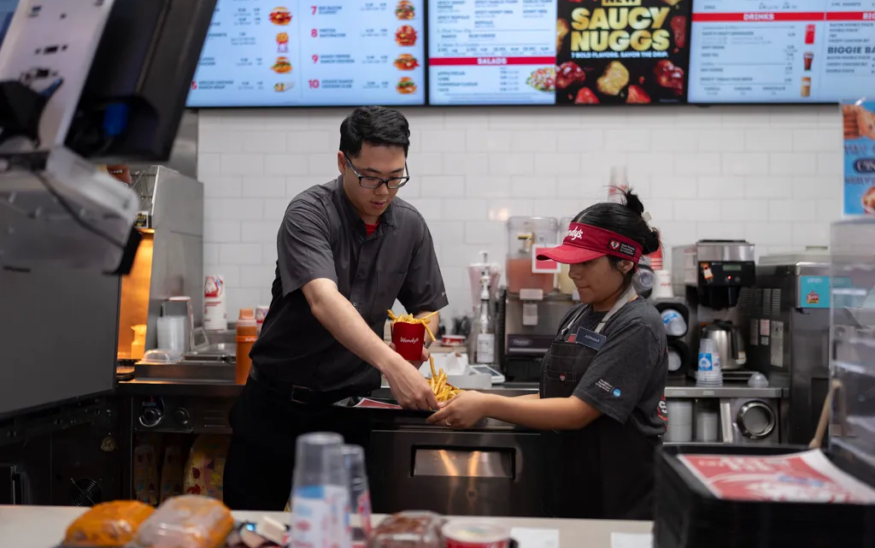
Lawrence Cheng, left, whose family owns seven Wendy's locations south of Los Angeles, works with part-time employee Adriana Ruiz at his Wendy's restaurant in Fountain Valley, Calif., June 20, 2024. (AP Photo/Jae C. Hong)
Arizona’s unemployment rate hits highest since COVID pandemic
Howard Fischer, Capitol Media Services//January 13, 2026//


Key Points:
- Incumbent Gov. Katie Hobbs faces election with mixed economic indicators
- Arizona’s unemployment rate at highest level since COVID pandemic
- Arizona’s median home listing price has dropped from $525,000 to $470,000
Arizona hit its highest unemployment figure in November since the end of the COVID pandemic.
The 4.3% seasonally adjusted rate is not that much higher than the prior numbers, and it still is three-tenths of a point below the figure for the same month nationally, but the numbers are being closely watched as Arizona heads into a statewide election, with the bid by incumbent Gov. Katie Hobbs to get another four-year term.
Her State of the State speech on Monday was an opportunity to argue that, overall, the economy has been good. And there have been a series of victories, including employment expansion by firms such as chipmaker TSMC, LG Energy Solutions, which is building a battery manufacturing complex, and Amkor Technology, which is involved in semiconductor packaging and testing.
But the three Republicans hoping to get their party’s nod to face off against her are making the state’s economy an issue.
Doug Walls, chief economist for the state Office of Economic Opportunity, said the latest overall report is more of a “mixed bag,” with some bright signs.
Not the least of that, he said, is the fact that Arizona continues to outperform the national average.
Walls also said wages in Arizona are up by 6.4% since the same time last year, compared with a 4.3% boost nationally. Even with that, however, the average Arizonan is earning $35.46 an hour, which is $1.54 less than the national average.
There are other signs in the collection of numbers monitored by both OEO and the federal Bureau of Labor Statistics.
The overall number of people with jobs in Arizona continues to increase, but Walls said the rate of increase is slower than it was before the pandemic.
And it’s not just the unemployment numbers that indicate economic health.
One of those is the job openings rate, computed by dividing the number of job openings by total employment. That dropped to 4.8% in Arizona in the most recent month and is now far below the nearly 8% figure in 2023.
At the same time, the “hire rate,” determined by the number of new hires relative to total employment, is down to 3.2% from 3.8% a month earlier.
“It could be that employers are just less certain of the economic environment to come,” Walls said. “They’re just not hiring as many new individuals as opposed to really hurting and having to lay people off.”
All that, he said, is consistent with the higher unemployment rate.
But there’s another figure that is already becoming an issue in the 2026 governor’s race: how Arizona is doing compared to other states.
Just this past week, Republican Congressman Andy Biggs, running for governor, sent emails claiming that Arizona “fell to 47th nationally in job growth in 2025.” He called it “a stunning fall for a state recognized for its growing economy over the previous decade.”
And Karrin Taylor Robson, another GOP gubernatorial hopeful, has cited that same No. 47 figure while calling into a radio talk show where Hobbs was being interviewed, calling it “a precipitous decline in job growth and job creation.”
The only thing is, that number is based solely on job growth for just the first half of last year, with the state at that time shedding more jobs during several of those months than it created.
A more realistic figure is year-over-year growth.
There is, in fact, some data to show how weak the economy was at that time. In fact, even the OEO website shows Arizona at No. 41 for job growth from June 2024 to June 2025.
That figure, however, can be misleading based on the time period covered.
For example, that same chart shows Arizona’s most recent figures year over year at No. 22.
But Biggs isn’t the only one picking and choosing what numbers to use.
As recently as Friday, Hobbs claimed that Arizona had the eighth highest job growth in the nation, at least in private sector employment.
That figure she chose to use, however, is not the most recent but instead covers the 12 months ending in September. The most recent report has Arizona at No. 16 in private sector job growth.
Still, there are trends.
In 2019, Arizona ranked first in the country in overall job growth. And in 2022, the year before Hobbs took office, Arizona was No. 8.
Congressman David Schweikert, the third Republican in the hunt for the GOP nomination, hasn’t used that No. 47 claim, but did say in a TV interview that Arizona used to be “a golden gem of wage growth, prosperity, affordability.”
“Almost none of those things are true today,” he said.
The latest unemployment numbers are composed of several factors.
“There was softer growth in retail trade,” Walls said, something he said is not surprising.
He said COVID disrupted the service side of the industry — think movies, restaurants and hairdressers — so people spent more on actual retail goods. That also generated a particular boost in employment in warehousing and related industries as people ordered more online for home delivery.
Walls also said that this created a “pull forward” effect, with consumers during that time buying things they might otherwise have put off. And that, in turn, means they need less now.
Also recording below-average gains is the state’s construction industry, particularly residential and multi-family apartments. In fact, the number of building permits issued dropped sharply in August and, according to the most recent figures, is down more than 49% from a year earlier.
“A lot of those larger projects are going to be interest-rate sensitive,” Walls said. “And with continued elevated interest rates at the national level, that is starting to see that play out and have some effects on those larger projects.”
But there are other effects of the higher interest rates.
“Housing inventories are up,” Walls said, referring to the number of homes on the market. There has also been an upward trend in how long it takes a home to sell.
And that all has occurred even as home prices have slid.
The median listing price in mid-2022 in the Phoenix area, as monitored by Realtor.com, was $525,000. Now that figure is below $470,000.
Walls said buyers are sitting on the sidelines.
“They’re just more willing to kind of wait it out to see if interest rates continue to go down or if prices continue to come down,” he said.
Some measures are being taken at the state level to make housing more affordable.
In 2024, lawmakers approved and Hobbs signed what’s known as a “middle housing” law. The measure, which took effect just this month, requires cities to allow duplexes, triplexes, quadplexes and townhomes in some areas now zoned for single-family homes.
That same year, however, Hobbs vetoed a “starter home act” that would have restricted the ability of larger cities to regulate lot sizes and setbacks. She called it “unprecedented legislation that would put Arizonans at the center of a housing reform experiment with unclear outcomes.”
A similar bill cleared the Senate last year but never made it out of the House.
And in this session, there will be efforts to repeal or alter a 2016 law that allows investors and others to buy up housing stock that otherwise might be used by families and convert them into vacation rentals.