Sign In
Upcoming Event
 Free Newsletter

Hobbs’ executive budget focuses on federal uncertainty, affordability and efficiency
Reagan Priest & Jakob Thorington, Arizona Capitol Times//January 16, 2026//
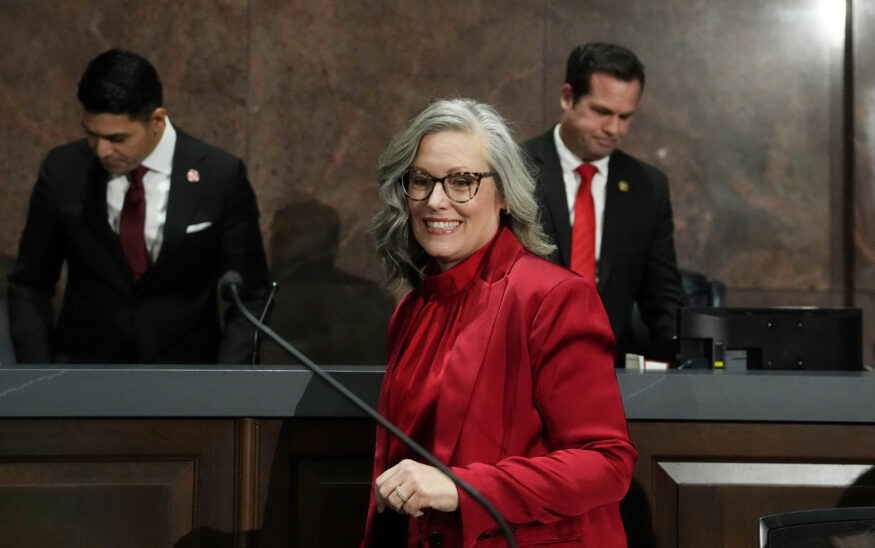
Arizona Democratic Gov. Katie Hobbs arrives at the podium to give her State of the State address in the House of Representatives at the Capitol with Speaker of the House Rep. Steve Montenegro, R-Goodyear, left, and Senate President Warren Petersen, R-Queen Creek, flanking the governor, Monday, Jan. 12, 2026, in Phoenix. (AP Photo/Ross D. Franklin)
Hobbs’ executive budget focuses on federal uncertainty, affordability and efficiency
Reagan Priest & Jakob Thorington, Arizona Capitol Times//January 16, 2026//


Key Points:
-
Gov. Katie Hobbs’ executive budget focuses on House Resolution 1, affordability initiatives and government efficiency
-
The budget hinges on creating new revenue streams and a reimbursement for border spending from the federal government
-
Hobbs’ proposal kicks off the budget process during what will likely be a tense legislative session
Gov. Katie Hobbs released her $17.7 billion budget proposal today with a focus on affordability and mitigating impacts from federal budget cuts, kicking off what will likely be another tense year for budget negotiations with Republican leaders.
Hobbs’ budget proposal comes amid an early fight between her office and Republican lawmakers over conforming the state’s tax code to federal tax cuts enacted by President Donald Trump’s “One Big Beautiful Bill,” formally known as H.R. 1. Hobbs vetoed the Republicans’ tax conformity bill on Jan. 16.
“I have a plan to balance our budget and cut taxes for the middle class by $200 million,” Hobbs told reporters at a press conference before her budget was released. “Republicans won’t show you their plan because they don’t have one.”
The governor’s budget focuses in large part on conforming the state’s distribution of Medicaid and the Supplemental Nutrition Assistance Program to new requirements in H.R. 1, as well as backfilling federal funding cuts to other programs.
Hobbs’ budget and her tax cuts rely on generating new revenue and saving money through a new tiered fee structure for event wagering, an elimination of tax incentives for data centers, increased advertising for the state lottery and funding two state agencies through a fee-based model rather than the general fund.
Under Hobbs’ plan, the budget would create a new 45% tax for large gambling companies who earn more than $75 million in monthly revenue. Currently, all operators in the state pay up to 10% taxes on gross wagering revenue. Her budget also hinges on the federal government reimbursing the state around $760 million in border security costs incurred since 2021, a grant program included in H.R. 1 but not expected to get under way until later this year.
“We have bipartisan agreement among our state Republican state legislators, Governor Hobbs, and Democratic state legislators that this is going to be something that we fight for, and we feel very confident that we are going to be able to get that,” said Christian Slater, Hobbs’ communications director.
Hobbs is also proposing spending $339 million on affordability initiatives, ranging from investments in affordable housing construction and child care to utility bill assistance and school meal grants. The governor’s budget suggests using a combination of federal COVID-19 recovery funds, general fund dollars and revenue from a new nightly fee on short-term rentals to pay for her affordability agenda.
The budget also makes nearly $45 million in one time funding from last year’s budget for child care ongoing, as families continue to struggle with high child care costs.
The governor also wants to create an Arizona version of the Trump administration’s controversial Department of Government Efficiency, known as DOGE. Hobbs’ iteration, dubbed Arizona Capacity and Efficiency, would save the state around $100 million by fiscal year 2029 though her budget is not dependent on those savings.
Hobbs’ ACE plan does not rely on mass layoffs of state employees the way Trump’s DOGE did, but instead will focus on selling off unused land and state vehicles, training employees in artificial intelligence usage and standardizing contract procurement processes.
Hobbs also wants to create a new Cost Containment Analytics team and add more resources to the Office of the Inspector General to identify areas for improved efficiency and prosecute fraud, waste and abuse. Those proposals come after months of scrutiny from Republicans over an alleged pay-to-play scheme at the Department of Child Safety and reports of fraud impacting the agencies distributing Medicaid and SNAP funding.
“I think it just reflects the governor’s ongoing commitment to efficiency in state government, and … we’re going to do it very differently from the federal government, we’re going to show the federal government how to do it right,” Slater said. “We’re not going to slash and burn indiscriminately. We’re not going to slash vital programs that are going to end up impacting Arizona in a negative way.”
The Governor’s Office is also pushing for reforms to the Empowerment Scholarship Accounts program for the fourth year in a row, arguing those reforms will allow for more wiggle room in the state budget. Hobbs is also proposing a $250,000 or more income cap and the elimination of the carryforward balances which allow students to spend one year’s unused funds in the next year.
She is also pushing for “programmatic reforms” in government such as fingerprint verification for private school employees and banning the purchases of luxury items. Hobbs’ proposals would not impact the pre-universal ESA program, which primarily gives funding to students with disabilities who need additional support.
Hobbs’ office is also proposing a 6.9% distribution to public schools from the state land trust through the extension of Proposition 123. The governor’s budget would also extend the nearly $300 million backfill lawmakers approved in last year’s budget in lieu of a Prop. 123 renewal.
Due to new federal Medicaid requirements as a result of H.R. 1, the governor is proposing $14 million in one time funding and 150 new full-time staff positions for the Arizona Health Care Cost Containment System to implement the requirements.
H.R. 1 would also impose penalties to states that have a payment error rate greater than 6% in Supplemental Nutrition Assistance Programs and Hobbs is planning on using $7.5 million in American Rescue Plan Funds to address the workload in lowering the state’s error rate of 8.8%. If Arizona doesn’t lower its error rate below 6%, the federal government would issue a penalty of nearly $200 million in 2027.
Much of the governor’s proposed budget is expected to be dead on arrival in the Republican-controlled Legislature, but it serves as a starting point for negotiations that are expected to truly begin in late May.