Sign In
Upcoming Event
 Free Newsletter

Proposition 123 extension triggers competing Republican proposals
Jakob Thorington and Kiera Riley, Arizona Capitol Times//January 17, 2026//

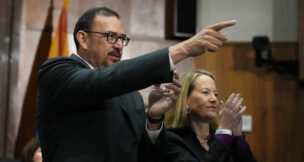
House Speaker Steve Montenegro, right, chats with Rep. David Livingston on June 24, 2025, as the House prepares to vote on a $17 billion "continuation budget." (Howard Fischer / Capitol Media Services)
Proposition 123 extension triggers competing Republican proposals
Jakob Thorington and Kiera Riley, Arizona Capitol Times//January 17, 2026//


Key Points:
-
House Republicans split on extending Prop. 123
-
Some want school funding measure to include ESA program
-
Democrats favor clean extension of $300 million funding
House Republicans started the session strategically scattered on Proposition 123, with one calling for a clean extension, another for dedicating funds to teacher pay and a third for putting off the proposal altogether until the next session. And though there is motivation to iron out a proposal and avoid cutting further into the already strained general fund, lawmakers put early disarray on display at the House.
House Speaker Steve Montenegro, R-Goodyear, said: “Prop. 123 was created for a specific purpose and to bring tax relief to Arizonans. We want to make sure that any proposal brought forward has that same spirit. It’s a conservative framework to make sure we’re lowering the tax burden on Arizonans. But the one thing I will tell you is we should not be using Prop. 123 for election year theatrics, and that’s some of what we’ve been hearing about as well.”
Prop. 123 is now gone and past, lapsing at the end of the last fiscal year.
And, at the start of session, House Republicans are not necessarily alone in their disjointed approach to the education measure.
Sen. J.D. Mesnard, R-Chandler, who led proposals in the Senate over the past two sessions, noted the need to regroup with stakeholders to figure out tax conformity before shifting gears to the education funding measure.
The Senate ended last session with some near-complete language, rumored to fit with school choice protections, but final amendments never materialized on the floor.
On the House side, Rep. Matt Gress, R-Phoenix, introduced a Prop. 123 proposal in line with the Senate, but it lost momentum toward the end of the session.
Rep. David Livingston, R-Peoria, then made a last-ditch effort amid budget negotiations to get a placeholder Prop. 123 extension through committee, but the majority again failed to finalize the language.
Now, the Legislature remains on the hook to backfill the near-$300 million in education funding previously provided to state schools by the state land trust fund.
Gress said the House is still conferring with members to determine where the caucus stands on Prop. 123 now, and whether the measure is, or should be, on the table at all, this session.
“In general, we may want to wait until next year,” Gress said.
For one, Gress said campaigning for Prop. 123 in an election year could prove costly.
“You’re going to have a lot of different campaigns going on with the gubernatorial, attorney general race, and so forth. So, you know, we’ll see what happens,” Gress said. “I think election year politics may cloud the passage of (Prop.) 123, unfortunately.”
Meanwhile, Gov. Katie Hobbs and public education groups seemed to have reached consensus on prioritizing a clean renewal of the measure.
And, in her State of the State address, Hobbs again struck out the possibility of adding any constitutional reinforcements for the Empowerment Scholarship Account program.
“The original ballot measure was successfully passed because it enjoyed the support of teachers, parents, business leaders, and Republican and Democratic elected officials,” Hobbs said. “Let’s recapture that spirit and keep the divisive, partisan policies out of negotiations. Let’s get serious about our once-in-a-decade opportunity to invest in our state’s public schools without raising taxes.”
But Gress is not on board with a clean renewal, hoping to keep the focus on teacher salaries.
“She wants to spend it on lots of different things instead of teacher pay,” Gress said. “Republicans have been very clear that they want to invest those dollars in teacher pay.”
Underlining the entire conversation is how a Prop. 123 proposal, or lack thereof, plays into efforts to align state taxes with recent changes to the federal tax code, as the Legislature seeks a range of tax cuts with limited budget capacity to do so.
Fully conforming to the federal tax code would reduce the state’s general fund by $1.15 billion over three years. On Jan. 14, Livingston pitched a trade to pay for tax conformity with the “clean” renewal that Democrats have been asking for.
Livingston said renewing the measure would give the state $900 million over three years to help pay for full federal tax code compliance. He said he believes the House could get 40 to 45 votes in favor of renewal if Hobbs negotiated it for conformity.
“I look at my job as finding solutions for the state of Arizona and if that’s $900 million that will flow through the budget to get the governor to sign on and get the Democrats to vote for (conformity), great,” Livingston said.
On opening day of the session, the nonprofit centrist think tank the Grand Canyon Institute published a report calling for lawmakers to come to a two-third consensus on a Prop. 123 renewal to skip referring the measure to the ballot so the law could go into effect sooner and bring in more money from state land trust proceeds immediately.
“It’s really irresponsible not to try to figure out a way to do it,” said Dave Wells, the research director at Grand Canyon Institute.
House Minority Assistant Leader Nancy Gutierrez, D-Tucson, said on Jan. 15 that she will soon be introducing a Prop. 123 renewal measure. So far, Livingston hasn’t spoken to her about potentially using the state general fund savings to cover the cost of tax conformity.
“I would not say I would be happy with that, but I do think it’s my job to negotiate,” Gutierrez said. “They could have been negotiating with us weeks ago. I think this is Republicans not wanting to negotiate and now learning they’re going to have to do that with us.”