Sign In




 Free Newsletter
Fontes talks GOP election efforts, federal data demands
Jordan Gerard, Arizona Capitol Times//February 28, 2026//
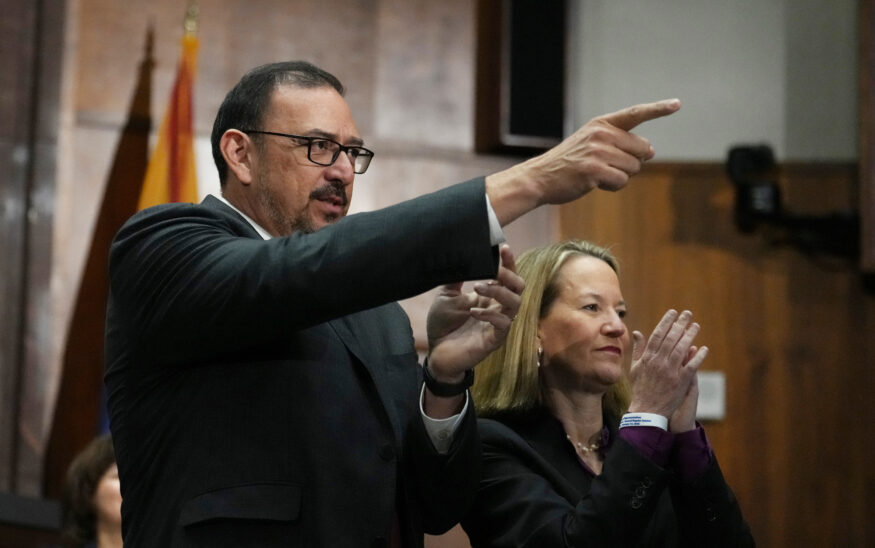
Arizona Secretary of State Adrian Fontes, left, and Arizona Attorney General Kris Mayes at the State of the State Address in the Arizona House of Representatives at the Capitol, Jan. 12, 2026, in Phoenix. (AP Photo/Ross D. Franklin)
Fontes talks GOP election efforts, federal data demands
Jordan Gerard, Arizona Capitol Times//February 28, 2026//


Key Points:
-
Secretary of State Adrian Fontes denies federal requests for sensitive voter data
-
Gives opinion and official perspective on GOP voting measures
-
Comments highlight tension between state and federal election officials ahead of 2026
Arizona’s top election official isn’t giving in to federal requests for state voter data, standing by his decision to tell federal officials to “pound sand.”
Secretary of State Adrian Fontes spoke at an event hosted by the League of Women Voters of Arizona on federal administrative overreach for sensitive voter roll data and several bills that would affect how Arizona runs its elections.
Fontes recapped the U.S. Department of Justice’s request for Arizona’s voter roll information, which started last summer. The request was repeated three times and denied three times by Fontes, who at one point, told the department to “pound sand.”
Publicly available voter data exists and includes information such as name, street address, birth year, political affiliation and the elections they voted in. However, the DOJ never made a request for that data, he said.
They requested sensitive information that includes month and date of birth, Social Security Number, driver’s license number or non-operating identification number, Indian census number, father’s name or mother’s maiden name, state or county of birth, voter signatures and email addresses, he said. The department did not disclose how the data would be used, Fontes added.
The department cannot obtain the information from other federal agencies either, due to the Privacy Act of 1974, he said, and each agency has restrictions on how it can obtain and use data.
“I can’t justify handing over, to an administration that’s careless, Arizona’s voter data, particularly the sensitive stuff that I’m barred from turning over,” Fontes said. “I kept saying no, because as you can see through the list, that’s some pretty sensitive information, and if it got out, your identity could be subject to being stolen, and that’s not something that I really want to happen to Arizona’s voters.”
Under Arizona law section 16-168, subsection F, sensitive data is not permissible to be disclosed. It reads in part, “… shall not be accessible or reproduced by any person other than the voter by an authorized government official in the scope of the official’s duties for any purpose by any designated entity of the Secretary of State.”
At first, the department said they wanted to make sure Arizona complied with several congressional acts, including the Voter Registration Act, Civil Rights Act of 1960 and the Help America Vote Act to get the data, but Fontes said it wasn’t a legitimate request and he wasn’t going to subject himself to a potential felony.
In January, the department filed a lawsuit against Arizona and cited all three congressional acts to turn over voting records. Fontes said he expects to hear something about the case within 30 to 60 days. Several similar cases in five states have been dismissed based on merit or procedural grounds. Those include West Virginia, Georgia, California, Oregon and Michigan.
Eleven states did turn over their voter rolls, and Fontes said he’s worried about what will happen to those voters, but Arizona will continue to refuse the request under his leadership.
Fontes talks about recent state legislation on elections
The secretary of state also discussed two bills that have recently moved through the state Legislature.
The first is the striker amendment to Senate Bill 1570 (diversity; equity; inclusion; training; prohibition), which would have allowed federal agents into polling locations under an agreement with a county recorder and county board of supervisors and with federal immigration agencies.
The bill is effectively dead because Sen. Wendy Rogers, R-Flagstaff, who filed the amendment, did not hear it in the Senate Judiciary and Elections Committee before the deadline on Feb. 20. It could come back as a striker amendment to another bill. The original bill was filed by Sen. Jake Hoffman, R-Queen Creek, but Rogers said they couldn’t hear it because Hoffman was ill and unavailable to present it, though many bills are heard in committee without the sponsor present.
“Some people are saying, ‘Oh it’s just political.’ Some people are saying ‘Oh, it’s just a fundraising thing,’” Fontes said. “I think it’s an absolute acknowledgement that ICE agents are not allowed into polling places in Arizona.”
Fontes did not elaborate but said his office, the Governor’s Office and the Attorney General’s Office are working on scenarios in case those issues, among others, arise. Later on Feb. 25, Fontes said in a statement that according to a call with federal election officials, Immigrations and Custom Enforcement (ICE) agents would not be at polling locations.
“I think we have to understand the fact that we are having this conversation tells us that we are not living in a regular democracy that we would understand 18 months ago,” he said.
He also alleged that the Trump administration was using ICE “as a cudgel against this weird fantasy that they have that the illegals are taking over the world.”
He pointed to a study by the Heritage Foundation that found a ballot has been cast by non-citizens 68 times since the 1980s. The Heritage Foundation is a conservative think tank based in Washington, D.C.
“Think about the billions of votes that have been cast,” he said. “You’re talking about all the municipalities, all the county courts, of all the county commissions and boards of supervisors, all of the state legislatures, all of the presidential races, all of the congressional races.”
Other bills that have caught Fontes’ attention include ones that would dismantle or alter the state’s mail-in voting system. About 80% of Arizonans send their ballots by mail, according to the Clean Elections Commission.
“That means only 20% of your voters are voting in person right now,” he said. “That means you would have to increase by five-fold all of the resources that you spend, all of the spaces where people vote because you’re basically relegating everybody to standing in line in one day and having to show their ID. But nobody’s done the fiscal analysis on that.”
Each location would need a minimum of seven non-volunteer employees to staff each polling location, he said.
“Take the number of polling places and the amount of money that you spend per ballot for in-person voting and multiply that by five. We don’t have the money for that,” he said. “We literally don’t have the ability to pay for them. The counties aren’t going to absorb that cost.”
Another bill, SCR 1001, filed by Sen. Shawnna Bolick, R-Phoenix, proposed to end early voting no later than 7 p.m. on the Friday before Election Day and prohibit contributions to candidates or ballot measures from foreign nationals. If passed by lawmakers, it would send the decision to voters.
Fontes concluded his comments and said, “I’m going to do everything that I can within the law so that I can make sure that we kind of preserve and protect the systems that we’ve got.”