Sign In
Upcoming Event
 Free Newsletter

Arizona Democrats renew call to ratify Equal Rights Amendment
Jordan Gerard, Arizona Capitol Times//January 23, 2026//

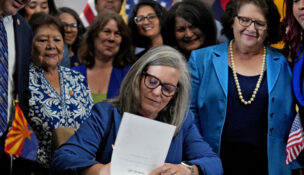
State Sen. Lauren Kuby, D-Tempe, stands for the pledge during a Senate session, April 24, 2025, at the state Capitol in Phoenix. (AP Photo/Samantha Chow)
Arizona Democrats renew call to ratify Equal Rights Amendment
Jordan Gerard, Arizona Capitol Times//January 23, 2026//


Key Points:
- Arizona faces a renewed push to ratify the Equal Rights Amendment
- The amendment has a complicated ratification history
- Opponents say the Fifth and 14th amendments already cover equality
It might be more than 100 years in the making, but calls to ratify the Equal Rights Amendment were renewed this week at a press conference.
Sen. Lauren Kuby, D-Tempe, said the movement is still growing. She was joined by the Equal Rights Task Force AZ, a coalition of groups and volunteers working to ratify the amendment, Rep. Quantá Crews, D-Phoenix, several other senators, advocacy group Unity Rising USA and women’s activist Civia Tarmakin.
This isn’t the first time lawmakers have pushed for Arizona to ratify the amendment, as they’ve made the call in past legislative sessions. Eventually, the decision will go to voters, Kuby said.
“It’s about time,” Kuby said. “The ERA does not create special rights. It affirms equal rights for all.”
The amendment, now over 100 years old since its first proposal in 1923, guarantees equality of rights under the law for all persons regardless of sex. Most importantly, it would expand constitutional protections for members of the LGBTQIA+ community, such as people who identify as non-binary or are transgender.
“It’s a very inclusive bill. It includes everyone, and it actually will protect men. We don’t want to discriminate against men. That is not the dominant theme here. It will protect working families and communities,” she said.

The amendment’s ratification history is complicated. In 1972, after the amendment passed with a two-thirds majority in both chambers of Congress, it was sent to the states, according to the advocacy website. Initially, there was real political momentum, with 30 states choosing to ratify the legislation, but by 1978 the pace had slowed significantly, with the proposal earning only five new state approvals over that six year span. That left it just shy of the required 38 states to ratify the Constitution. And though the Constitution does not set a specific time limit for ratification, the proposal’s self-imposed seven-year deadline expired, leaving the would-be amendment in limbo.
President Jimmy Carter signed an extension bill to 1982, breathing new hope into supporters, but no additional states signed on. Legislators can introduce “start over” bills in Congress, but no such bill has been introduced in the House or the Senate.
Yet despite the missed deadline, efforts to ratify the amendment were not abandoned, and advocates at the state and national levels continued working to see it ratified — and to some success. In fact, as recently as 2020, Virginia signed on.
Some constitutional scholars say the amendment is now part of the Constitution because it has the required number of ratifications. However, the Archivist of the U.S. has not taken steps to publish the amendment as the 28th amendment due to political and legal challenges, according to the website.
Arizona is one of 12 states that have not ratified the amendment. Opponents say the amendment isn’t necessary because the Fifth and 14th Amendments already guarantee equal protection under the law, as do federal, state and local laws that prohibit sex discrimination and unequal pay, according to the Center for Arizona Policy.
The center also says the amendment is legally dead, and if Arizona ratified it, it would likely embroil the state in a lengthy and expensive court case.
Yet despite those legal challenges, some lawmakers are still committed to ratification. Kuby said there are a lot of laws supportive of equality, but people can’t rely on the courts because laws can shift.
The Legislature’s current longest serving lawmaker, Sen. Lela Alston, D-Phoenix, said the amendment was in play when she first ran for office in 1976.
“My daughter then was 15 years old and I thought for sure that by the time she was 21, she would have equal rights,” Alston said. “I now have granddaughters in their 30s and we still haven’t gotten there.”
Crews said women hold the nation on their shoulders, generation after generation, and today’s women stand on the shoulders of women who fought for the right to vote, the right to open a bank account and own land. She pointed to Arizona’s workforce and said women are in every fabric of the economy.
“We’re not standing here asking for these bills to be heard and to be moved through the legislative process because we think it’s just a cute idea,” she said. “I’m talking to the majority party. Your mothers, your daughters, your spouses, your nieces, your family, the women you love, have worked hard for this. The least Arizona can do is ratify this amendment.”