Sign In


 Free Newsletter

Physician shortage prompts states to embrace immigrant doctors
Stephanie Akin, Pluribus News//February 20, 2026//
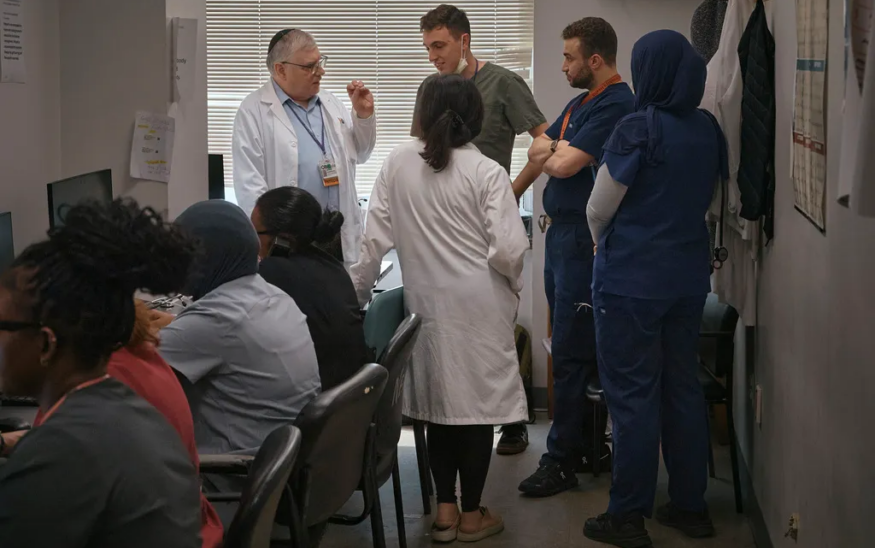
A group of resident doctors talks with a senior doctor inside Brookdale University Hospital and Medical Center on Tuesday, July 1, 2025, in the Brooklyn borough of New York. (AP Photo/Andres Kudacki)
Physician shortage prompts states to embrace immigrant doctors
Stephanie Akin, Pluribus News//February 20, 2026//


Key Points:
-
Lawmakers in 16 states consider bills to ease medical licenses for foreign-trained doctors
-
Bills require doctors to work in underserved areas, with broad support from various groups
-
Opponents of the bills raise concerns about verifying quality of foreign training programs
Lawmakers in at least 16 states are considering bills that would make it easier for foreign-trained doctors to get medical licenses.
The bills, which span states as politically distinct as New Jersey and Georgia, enjoy unusually broad support, including from conservative free-market groups, business associations and left-leaning immigration advocates. Most would require participating physicians to commit to working in underserved areas.
It’s the latest wave of a movement that has quietly reshaped physician licensing policy across the country, even as the federal government’s immigration crackdown threatens to undermine the pipeline these laws are designed to tap.
“Working in the ER, I see the backup as people are placed in the hallway suffering strokes and heart attacks because we don’t have the physicians to see these people,” said Arizona Rep. Selina Bliss, a Republican, said at a hearing before her bill advanced in this week. “That’s the importance of this bill.”
The push comes as the United States faces a worsening physician shortage, particularly in primary care and in rural areas where aging populations and burnout are accelerating the decline in practicing doctors. The Association of American Medical Colleges projects a shortage of up to 86,000 physicians by 2036, including as many as 40,400 primary care doctors.
“The shortage is real, and it affects the health, safety and the economic stability of our nation.” Wyoming Rep. Jacob Wasserburger, a Republican, said at a recent hearing on the bill he is carrying. “Wyoming cannot afford to leave qualified physicians on the sidelines while patients wait for care.”
Supporters of the legislation say foreign-trained physicians are particularly well-positioned to address that gap. Research shows they are more likely than American-trained graduates to enter primary care and practice in lower-income and disadvantaged communities. Some studies have found that their patient outcomes are comparable to, or in some cases better than, those of doctors trained in the U.S.
States have little control over the supply of American-trained physicians because residency slots are capped at the federal level. But by recognizing residencies completed abroad that meet standards set by American credentialing organizations, supporters say states could tap a pool of experienced physicians who are already present in the country but can’t work in their field.
A Federal Reserve Bank of Minneapolis study found that of physicians who immigrated to the U.S. between 2004 and 2022, only 1 in 3 who were employed were working as a medical resident or physician.
“We’re all familiar with the taxi driver who immigrated to the United States and who, in their country of origin, was a nuclear physicist, an engineer or a physician,” Nebraska Sen. Merv Riepe said at a hearing on his bill this month. “It reflects a real structural problem: highly trained professionals whose credentials and skills are under-utilized because our systems are not designed to integrate them effectively.”
Some advocates say states should also try to entice physicians to relocate from countries with high medical standards but lower average salaries than the United States.
The details of the proposals vary, but they generally require physicians to have graduated from a foreign medical school and postgraduate training program substantially similar to a U.S. program; passed all three steps of the United States Medical Licensing Examination; and obtained certification from the Educational Commission on Foreign Medical Graduates, the organization that assesses whether international medical graduates are ready to enter residency or fellowship programs in the United States.
Many states require applicants to have a valid federal immigration status and an employment offer, with some stipulating that the job must be in a targeted underserved area. Those who qualify would initially practice under supervision on a provisional license. In some states, participating doctors would eventually become eligible for full licensure.
Policy analysts who have studied early state efforts say the results vary widely depending on the way the provisions are designed.
A report in March from the nonpartisan Niskanen Center identified several ways existing laws may be too restrictive. Laws passed in Colorado and Tennessee require that sponsoring employers also operate a residency program — a provision that effectively limits participation to large urban teaching hospitals and excludes the rural and underserved areas the laws are designed to serve.
Tennessee’s home-country residency requirement of three years or more inadvertently screens out primary care physicians, whose residencies in many countries last only one year. And states including New York and California have created only temporary license categories with no pathway to full, permanent licensure, a structure the report says draws limited interest from physicians and limited commitment from employers.
Tennessee, the first state to enact such a law, has encountered additional problems. Its medical licensing board has resisted issuing applications, with members saying the law forces them to lower standards. The standoff has left the law largely unimplemented.
Even physicians who obtain a license under these new pathways may struggle to find employment because all 24 specialty boards in the United States still require a U.S.- or Canada-based residency as a condition for sitting for board certification exams, according to the Niskanen Center.
Many hospitals require board certification for employment and hospital privileges, and physicians without it pay higher malpractice insurance premiums, creating a financial disincentive for employers to hire them.
Opposition to the bills has come primarily from medical professional organizations, which warn that accepting foreign credentials could compromise patient safety. Critics have raised concerns about verifying the quality of foreign training programs, language proficiency and malpractice standards.
“There may be a medical shortage,” Rep. Ralph Heap, a retired orthopedic surgeon, said at a hearing on the Arizona bill. “But do we really want a bad doctor that may cause worse problems than having a shortage?”
In response to those concerns, a coalition of major credentialing bodies — the Federation of State Medical Boards, the Accreditation Council for Graduate Medical Education, and Intealth — created an advisory commission in 2023 to develop guidance for states.
The commission, on which the American Medical Association holds a seat, issued updated recommendations in August covering six areas: comprehensive competency assessment during the supervisory period, individualized evaluation at the start of supervision, use of specialty-specific exams, regular multimodal review including direct observation and medical record audits, qualifications for supervising physicians, and protections for the employee rights of internationally trained doctors.
Notably, the commission stopped short of recommending that specialty boards drop their U.S. residency requirement, leaving that barrier unaddressed.
The current rush of legislation builds on a foundation laid largely over the last five years. At least 18 states have already enacted similar policies, including Republican-led Florida, Arkansas and Texas and Democratic-led Minnesota and Massachusetts.
The idea grew out of emergency pandemic credentialing, when states including New York and New Jersey offered temporary authorizations to physicians who needed to fast-track their paperwork to work in COVID-specific hospital units and nursing homes. Conservative groups focused on deregulation, including the Cicero Institute and the American Legislative Exchange Council, subsequently developed model legislation that spread through statehouses across the country.
But the movement now faces a complication from Washington. New federal rules have imposed $100,000-per-applicant fees on the H-1B visas that most hospitals use to employ foreign-born physicians, an amount hospitals say they cannot afford.
Broader immigration enforcement has also begun to shrink the pool of candidates these laws were designed to attract, putting states that have embraced the idea on a potential collision course with the administration.
“There are all of these contradictory forces that are making it very, very difficult to have any kind of cohesive policy,” said Eram Alam, a historian at Harvard who studies immigrant physicians in the United States.
Alam said she will be watching in the coming months to see whether legislative momentum stalls as some conservative lawmakers pivot toward immigration positions aligned with the Trump administration, or whether the pipeline of interested physicians dries up before these laws can be fully tested.