Sign In
Upcoming Event
 Free Newsletter

Data center expansion looms over midterm elections
Reid Wilson, Pluribus News//March 13, 2026//
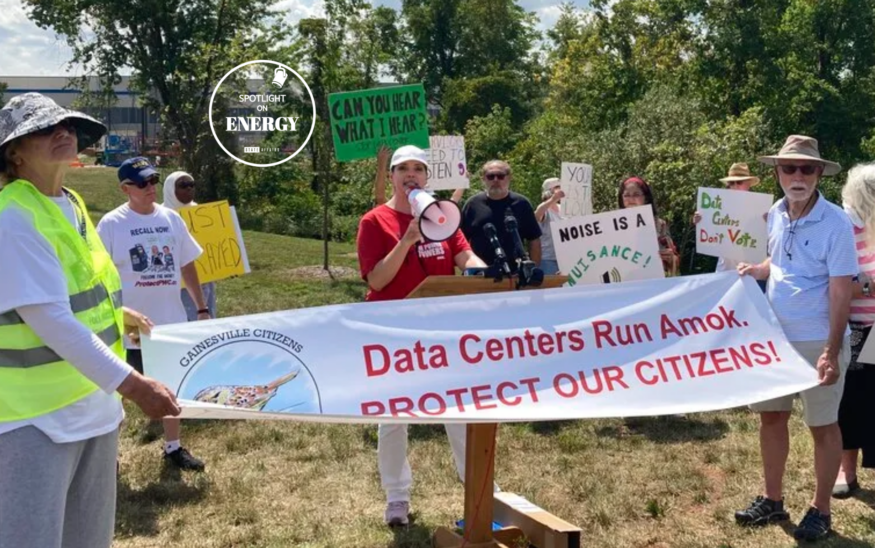
An Aug. 29, 2022, rally near Manassas, Va., protesting a newly built data center for Amazon Web Services. (AP Photo/Matthew Barakat)
Data center expansion looms over midterm elections
Reid Wilson, Pluribus News//March 13, 2026//


EDITOR’S NOTE: This story is part of a special State Affairs series highlighting energy policy dominating state legislative action this year. See the full list of stories here.
STERLING, Va. — Some of America’s largest corporations maintain major outposts in the bustling Washington suburbs near Dulles International Airport. Today, as McMansion communities expand ever westward toward the Shenandoah foothills, many of those same companies are constructing data centers in the region.
The massive rectangles of windowless server farms make up the largest concentration of data centers and computing power in the world. But it has also generated a sharp backlash in the surrounding communities, where energy bills are skyrocketing and noise complaints are increasingly common.
As the booming artificial intelligence and cloud computing industry strikes deals to build ever-larger data centers, that backlash is beginning to turn political. Democrats and Republicans are starting to campaign against state-funded tax incentives for those companies, reconstituting a not-in-my-back-yard coalition that has its eyes on the fast-approaching midterm elections.
“It’s a political issue because no one wants to see, for example, what we’ve seen in Northern Virginia, which is, essentially, where they just built [data centers] out in a very unregulated way, without any community inputs,” Maryland Gov. Wes Moore, a Democrat, said in an interview.
In Virginia, the fight over data centers has pitted Democrats — now in total control of state government — against each other. Gov. Abigail Spanberger, the new Democratic governor, has sparred with powerful Senate President Pro Tem Louise Lucas over continued tax breaks for new data centers.
Other states are more willing to welcome the big spenders.
“There’s no doubt that it could become a political issue,” Mississippi Gov. Tate Reeves, a Republican who has worked to attract data centers to his state, said in an interview.
But Reeves, who governs one of the poorest states in America, sees a political benefit to the centers: “We’re building capacity, and the companies are going to pay for it,” he said. “The ratepayers are not going to pay for it.”
Few candidates directly mention data centers in their campaign ads or on the stump. In a few cases, candidates or outside interest groups have used televised advertising to slam opponents who supported data centers, according to monitoring by AdImpact, a firm that tracks political ad spending. Those ads aired in a congressional primary in Texas, a county commissioner’s race in North Carolina, and a gubernatorial primary in Georgia.
But political strategists expect data centers to play a role in this year’s conversation, because of the confluence of prominent boogeymen those centers bring together: The billionaires who fund them, the artificial intelligence they fuel, and the higher power and water bills landing in consumers’ mailboxes.
“You have the collision of two very potent issues encapsulated in this debate: The cost of living issue in combination with people’s insecurity around AI has transformed this once highly localized issue into a national political debate,” said Ken Spain, a former top official at the National Republican Congressional Committee who wrote a post this week detailing the threat to data centers in the coming campaign.
Polling conducted by Narrative Strategies, Spain’s public relations firm, found about a third of Americans, 36%, say data centers do more harm than good. And more Americans said they and their families stood to lose more from data center construction than gain, by a 30% to 25% margin.
Spain said there is no consensus yet on how to address data centers or AI’s impact in the workforce, in either party.
“Both parties are really divided on how to move forward when it comes to handling the issue of AI. And this is one area where that seems to be playing out,” he said. “There’s obviously the emergence of affordability in America combined with the distrust of big tech, and now the increased skepticism around AI and what that means for people’s futures. It has really turned into an issue that has raised concerns on both sides of the aisle.”
Backlash to data centers is fiercest in some of the suburban cities and towns where those centers might be built. City councilors in Chandler, Ariz., unanimously rejected in December a proposal to build a data center. The city of Pekin, Ill., south of Peoria, rejected a data center plan this week. In September, Microsoft dropped plans to build a data center in rural Wisconsin amid fierce local opposition.
All told, as much as $98 billion in U.S. data center projects have been blocked or delayed since May 2024, according to Data Center Watch, a group that tracks public opposition to such sites.
Spain predicted the data center industry would launch a more robust campaign to change their image. Already, Facebook and Instagram parent company Meta has spent about $6 million on campaign-style ads touting the economic benefits of the new centers.
“From an industry perspective, shaping public opinion and making a compelling case to policymakers is going to require a more sophisticated effort,” Spain said. “The industry is going to have to treat this more like a political campaign and understand that the ground can and likely will continue to shift beneath their feet.
“It’s going to require a sophisticated approach and a multi-layered approach that includes building public support, coalition building, crisis planning. It can’t be a mere messaging exercise.”
Read more:
Va.’s data center boom shows how hard it is for lawmakers to rein in the industry
Lawmakers seek solutions to rising electricity rates
Pro-coal legislation picks up in push to meet growing energy needs
Data center growth threatens state climate goals
Electricity demand spurs states to find a way to meet the moment