Sign In


Upcoming Event
 Free Newsletter

Arizona leaders struggle to find compromise on rising energy costs
Reagan Priest, Arizona Capitol Times//March 13, 2026//
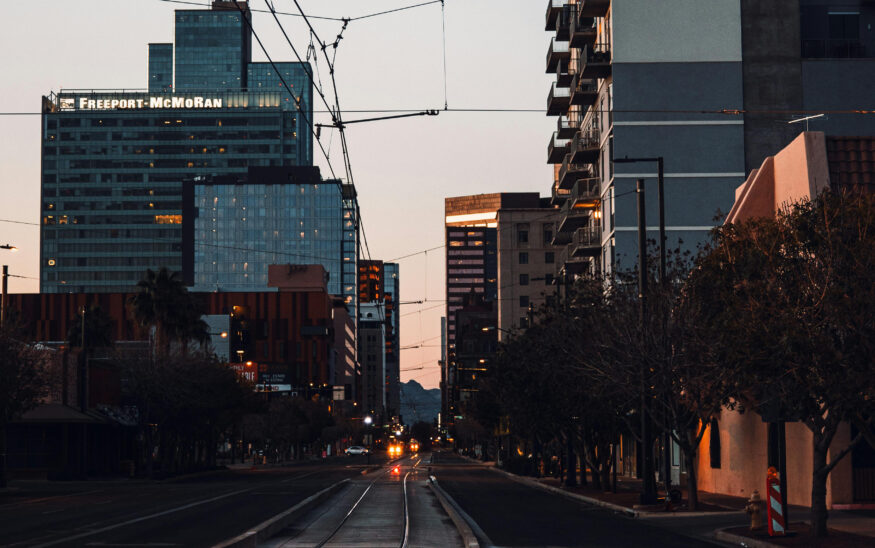
Downtown Phoenix at dusk. (Audrey Walsh / Pexels)
Arizona leaders struggle to find compromise on rising energy costs
Reagan Priest, Arizona Capitol Times//March 13, 2026//


Key Points:
-
Energy bill affordability is top of mind for Arizona leaders
-
Republicans and Democrats in the Legislature disagree on how to lower costs
-
Gov. Katie Hobbs is unlikely to sign many Republican energy bills
In Mesa, six Arizonans gathered to tell Gov. Katie Hobbs about how utility bill assistance programs have made it easier for them to pay their bills, keep their homes and provide food for their families.
One woman named Beverly told the governor that she received a $400 credit toward her Salt River Project utility bill with assistance from the Mesa Community Action Network. Without that credit, Beverly said she doesn’t know what she would do.
“The prices keep going up and up and there’s nothing you can do about it except for just struggle,” she said.
Down at the state Capitol, lawmakers and Hobbs are trying to figure out what the state can do to lower those prices as the cost of energy continues to soar. Over 50 bills have been introduced on energy issues like data centers, small modular nuclear reactors and solar and wind farms.
Hobbs tends to remain tight-lipped about legislation that is still making its way to her desk, but she told reporters she is eagerly awaiting policy recommendations from a task force she established via executive order in the fall.
“There’s a lot of people who want to do something and so they write a bill, and the bill may or may not help,” Hobbs said. “I think framing it around what this group of experts looked at and using that to inform how we move forward is really important.”
With Arizona in a period of divided government, it is difficult for the state’s leaders to find solutions to any problem facing the state. And on a topic as complex as energy, there is no silver bullet answer that will satisfy everyone involved.
Republicans in the Legislature want to make it easier for utility companies to build new nuclear, coal and natural gas plants, while placing additional burdens on solar and wind developments. Democrats and Hobbs want to boost renewable energy resources and rein in data center growth.
Further complicating efforts from both the legislative and executive branches is the Arizona Corporation Commission’s exclusive, constitutionally-granted authority to set utility rates. While other states have passed laws implementing performance-based ratemaking or issued executive orders allowing utility regulators to pause rate increases, only elected corporation commissioners can create policy around ratemaking in Arizona.
But that hasn’t stopped lawmakers from nibbling around the edges of the commission’s authority this session.
Most of the energy bills still active in the Legislature are from Republican lawmakers and target power plant regulations that can often increase utility bills for customers. One bill from Rep. Teresa Martinez, R-Casa Grande, would allow utility companies to replace existing power plants or build new power plants next to existing plants without going through the commission’s typical environmental review process.
Martinez said during a March 10 House floor debate on the bill that she intends to make utilities cheaper. Representatives for Tucson Electric Power noted during a March 4 Corporation Commission hearing that the review process for new power plants can be arduous and that nearly all costs the utility incurs in the process will eventually be passed on to customers.
“(It) is a process that could cost ratepayers hundreds of thousands of dollars to put an evidentiary hearing in front of the committee,” a TEP executive said. “… it’s logistically difficult and it’s expensive.”
Even though most Republican bills on this topic would only forgo the review process if a plant or location has already undergone it once, environmental advocates and Democrats like Rep. Mariana Sandoval of Goodyear argue the legislation “reduces meaningful public oversight of new power plant construction.”
Rep. Justin Olson, R-Mesa, previously served on the commission and introduced a bill that would prevent utility companies from prioritizing emission reduction goals or renewable energy sources when creating statutorily-required plans for energy generation and capacity. Olson says forcing utility companies to be “technology-neutral” will allow them to prioritize affordability, but Democrats say it will only promote costly coal and natural gas projects.
Hobbs vetoed a similar bill from Olson last year, and other attempts to kneecap renewable energy sources are also likely to face her veto pen. Hobbs wrote in a veto letter for Olson’s 2025 bill that she is not interested in bills that “work against building an energy economy of the future.”
In the meantime, Arizonans are likely to continue facing high utility bills, as two of the state’s major electric utility companies — Arizona Public Service and Tucson Electric Power — are both seeking 14% rate increases from the commission. After meeting with the utility bill assistance recipients, Hobbs told reporters that she believes the state’s utility companies are eager partners in the quest to lower energy costs.
“In my conversations with utility leaders, it’s a big concern for them,” Hobbs said. “Their top priority is making sure that electricity stays affordable for households and for existing customers, and it’s a challenge that we all have to tackle together.”