Sign In


 Free Newsletter

Legislature’s data center conversations miss water angle
Reagan Priest, Arizona Capitol Times//February 28, 2026//
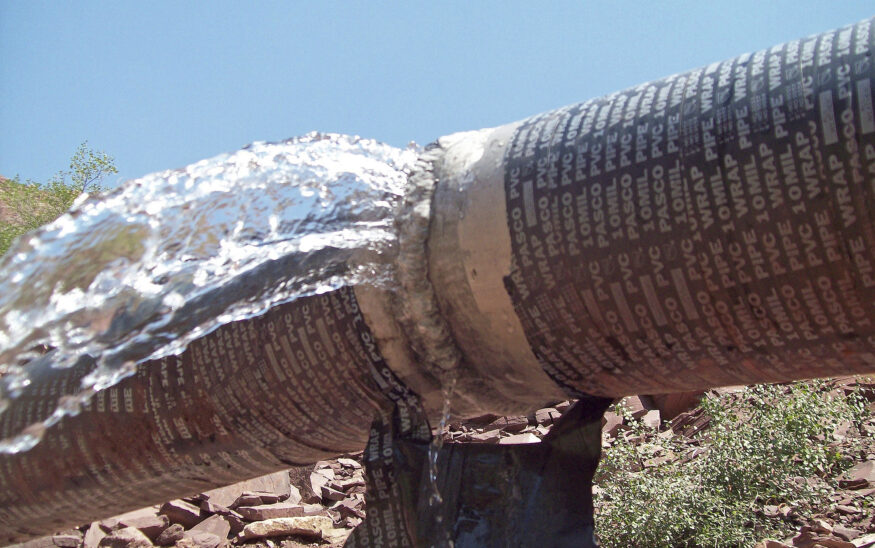
FILE - This undated photo provided by the National Park Service shows water spraying from a break in an exposed section of the Grand Canyon trans-canyon waterline. (National Park Service via AP, File)
Legislature’s data center conversations miss water angle
Reagan Priest, Arizona Capitol Times//February 28, 2026//


Key Points:
-
There are no active bills on data center water use
-
Business advocates say water is a ‘moot point’
-
Environmental groups at least want water reporting requirements
As Arizona lawmakers look to address constituent concerns over data center growth in the state, water usage is increasingly fading from the conversation.
Republican and Democratic legislators introduced 13 bills this session related to data centers, but now that the Legislature has entered crossover week, many of the bills aimed at curbing data center water usage have landed on the cutting room floor.
Those bills, sponsored by Democratic lawmakers, would have limited daily water usage for data centers — many of which rely on large amounts of water to keep the technology and facilities cool.
Gov. Katie Hobbs proposed imposing a water user fee on data centers as part of her executive budget, saying a fee of $0.1 per gallon could raise $6.5 million per year that would go toward Colorado River conservation.
Data center developers are increasingly moving away from water cooling as cheaper and more efficient air cooling methods become available. Some, like the Goldwater Institute, argue this is proof that lawmakers should let the free market take its course before imposing water regulations.
“I don’t want to dismiss concerns about water, but for future builds, water is almost a moot question because the technology has advanced so quickly that the water issue is no longer a major factor in whether a data center is utilizing resources to the maximum efficiency,” said William Beard, the municipal affairs liaison at the Goldwater Institute.
Beard recently authored a study for the Goldwater Institute urging lawmakers to resist the urge to respond to “municipal backlash” against data center developments in cities like Tucson, Chandler and Phoenix.
“Much of this response is driven not by evidence, but by persistent myths — particularly surrounding electricity and water usage — that mischaracterize how modern data centers actually operate,” the report states.
Beard noted that the Goldwater Institute has not taken an official position on a potential data center water user fee, but is generally opposed to the concept.
“The entry to doing business should be as low as possible, with the fewest hurdles, and they should be consistent across the board,” Beard said.
However, as the state faces an uncertain water future amid stalled Colorado River negotiations, others are still urging caution even as data centers switch to air cooling technology. Lindsay Rogers, the policy manager for municipal conservation at Western Resource Advocates, said air cooled systems often contribute to increased water use in other ways.
“Those dry cooled technologies, while they’re going to significantly reduce your onsite water demand, they’re going to increase your indirect offsite water demand associated with power generation,” Rogers said. “With traditional electric generation from coal and combined cycle gas plants, they have that very large water footprint.”
Rogers said those air-cooled systems use less water if the data center is powered by a renewable energy source like solar or wind, which requires little to no water. Additionally, she said policymakers can curb water usage without imposing fees on data center operators by implementing water use efficiency targets or expanding water use reporting.
“It’s very common for data centers to not report out on their water use on site or their water use effectiveness or their cooling technology and that makes it challenging to determine how much water those (cooling) systems exactly use,” Rogers said.
There is bipartisan support for a bill from Rep. Gail Griffin, R-Hereford, to impose reporting requirements on utility companies serving data centers, but the bill focuses on electric system load growth, billing and contracts for data centers. Whether lawmakers would be supportive of requiring reporting on water usage is another story.
Hobbs’ budget director Ben Henderson told lawmakers when presenting the governor’s budget in January that a water user fee would have the added benefit of allowing the state to monitor data center water usage.
But any proposals that could slow data center growth are likely to be nonstarters in the Republican-controlled Legislature. A bill from GOP Rep. Neal Carter of San Tan Valley that would have ended the state’s tax incentive on technology purchases for data center operators never received a hearing.
“You can either be part of the wave or let the wave crash over you and wipe a lot of existing things out at the same time,” Beard said.