Sign In
Upcoming Event
 Free Newsletter

Prediction market Kalshi takes legal stand against Arizona’s gambling laws
Howard Fischer, Capitol Media Services//March 16, 2026//
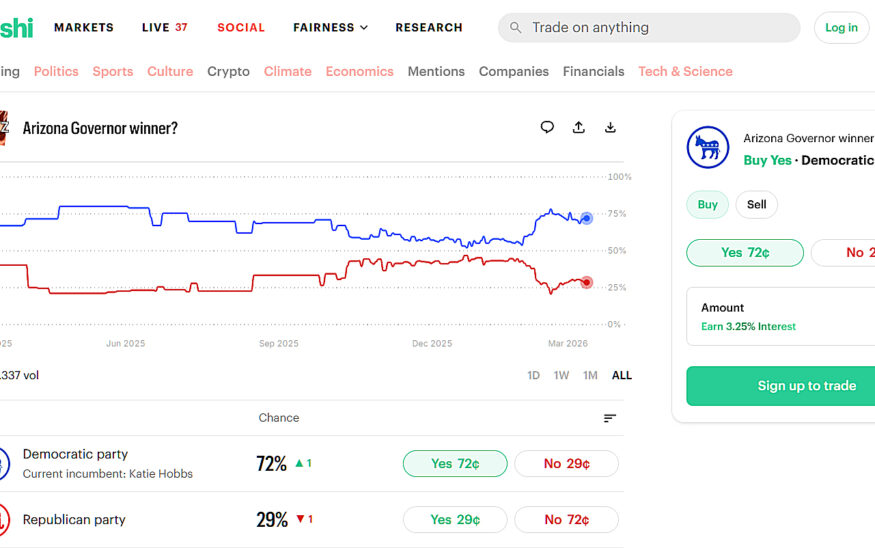
A Kalshi prediction on the 2026 Arizona gubernatorial race. (Howard Fischer / Capitol Media Services)
Prediction market Kalshi takes legal stand against Arizona’s gambling laws
Howard Fischer, Capitol Media Services//March 16, 2026//


Key Points:
-
KalshiEX LLC faces lawsuit from Arizona Department of Gaming
-
Kalshi claims its prediction market is regulated by federal law
-
Kalshi’s lawyers argue its activities are akin to a futures market
A company that lets people bet on everything from where Taylor Swift and Travis Kelce will get married to whether Katie Hobbs will get another four year term as Arizona governor is asking a federal judge here to stop the state from trying to shut it down.
In a new lawsuit, KalshiEX LLC contends that its prediction market is regulated by the Commodity Futures Trading Commission. And that, according to the company’s team of lawyers, makes what it offers to Arizona residents beyond the reach of the Arizona Department of Gaming.
Kalshi is seeking quick action in the form of a preliminary injunction.
That’s because the Arizona Department of Gaming already has sent a letter to Tarek Mansour, the company’s chief executive officer, arguing that Kalshi’s practices run afoul of laws that regulate gambling on professional and college sports. Douglas Jensen, the agency’s chief law enforcement officer, said state law says only companies with a state license can do that.
But Jensen said this isn’t just about whether Arizonans can wager on their favorite teams. He said that the state criminal code makes it illegal to accept wagers, not just on games of skill or chance but on “any other unknown or contingent future event or occurrence whatsoever.”
Jensen told Mansour that failure to stop what Kalshi is doing could make the company liable for providing restitution to those who have lost money. And he even suggested that it could lead to criminal charges.
Kalshi, seeking to get a step ahead of that, now wants U.S. District Court Judge Michael Liburdi to rule that its activities are regulated by federal law which it says preempts any state regulation. More to the point, it wants the judge to bar the state from trying to enforce its laws against it.
There was no immediate comment from the Attorney General’s Office which represents the Department of Gaming and would be the one to take Kalshi to court.
Central to the legal dispute is not just what federal laws say but whether what Kalshi and similar firms do can be considered gambling. Kalshi’s attorneys say it is not.
Instead, they argue their activities are more akin to a futures market, where people can buy or trade on what they figure the price of a specific commodity will be worth on a future date. What it also allows traders to do is hedge against losses.
One example of such a market, cited by the Commodity Futures Trading Commission, is that a Kansas wheat farmer may worry the price of wheat falls before harvest and sale date. To minimize the risk, the farmer can sell future contracts guaranteeing the price the farmer will receive.
Of course, if the price of wheat is higher at time of harvest, it is the person who bought that contract at a lower price who wins financially.
What Kalshi does, the attorneys said, is no different — even if it doesn’t involve a crop. And they said the CFTC itself backs that position, having said in a lawsuit in Nevada that it says it has exclusive jurisdiction to regulate all types of “derivatives markets” like Kalshi.
The way Kalshi’s lawyers describe its market is as “a type of option.”
“This form of derivatives contract identifies a future event with several possible outcomes, a payment schedule for the outcomes, and an expiration date,” they told Liburdi. And they said these are most commonly “binary questions,” with each “yes” position having an equal and opposite “no.”
“For example. A derivatives contract might center around whether an earthquake will take place in Los Angeles County before Dec. 31, 2026,” they explained, with a buyer choosing either the “yes” or “no” position. “If an earthquake does take place in Los Angeles County before the end of the calendar year, then the ‘yes’ position would be paid out.”
In fact, Kalshi has such an issue on its website now.
The current thinking is that the chances of that happening are just 8%. That means someone betting “yes” can buy a contract for just 8 cents; anyone taking the currently more popular position that it won’t occur can buy a contract for 92 cents.
About $95,000 has been put up on both sides of the issue, with winners getting $1 for each wager. Kalshi makes its money by taking a fee on trades.
But the list of available things on which people can put money on is much broader.
Take politics for example.
The current Kalshi line on the governor’s race has the Democratic nominee — not named on the website — with a 72% chance of winning versus 29% for whoever the Republicans nominate. Almost $240,000 has been put up.
And 65% of those who have put up money think that the Democrat candidate will win the attorney general’s race against 37% for any GOP nominee, though Kalshi users have put only $4,515 at risk.
More are willing to bet on national issues, with nearly $1.8 million put up on the question of the makeup of Congress following the 2026 election.
Of note is that, until early this month, the most popular guess was the outcome would be a Republican Senate and a Democratic House. But that has shifted to the point where nearly half of those in the market believe the Democrats will control both chambers in 2027.
There also are issues where winners and losers can be determined much quicker.
For example, there are questions about the average price of gasoline in the United States, both for the current week and the current month. There even are daily questions about how hot it will get in specific cities.
And you can even put money down on the question of whether the U.S. will confirm before the end of this year that aliens exist. For the record, 83% of the more than $11 million being bet on this subject say that’s not going to happen.
The Arizona lawsuit is not the first of its kind.
Company lawyers convinced a federal judge in Tennessee last month to grant a preliminary injunction — what is being sought here — barring the state from taking action against Kalshi’s operations there. There was a similar ruling in New Jersey.
But there is no consensus: Judges in Nevada, Massachusetts, Maryland and Ohio have refused to block officials in those states from regulating these contracts.
“These decisions are mistaken and have been appealed,” Kalshi’s lawyers told Liburdi.