Sign In
Upcoming Event
 Free Newsletter

Insurers say Arizona’s wildfire mitigation plans are not enough
Bob Christie, Associated Press//March 17, 2026//
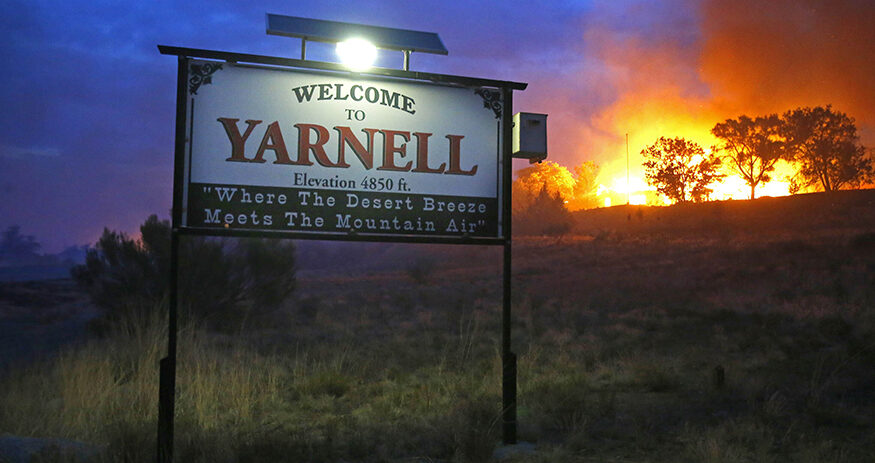
A wildfire burns homes in Yarnell on June 30, 2013. June 30, 2023, marks 10 years since one of the deadliest wildland fires in the U.S. killed 19 members of an elite central Arizona crew. The city of Prescott and neighboring town of Yarnell are honoring the Granite Mountain Hotshots with public events, including 19 bell tolls. (David Kadlubowski/The Arizona Republic via AP)
Insurers say Arizona’s wildfire mitigation plans are not enough
Bob Christie, Associated Press//March 17, 2026//


Key Points:
-
Arizona law shields electric utilities from most lawsuits if their equipment sparks a catastrophic wildfire
-
Insurers and trial lawyers criticize the law’s wildfire mitigation plans as sparse and lacking detail
-
Arizona utilities’ wildfire mitigation plans are under review by the state Forestry Department
A 2025 law shielding Tucson Electric Power, Arizona Public Service and other electric utilities from most lawsuits if their equipment sparks a catastrophic wildfire had just one requirement: The power companies must create comprehensive plans to minimize the risk of fires.
But insurers and trial lawyers who initially argued against the law and negotiated changes to remove their opposition are rebelling now that the plans are being rolled out. They call them sparse, lacking detail and an exercise in “check the box” bureaucracy that will do little to boost protection while leaving homeowners and other Arizonans on the hook if they lose everything in a fire.
In exchange, the utilities will be shielded from lawsuits that could cost them billions of dollars if a town like Payson or Prescott is wiped out by a wildfire caused by their power lines.
The insurers and trial lawyers are also highly critical of the state agency charged with reviewing what are called “Wildfire Mitigation Plans.”
They say that, despite explicit authority in the law, the Department of Forestry and Fire Management failed to write detailed administrative rules requiring the plans written by TEP, APS, and other companies to lay out the specifics of the actions they would take to limit fires.
Instead, the agency charged with reviewing the plans basically restated the general provisions in the 2025 law in 3 pages of rules it published last month. And despite telling lobbyists for insurance companies, their national associations, and trial lawyers in October that it would consult with them on potential rules and hold a public comment period before they were published, the agency never did so.
Tom Torres, director of the Forestry Department, said the legislation contained a series of details on what the wildfire mitigation plans must contain and the agency essentially adopted those so utilities had them before they filed their plans.
“Our approach to rulemaking was to describe what was required from the legislation. And as we receive the plans and we learn about what is submitted—we’ll learn from that,” Torres said in a Monday interview. “This isn’t to say that our rulemaking won’t be modified in the future, but we felt that the descriptions that were in … the bill were sufficient for us to get started.”
The public will have a chance to weigh in on the plan submitted by APS at an informal public meeting on Wednesday; APS serves about 1.4 million business and residential customers in 11 of Arizona’s 15 counties. Forestry officials will review the plan submitted by TEP’s parent company, Tucson-based UNS Energy, on April 7. Besides 458,000 Tucson-area customers, UNS provides electric services to 105,000 customers in southern and northwestern Arizona through Unisource Energy Services.
The agency is under a tight timeline to review and approve the plans. Under the new law, if it requests no changes, it must OK one just four months after it is submitted. If it requests changes, the utility gets 90 days to respond, then the Forestry Department is allowed two months to review and approve the modified plan.
APS’s plan was filed on Feb. 1, meaning it could be approved and the company given the massive liability shield by June 1 if no changes are requested. TEP’s most recent version was filed on March 2, so its plan could win approval by early July.
Torres said the review process has just started and as his staff pores through the plans, they will listen to comments made during the public meetings.
“We’re going to take public comment seriously, and that includes the stakeholders (like insurers). It includes the affected towns and counties, as required by the bill,” he said.
“We are not anywhere near complete with the review of the submitted plans, and we’re taking that responsibility seriously,” he added. “So if stakeholders have comments, and I know that stakeholders will have comments, I encourage them to provide them to us for consideration as we move through the review process.”
Sen. J.D. Mesnard, R-Chandler, added the provision specifically authorizing the Forestry Department to write rules detailing what specifics needed to be included in the utilities’ wildfire mitigation plans. Such administrative rules are frequently needed to put flesh on the bones of legislation that, by its very nature, is general and requires rules to implement legislative intent, but are time-consuming without the exemption Mesnard inserted in the bill.
Mesnard was surprised to learn that the agency had not done so, since the law outlines the agency’s review responsibilities and allows it to charge whatever fees it needs to cover employees’ and others’ review costs.
“I guess I assumed that there would be some level of detail, but figured that the oversight from DFFM would add to what is outlined in the statute itself,” Mesnard said.
The insurance and trial lawyer lobbyists were never told the “rules” had been published and didn’t learn about them until a Capitol Media Services reporter spotted them at the bottom of the agency’s utility mitigation plan website.
“We consider this to be strikingly insufficient substantively,” Lee Ann Alexander, vice president for policy for the American Property Casualty Insurance Association, said in an email on Monday.
APS pushed hard for the liability shield bill, joined by TEP and other Arizona utilities, because they were worried that a wildfire sparked by their power lines could expose them to massive liability. Utilities in California, Oregon and Colorado have faced major lawsuits after their equipment was found or suspected of causing forest fires that, in some cases, consumed entire communities.
Pacific Gas & Electric Co. in California was forced to seek bankruptcy protection a year after a hook holding up a transmission line broke in 2018, sparking a fire that destroyed the northern California town of Paradise and killed 85 people.
In 2025 alone, Arizona and seven other states passed laws limiting utilities’ liability for wildfires, according to the insurance association.
Alexander pointed out that the rules adopted by a California agency for utilities creating wildfire mitigation plans run to 255 pages. Her group pushed for specific, detailed items to be included in the Forestry Department’s rules, but most were not adopted.
A spokeswoman for APS, Yessica del Rincon, said the company has a “rigorous and comprehensive” wildfire mitigation strategy that includes modern technology like artificial intelligence and high-definition remote cameras to detect smoke to monitor its system.
The company’s wildfire mitigation team includes former wildland firefighters, foresters and meteorologists.
“The plan shows APS’s commitment to proactive, industry-leading wildfire risk management, and we look forward to demonstrating our thoughtful approach during its review by the Arizona Department of Forestry and Fire Management,” said a company statement provided by del Rincon.
The filed plan outlines ongoing efforts by APS to trim back trees and other vegetation, upgrade power line equipment such as fuses and automatic shutoff switches, and to shut off power to vulnerable lines during high wind events. Those so-called “Public Safety Power Shutoffs” are required elements of the plans that must be included in the 2025 law.
Despite research showing they are highly effective in preventing fires, most utilities view Public Safety Power Shutoffs as a last resort, since they are highly disruptive to customers and carry their own risks, according to a research paper from the Pacific Northwest National Laboratory, a U.S. Department of Energy facility.
The wildfire mitigation plans filed by APS and TEP both discount the use of PSPS’s, saying they’d rarely be used.
“The Companies use a backstop approach where only under the most severe drought and extreme wind conditions would PSPS be triggered,” the plan filed by TEP and Unisource says.
Joseph Barrios, corporate communications manager for Unisource and TEP, said the companies work year-round to reduce wildfire risk.
“The companies’ wildfire mitigation plan describes the standards and significant measures we use to reduce wildfire risks through robust operations, maintenance, system hardening, public safety preparation and prevention programs,” Barrios wrote in a statement provided to Capitol Media Services.
APS’s plan notes that its “wildfire mitigation toolkit” includes widespread grid modernization, distribution system hardening, feeder coordination studies, hazard tree risk assessment and defensible space around poles programs, among others
“We rely on all these tools first and only use a PSPS when the conditions in certain areas of our system warrant this intervention,” its plan says. “If APS needs to initiate a PSPS, efforts are made to limit the number of customers affected and the amount of time they are without power.”
In a lengthy interview last week, Alexander said administrative rules that fill legislative gaps are critical, especially because homeowners and businesses, as well as insurance companies, are losing their ability to recover damages from electric companies.
Insurers opposed the bill because it prevents them from recovering what they pay their clients for losses from utilities. Alexander noted that means everyone’s premiums could rise after a major wildfire, to say nothing of the large number of uninsured people — both homeowners and those who own businesses – who will lose as well.
That means getting the wildfire mitigation plans right affects everyone.
“It will not necessarily stop fires to have a robust wildfire mitigation plan,” Alexander said. “But you’re sure going to get a lot closer to a place that people should feel comfortable if it’s robust and is detailed, and gives dates and timelines and specific processes, rather than just what may appear to be a ‘check the box’ plan that complies with the specific items outlined in the statute.”
She said that by comparing the size of the APS documents to those filed by utilities in other western states “it seems hard to imagine” that they will hold the power companies to account. Once a plan is approved by the Forestry Department, it becomes nearly impossible to sue a power company for sparking a fire under the 2025 law.
“To us, it does look very thin, and it proves the point to us you need to have a rulemaking,” she said. “You’ve got to have some very strict standards.”
The plans created by APS and TEP are strikingly lacking in detail when compared to those written by utilities in other states. APS’s plan runs 69 pages and contains no details on investment in new equipment, details of its inspection programs or other items contained in plans for Utah and California utilities. TEP’s runs just 26 pages.
But Barrios said comparing the two is not reasonable, noting that each utility has “unique risk mitigation considerations” based on location and other factors.
And he noted that while California utilities are required to list all their internal processes and procedures in their plans, “our plan complies with Arizona’s statutory requirements and the Department of Forestry and Fire Management has raised no concerns.”
PG&E, a utility that serves much of California, has a wildfire mitigation plan that runs 593 pages, plus a 66-page appendix. Rocky Mountain Power, which supplies 1.2 million customers in Utah, Wyoming and Idaho, uses 153 pages to detail its 2023-2025 plan — and notes it planned to invest $446 million over that time to replace fire-prone equipment and trim vegetation to help protect its customers.
The plans filed with DFFM by APS and TEP contain no details on how much money they might need to spend and only general outlines of how they plan to upgrade their systems.
Barry Aarons, a lobbyist who represented trial lawyers who opposed the bill as it moved through the Legislature, said the final bill’s definition of the mitigation plans left a lot of wiggle room for utilities.
“This is what our worst nightmare was — they were going to decide what a ‘reasonable plan’ was, and DFFM was just going to hold some hearings and tell them what a great group of people they are for filing their reasonable plan,” Aarons said.
“And it’s not enough,” he said. “They have to have stakeholder meetings. They have to actually sit down with all the interested parties and go over their plans, line by line, and determine whether the plan is enough to make sure that they are living up to their part of the agreement that was made.”
The initial bill contained not only the sweeping liability protection for utilities but limited the ability of homeowners or business owners to recover anything but actual damages, things like use of a destroyed car or lost business.
Facing strong opposition, Mesnard crafted an amendment that took those items out, making the bill more palatable, if not tasty for the opponents. People or businesses can still join in a class-action lawsuit to recover incidental damages — but only if the utility doesn’t follow its approved mitigation plan.
Christian Slater, spokesman for Arizona Gov. Katie Hobbs, a Democrat, said she stood up for ordinary Arizonans by fighting for the changes that eventually made it into the bill. Those included ensuring the wildfire plans were reviewed by experts at the Forestry Department rather than by the Arizona Corporation Commission, which oversees regulated utilities like APS and TEP, or by the boards of publicly owned utilities like the Salt River Project.
“The administration will continue working on a common-sense approach that ensures corporations are doing their fair share to prevent wildfires and protects Arizonans from potential negligence,” Slater said in a statement.
Aarons said it is critical for the Forestry Department, part of Hobbs’ administration, to ensure that his group and others who represent homeowners and others who are losing the right to sue are heard as they were promised during talks on the bill.
“There’s a lot more work that needs to be done, and their promises need to be kept,” Aarons said. “You’ve got to do rule making, got to have stakeholder meetings, got to do all of that — or else this whole thing was a sham.”