Sign In
Upcoming Event
 Free Newsletter

Fontes, Kolodin clash over Arizona election security
Howard Fischer, Capitol Media Services//September 1, 2026//
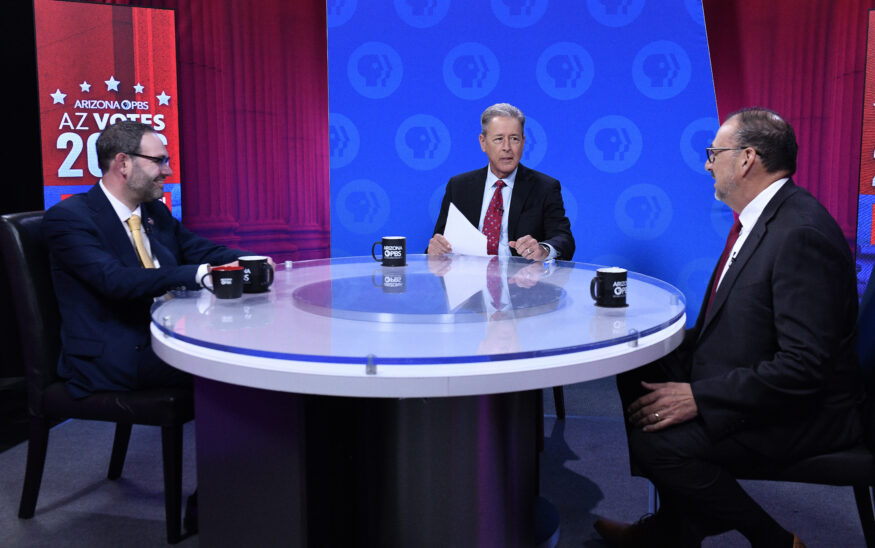
Secretary of state candidates Alexander Kolodin, left, and Adrian Fontes, right, in a Aug. 31, 2026 debate on KAET-TV with host Ted Simons. (Howard Fischer/Capitol Media Services)
Fontes, Kolodin clash over Arizona election security
Howard Fischer, Capitol Media Services//September 1, 2026//


PHOENIX — The outcome of the highly contested race for secretary of state could depend on whether voters believe Arizona’s elections are safe and secure.
“They’ve been safe and secure for a long time,” incumbent Democrat Adrian Fontes said during a half-hour televised debate Monday on KAET-TV.
But Republican challenger Alexander Kolodin repeatedly sidestepped the question from moderator Ted Simons. Instead, the Scottsdale lawmaker said the issue is voter perception.
“There’s no doubt that confidence in our elections here in Arizona is at an all-time low,” he said. “And the responsibility of that sits squarely on the shoulders of Secretary Fontes.”
Fontes, who is seeking a second four-year term as the state’s chief election officer, disputed that claim. But he told Kolodin that if people have lost faith in election accuracy, he should consider his own role in that.
It starts, Fontes said, with challenging the results of the 2020 election.
In one such case, U.S. District Court Judge Diane Humetewa said what Kolodin presented was “sorely wanting of relevant or reliable evidence.”
“The various affidavits and expert reports are largely based on anonymous witnesses, hearsay, and irrelevant analysis of unrelated elections,” Humetewa added. “Allegations that find favor in the public sphere of gossip and innuendo cannot be a substitute for the earnest pleadings and procedure in federal court.”
The State Bar of Arizona placed Kolodin on probation for 18 months for his role in that case and others. He was required to complete five legal programs, most of them relating to the ethical requirements for lawyers, including one on the filing of “meritorious claims” and another on “fairness to opposing parties and counsel.”
“You are one of the folks who was the architect of the ‘Big Lie’ here in Arizona,” Fontes said to Kolodin during the Monday debate.
“You’re the one who has caused the misinformation and distrust,” Fontes continued. “You’re like the arsonist who causes the fire and then says you’re going to come in and cure things.”
Kolodin, for his part, attacked Fontes for his role in fighting various efforts he believes will make elections more secure by ensuring that only citizens are registered.
In one case, Kolodin had to get an order from a federal judge for Fontes to turn over records he is required by law to maintain to ensure accurate voter rolls.
More recently, Fontes has fought efforts by the Trump administration to obtain unredacted state voter rolls. That includes not just public information, like name, address, and party registration, but also the last four digits of someone’s Social Security number.
Kolodin said he didn’t understand why Fontes would object.
“The private information Mr. Fontes said he was trying to protect from the federal government? Social Security numbers,” he said. “You know who issues those Social Security numbers? The federal government.”
And since the feds have that, Kolodin said Fontes “has wasted taxpayer dollars on a court fight.”
Kolodin acknowledged, however, that Fontes actually won that fight, with federal judges rejecting the administration’s bid for that information — not only here but in close to two dozen other states. But he said the U.S. Supreme Court has yet to weigh in.
Candidates clash on Trump postal order
The two contenders also had different ideas about efforts by the Trump administration to get the U.S. Postal Service to refuse to deliver mail ballots to voters who live in states that refuse to provide information that would go into a federal database.
Fontes has gone to court — along with election officials in other states — to block the regulations. And Kolodin?
“I have a way to make sure our voter rolls are clean without having to give any information whatsoever to the federal government,” he said, without directly responding to the question.
Mail-in voting is extremely popular in Arizona, with upwards of 80% of ballots cast by mail.
The president has repeatedly questioned whether mail voting is subject to fraud, without providing any evidence to the contrary. In fact, he has continued to mail his own ballot, including this year in Florida’s Republican primary.
Kolodin is the sponsor of Proposition 144, which will be on the November ballot. One key provision would require people to produce identification before casting a ballot. He insisted, however, it wouldn’t automatically kill mail-in voting.
“It’s not true,” Kolodin said. But he would not say how it would work. And nothing in the ballot measure provides any answers.
Fontes, however, said it would be “impossible” to administer mail-in voting if Prop. 144 is approved.
“People are going to have to go take their ballot in instead of putting it in the mail,” he said.
The only other plausible alternative, Fontes said, would be for those who still want to vote by mail to include a photocopy of their identity documents and submit it with their ballots.
“I mean, who has a photocopier at their house?” he asked. “It’s unworkable, it’s unreasonable.”
Confirming mail-in ballots
Fontes added that mail ballots require voter identification.
Election workers must compare the signatures on ballot envelopes with other samples they already have on file. If they match, election workers open the envelope and count the vote. If there is any question, election workers can contact voters and ask them to provide further information.
That process, however, came under question when Kari Lake challenged her loss in the 2022 gubernatorial race.
A legal expert her attorneys called testified that about 274,000 signatures on early ballots were compared in less than three seconds, with about 70,000 in two seconds or less. That, Lake’s lawyers argued, shows there really was no verification.
But Maricopa County Superior Court Judge Peter Thompson said Lake failed to prove that Maricopa County failed to review the signatures on ballot envelopes. And he said the amount of time election workers spent on them is legally irrelevant.
Kolodin filed a lawsuit in 2022 on behalf of the Arizona Republican Party asking judges to kill mail-in voting, arguing that anything other than voting in person — and on Election Day — is unconstitutional.
That legal effort failed.
No-excuse early voting did not exist in Arizona until 1991, when the Republican-controlled Legislature approved the change.