Sign In


 Free Newsletter

Candidate order on Arizona ballots varies by county
Howard Fischer, Capitol Media Services//September 15, 2026//
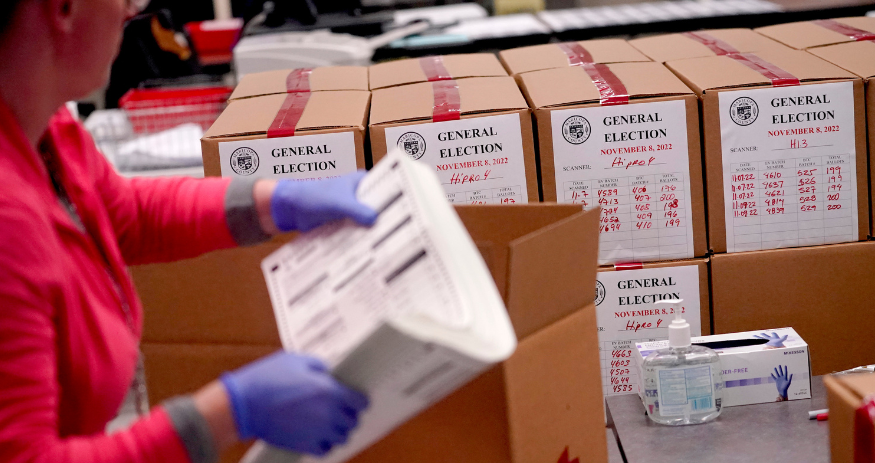
An election worker boxes tabulated ballots inside the Maricopa County Recorder's Office on Nov. 9, 2022, in Phoenix.(AP Photo/Matt York, File)
Candidate order on Arizona ballots varies by county
Howard Fischer, Capitol Media Services//September 15, 2026//


PHOENIX — Wondering why Democrats are listed first on your ballot? Or perhaps Republicans?
It’s not a conspiracy or even political intrigue. Instead, it depends on where you live. Lawmakers set it up that way.
But questions remain about whether Arizona’s ballot-order system is fair — and whether those listed first have a small but potentially significant advantage.
And, as both federal court litigation and state legislation have shown, what people believe about the existence of a statistical difference is linked to whether they think the current system helps or hurts them and their party.
Under the state Election Code, the order candidates appear on the general election ballot is set based on how well that party’s candidate did in each county in the most recent gubernatorial election.
So ballots this year in Apache, Coconino, Maricopa, Pima, and Santa Cruz counties will list Democrat Katie Hobbs, who won in those counties in 2022, ahead of Republican Andy Biggs. For residents of the other 10 counties, the first name they will see in the gubernatorial race is Biggs because Kari Lake outpolled Hobbs there four years ago.
Everyone else on that ballot gets the same preference.
In Pima County, for example, Democrats running for Congress and the Legislature will also get top billing. Ditto the other four counties where Hobbs beat Lake in 2022, regardless of how well other Democrats on the ballot did that year. Conversely, Republicans in the other 10 counties will get top billing.
Does name placement matter?
Democrats certainly thought so in 2019, when they challenged the system in federal court.
At the time, Republican Gov. Doug Ducey’s 2018 victory over Democrat David Garcia meant that Republicans would be listed first in 11 of the state’s 15 counties in the 2020 and 2022 elections. That included Maricopa County, the state’s largest.
National Democratic groups argued that being listed first gives candidates an advantage and asked U.S. District Judge Diane Humetewa to replace the state’s system with one that randomly rotates the ballot order.
They cited research showing that voters tend to choose the candidate listed first in a race, also known as the “primacy effect.”
John Krosnick, a Stanford University professor, testified that the concept of “order effects” is not unique to ballots. He said this is because people take in information in a certain order.
Consider a menu.
“We typically start reading at the top of the menu and move down,” he told the judge. “When we encounter objects, usually there is a tendency to lean to the first thing we see.”’
This also shows up in polling, Krosnick said. If people are asked to rank the importance of issues like education, crime, and the environment, they tend to rank the first one they hear as the most important. Krosnick said that’s why pollsters routinely rotate the order of options when asking such questions.
Mary O’Grady, the attorney for Hobbs when she was secretary of state at the time, countered with testimony from Sean Trende, the senior elections analyst for Real Clear Politics. He questioned the reliability of studies showing any correlation between ballot order and voter choices.
In the end, though, Humetewa dismissed the case because the plaintiffs who filed the lawsuit could not show they had legal standing or had been injured.
As it turned out, Democrats did fairly well in the 2020 race.
Joe Biden defeated Donald Trump in the presidential race. Mark Kelly ousted McSally — she had been appointed by Ducey to fill out the term of John McCain after his death — from the U.S. Senate. Democrats also won five of the nine congressional seats.
And in 2022 Hobbs beat Lake for governor, and Democrats elected Ruben Gallego to the U.S. Senate and took the races for secretary of state and attorney general.
Republicans reconsider name placement law
Rep. Alexander Kolodin, a Scottsdale Republican, concluded last year that Democrats were right to claim it’s not fair to have ballot order determined by who won the last governor’s race.
So he introduced legislation requiring general election ballots to be crafted so that, from precinct to precinct, the order of which party goes first rotates. That would have meant that each party gets an equal chance to be in that first position — essentially what Democrats asked for ahead of the 2020 election.
He convinced colleagues in the House to adopt the rotation plan. But the plan failed when two Republican senators joined with all the Democrats to kill it.
Kolodin, now running for secretary of state, said he remains convinced the current ballot order system needs to be replaced.
“No political party should enjoy an advantage over another merely because of how a ballot is designed,” he said, adding that it “ensures fairness for all Arizonans, regardless of party.”
All this becomes relevant again with the November general election.
In counties where Biggs defeats Hobbs, Republicans will have top billing in the 2028 and 2030 elections. In the counties she wins, Democrats will have top billing in each race for the next two elections.