Sign In



 Free Newsletter


The Fix Our Forests Act is ready – bring it to a vote
By Neil Chapman, Guest Commentary//October 16, 2026//
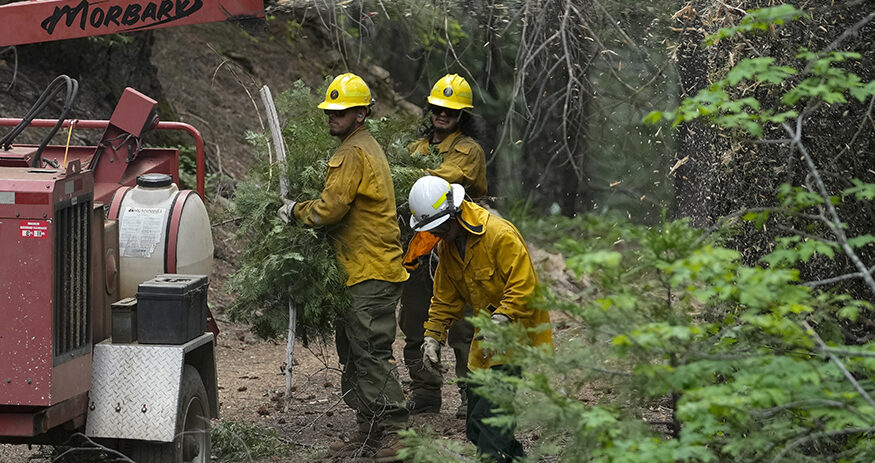
U.S. Forest Service crew members put tree branches into a wood chipper as they prepare the area for a prescribed burn in the Tahoe National Forest on June 6, 2023, near Downieville, Calif. (AP Photo/Godofredo A. Vásquez)
The Fix Our Forests Act is ready – bring it to a vote
By Neil Chapman, Guest Commentary//October 16, 2026//


Nearly 3 million acres of ponderosa pine cover northern Arizona, from the Grand Canyon to the New Mexico border. They can grow as high as 150 feet, their dark bark lightening with age to a coppery orange. They give off a beautiful scent, especially in sunlight. Some say butterscotch, others say vanilla, but nobody forgets it.
As the Wildland Fire Battalion Chief in Flagstaff, Arizona, I work and live among this beauty. Set against the Coconino National Forest, Flagstaff faces a higher risk of wildfire damage than 99% of the country. In my opinion, it also has more natural beauty than 99% of the country—and that beauty comes from fire.
Northern Arizona’s forests and grasslands are fire-adapted ecosystems, where frequent, low-intensity fire shapes and rejuvenates the land. These fires are not intruders — they are part of the ecology, recycling nutrients, clearing accumulated vegetation, and maintaining a healthy ponderosa pine forest.
But high-intensity wildfire has become increasingly common — not just in Arizona, but across the United States. That leaves those of us in fire management with one question: how can we manage forests better so that fire stays an asset?
A solution already exists. The Fix Our Forests Act would reduce catastrophic wildfire risk by encouraging proactive forest management and improving coordination across jurisdictions. It passed the U.S. House with overwhelming bipartisan support in January 2025, and its Senate companion cleared a key committee last October. But it has been waiting for a floor vote ever since — and that inaction is now a barrier to a safer Arizona.
For the past century, we have managed our forests through a single lens: wildfire suppression. Sometimes that instinct is right. But suppress every small burn, and the needle litter, dead brush, dry leaves, and young trees that feed wildfires keep building up. This is the suppression paradox: stopping every small fire makes a larger, more intense fire more likely.
This is the problem the Fix Our Forests Act was written to solve. It clears the way for proactive forest management — ecological thinning, prescribed burns, and hazardous fuels treatment where the risk is highest. It also streamlines permitting that often stalls science-based forest health work for years while fuel accumulates.
Even so, no one controls enough ground to stop the next fire alone. Fire does not check who owns the land — it crosses from national forest to state trust land to a subdivision without slowing down. The Fix Our Forests Act strengthens coordination across federal, state, local, and tribal agencies and creates a Wildfire Intelligence Center to put real-time data in the hands of decision-makers. In northern Arizona, where a fire can cross three agencies’ land in minutes, turning three partial snapshots into one picture saves acres and lives.
The bill also reauthorizes the Collaborative Forest Landscape Restoration Program, which funds science-based restoration at meaningful scales. It helped form the Four Forest Restoration Initiative (4FRI), an effort to restore ponderosa pine across four Arizona national forests that has accomplished over 600,000 acres of ecological thinning and over 1.5 million acres of beneficial fire. This work pays for itself: every dollar spent on restoration in high-risk country returns an estimated seven dollars in fires we never had to fight.
None of this brings the risk to zero. But I pay a premium to live here anyway, and I am not alone. I do it for what is outside the window — ponderosa pines stretching toward the horizon, mountains catching the evening light, a national forest in my backyard for my family to enjoy. We can learn to live safely with fire, embracing it as an asset rather than fearing it as a threat — but we have more work to do first.
The Fix Our Forests Act can guide that work to better protect our forests, our communities, and our homes. But it cannot do that without a Senate floor vote. Senator Gallego voted for it in the House, and I hope he will again in the Senate — with Senator Kelly beside him. The people of Arizona, and the beautiful landscapes they call home, are counting on them.
Neil Chapman is the Wildfire Battalion Chief for the city of Flagstaff, Arizona, where he oversees the Forest Health, Prevention, and Preparedness functions of the Department’s Wildland Fire Management Program. He can be reached at neil.chapman@flagstaffaz.gov