Please ensure Javascript is enabled for purposes of website accessibility

Arizona’s next economic chapter depends on moving what we build

Tony Lydon

For more than three decades working in industrial real estate and supply chain logistics, I have seen one principle hold true in every successful market: strong economies are built on the ability to move goods efficiently.

That sounds simple. It is not.

Every product we rely on — building materials for homes, components for advanced manufacturing, goods on store shelves — depends on a system that works quietly in the background. When that system is strong, growth follows. When it is strained, everything becomes more expensive, less reliable and harder to sustain.

Arizona is approaching that inflection point.

Our state has spent decades making deliberate decisions to build a competitive economy. We have invested in higher education and embraced pro-growth policies. Arizona now competes nationally for advanced manufacturing, logistics and investment.

But success creates pressure.

Today, metro Phoenix has become a major hub for manufacturing and distribution in the western United States. Companies that once clustered in California are expanding here. Supply chains increasingly run through Arizona. That growth is not theoretical; it is already happening.

And it is placing strain on how we move freight.

We can debate individual projects. We can discuss location and community impacts. Those are fair conversations. But Arizona’s logistics network is running nearly at capacity.

Standing still carries real consequences for a growing state like ours.

If freight demand accelerates without corresponding investment in infrastructure, the consequences are predictable. More trucks on already burdened highways. Higher transportation costs embedded in housing and groceries. And a gradual erosion of the advantages that have made Arizona competitive.

That is the context in which projects like BNSF’s Logistics Park Phoenix in the West Valley should be evaluated.

From a supply chain perspective, facilities of this scale are foundational. They connect regions to national and global trade networks and give manufacturers confidence that goods can move reliably and cost-effectively.

There is a reason similar facilities in places like Chicago, Kansas City, and Dallas-Fort Worth have attracted billions in investment. They expand capacity, improve efficiency and signal that a region is serious about competing.

Arizona now has a similar opportunity – one equivalent to the economic impact of seven Super Bowls annually.

That does not mean concerns about traffic, infrastructure or community impact should be dismissed. Large-scale projects require planning, transparency and enforceable commitments.

Success depends on getting those details right, particularly around roads, utilities and the impacts on surrounding communities. But those are challenges to solve, not reasons to stand still.

Throughout my career, I have worked with companies making location decisions across North America. One factor consistently rises to the top: confidence in infrastructure. If a region fails to show it can move goods efficiently today and into the future, it becomes harder to attract employers that create high-quality jobs and sustained growth.

Regions that recognize the importance of opportunities like this benefit for generations. Those that hesitate often find themselves trying to catch up.

The conversation in the West Valley should not be framed as growth versus no growth. Arizona will continue to grow. Goods will continue to move. The real choice is whether our growth is supported by modern, efficient infrastructure or constrained by a system which cannot meet demand.

From where I sit, the path forward is clear.

If Arizona intends to remain competitive and continue attracting investment, we need to ensure our logistics infrastructure keeps pace with our ambitions.

That is not about one company or one project. It is about whether we are prepared to build the next chapter of Arizona’s economy or allow it to be defined by the limits of yesterday’s infrastructure.

Tony Lydon has spent more than 30 years advising industrial users, developers, and investors on supply chain strategy and logistics-driven economic growth.

How much money did citizens in your state lose to cryptocurrency fraud last year?

 Key Points: 
  • Americans lost over $11 billion in cryptocurrency crimes
  • California reported the most crypto crimes and dollars lost
  • Twenty-three states have enacted crypto ATM regulation laws to curb fraud

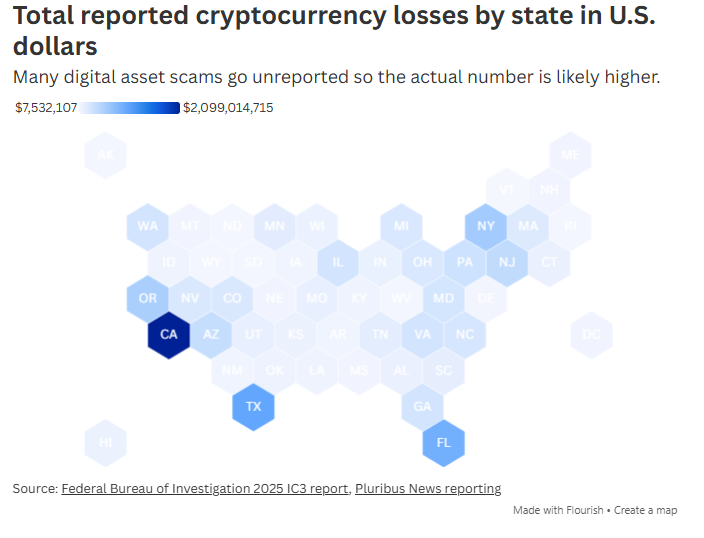
Americans reported losing more than $11 billion in cryptocurrency-related crimes between 2024 and 2025, according to a new report from the Federal Bureau of Investigation that found complaints rising 21%.

California by far reported the most cryptocurrency-related crimes and dollars lost to digital asset scams last year, nearly double that of runner-up Texas in both categories, according to new data the FBI released its annual Internet Crime Report for 2025. Residents in the largest states – California, Texas, Florida and New York – reported the most complaints and overall losses. But after those mega-states, the correlation between population and the number and scale of scams becomes less clear: Oregon, which ranks 27th by population, reported the fifth largest losses due to cryptocurrency-related crime: $545,938,510. The FBI data shows cryptocurrency scams resulting in a total of a reported $11.366 billion in losses. Seniors were the hardest hit of any age group: Americans over the age of 60 reported the most complaints and the largest amount lost — more than $4.4 billion from that group alone last year.

Twenty-three states have enacted crypto ATM regulation laws in total, with 10 states passing laws in 2025. At least 22 bills have been introduced this year. Indiana in March became the first to outlaw the kiosks with the enactment of House Bill 1116.

In the last month lawmakers have passed bills to do so in Alabama (HB 303), Florida (HB 505), Wisconsin (AB 968) and Kansas (HB 2515 and HB 2591), Mississippi (HB 1625) and Kentucky (SB 189).

Emma Kinery is a State Affairs national reporter covering state politics and policy out of our Washington, D.C. office. Contact Emma Kinery at ekinery@stateaffairs.com or on X @EmmaKinery.

RELATED

Beshear signs cryptocurrency kiosk regulation bill, joining slew of other states

Mississippi Gov signs law tamping down on elder fraud from crypto ATMs

Alabama latest state to regulate cryptocurrency ATMs, seeking to curb fraud

Kansas passes crypto ATM bill; third state to do so in a month

Indiana becomes first state to ban cryptocurrency ATMs

Florida passes crypto ATM bill to curb scams targeting seniors

Wisconsin passes stringent crypto ATM regulation bill

Lawmakers in New Jersey aim to outlaw crypto ATMs, citing ‘rampant’ scams

Arizona implements law to regulate Bitcoin ATMs and prevent fraud

States move to rein in crypto ATMs as scams surge

Data center growth threatens state climate goals

EDITOR’S NOTE: This story is part of a special State Affairs series highlighting energy policy dominating state legislative action this year. See the full list of stories here.

Climate-conscious state lawmakers have proposed policies to keep states on track to meet their environmental goals, as rising electricity demand spurred by data center development is threatening to hamstring efforts to rein in greenhouse-gas emissions. 

Those proposals include requiring or incentivizing data centers to provide their own clean power; data center development moratoriums; establishing virtual power plants; ramping up rooftop solar; and establishing cap-and-trade programs.

Experts say the demand for electricity to power the surge in data centers is projected to be so great that even if states and utilities put more clean power on the grid, emission-heavy power sources such as coal and natural gas likely must be kept online to ensure reliability and prevent brownouts and blackouts.

“The data center industry operates on timelines that are just vastly different than the utility industry,” said Brendan Pierpont, director of electricity at Energy Innovation. “I think the expectations between these two industries are really mismatched, and that’s creating a lot of pressure on utilities and on the states that have these goals.”

Electricity usage is forecast to grow by an average of 5.7% per year over the next five years. Data centers are the largest driver of demand and energy growth, accounting for roughly 40% to 55% of demand growth in utility load forecasts, depending on what actually gets built, according to Grid Strategies, a consulting firm. 

Data centers are specialized buildings that house networking and other computer equipment needed to support artificial intelligence, cloud computing, financial transactions, video streaming and numerous other essential parts of the economy. They can use as much electricity as a city and hundreds of thousands of gallons of water to cool their systems, depending on the size of the facility.

The One Big Beautiful Bill Act has cranked up data center development thanks to a provision allowing companies to take immediate deductions for certain capital investments — including the equipment housed in data centers — rather than spreading those write-offs over several years.

States must balance climate goals against the economic benefits of hosting data centers, though some critics say the costs in lost revenue outweigh the benefits. According to McKinsey, “States that can effectively plan, manage, and mitigate the risks of data center growth stand to unlock millions, perhaps even billions, of dollars in direct and indirect growth.”

Currently, 15 states — most of which are run by Democrats — have enacted legislation requiring that all energy needs be met by 100% clean or renewable energy by a certain date. Ten states, including five with 100% clean energy laws, also must reach economy-wide climate goals by a certain date under current laws. Those include California, Colorado, Illinois, Michigan and New York.

CaliforniaIllinois, and New York are among the roughly half a dozen states where legislation has been introduced to require or incentivize data center developers to provide or procure their own clean or renewable power. 

In Illinois, Democratic Sen. Ram Villivalam unveiled his far-reaching measure, known as the Power Act, at a press conference in February. He underscored that the bill includes a Bring Your Own New Clean Capacity and Energy provision, “ensuring data centers power their operations with new locally deliverable renewable energy and battery storage.” 

The measure would also require data centers to pay into a fund to support low-income energy assistance, avoid power cutoffs and boost home weatherization programs. They would also have to disclose water usage. A cumulative assessment would have to be done before being sited near low-income communities.

Opponents of the bill, including the Data Center Coalition and the Illinois Manufacturers Association, said it would hurt Illinois by prompting developers to go to other states. The Data Center Coalition is backed by companies including Amazon, Google, Microsoft and Meta.

Jen Walling, head of the Illinois Environmental Council, countered that data centers would continue to have a presence in the state thanks to its access to water and power. 

“They are looking here, and they’ll still look here, even if we have regulations in place,” Walling said at the press conference. 

Lawmakers in at least six states, including GeorgiaMichigan and Oklahoma, have introduced legislation to pause data center development over concerns that a sudden surge in data centers could hurt consumers, the environment and the grid.

In Michigan, a resolution was introduced calling for a pause in construction and reviews by state agencies on the fiscal, utility and environmental effects of data centers. That includes assessments of electric load growth, water withdrawals and local infrastructure costs, as well as increased transparency and local government participation in siting decisions. 

“Absolutely unchecked data center growth makes it harder for us to hit our clean energy targets,” said Ben Poulson, state government affairs director for the Michigan League of Conservation Voters. “It doesn’t have to be that way, and it really is a policy choice.”

To that end, Pam Kiely, associate vice president for the U.S. region at the Environmental Defense Fund, said some states will look to cap-and-trade programs to protect the climate from greenhouse gas pollution associated with growing electricity demand from data centers.

Cap-and-trade programs typically involve capping emissions and establishing a market for selling allowances that businesses and others can buy to emit more than the cap permits. The funds raised tend to be used to mitigate and prevent damage related to climate change.

Kiely pointed to California revamping its programs last year, Virginia Democrats pushing to return the state to the Regional Greenhouse Gas Initiative, and U.S. Sen. Michael Bennet’s Colorado gubernatorial campaign platform including the establishment of a cap-and-trade program.

“We want increased demand in the power sector … because we know how to decarbonize that sector,” Kiely said. “But that also means we need a policy framework that’s capable of ensuring continued decarbonization even as demand grows.”

Arizona won’t cut Colorado River withdrawals without enforceable conservation promises

Key Points:
  • Arizona is embroiled in an interstate dispute over access to the Colorado River
  • Gov. Katie Hobbs refuses to agree to any deal unless upper basin states offer firm water conservation plans
  • Arizona has set aside $3 million for potential litigation over water rights

On Feb. 2, Gov. Katie Hobbs made her position on the Colorado River clear. Either the “upper basin” states offer up a firm commitment for water conservation, or she won’t agree to any new cuts for Arizona.

But the decision to refuse a deal over the embattled water source would not be without consequence. In fact, it would lead to federal intervention by way of Interior Secretary Doug Burgum, who would impose his own solution on the seven states that draw water from the river.

The caveat? Burgum has so far refused to do more than convene the governors of the affected states. And Terry Goddard, president of the Central Arizona Water Conservation District, which oversees the state’s Colorado River supply, said the options put forward by the Interior Department “are not palatable to Arizona or California,” one of the two other “lower basin” states.

“All Burgum’s done is set us up for litigation,” he told Capitol Media Services. “And I think that’s sad.”

In November, Hobbs asked Burgum to get involved and develop a plan to protect Arizona water users, specifically by requiring conservation in the upper basin states of Colorado, New Mexico, Wyoming and Utah. But on Monday, she did not dispute that — even during Friday’s meeting — all Burgum has done is encourage states to work together.

Still, the governor said she thinks the negotiations don’t necessarily have to wind up in court, even though Arizona has already set aside $3 million for litigation.

“While we didn’t leave with a lot of specifics — the details are to be worked out through negotiation — I think that we came away with hearing that nobody wants to end up in litigation,” Hobbs said. “We want to find a way to get to a deal.”

But Hobbs said that means recognizing that Arizona, which already has agreed to give up 27% of the water it has been getting from the Colorado River, won’t give up a drop more unless there are firm and enforceable promises that the upper basin states will share in the burden.

That theme was echoed by Tom Buschatzke, director of the state Department of Water Resources.

“We need certainty that there are reductions in upper basin usage because that is one of two tools that we have,” he said, drawing attention to historic drought conditions that have meant less water flow.

“You can’t make it snow or rain,” Buschatzke said. “But you can reduce your demand. So that has to be a tool that’s in play at some level.”

At the heart of it is the need to reduce Colorado River use, with some estimates showing that water consumption needs to be cut by up to 3.2 million acre-feet a year. That’s enough to serve more than 9 million homes.

The lower basin states of California, Nevada and Arizona have agreed to trim usage by 1.5 million acre feet, enough to serve about 4.5 million homes a year. And Arizona, which, contractually and legally, has the lowest-priority claims to river water, has to cut its own withdrawals by 27%.

Upper basin states have said they’re willing to voluntarily conserve water, which would mean more water would flow downstream to the lower basin states. But Hobbs noted that it has not yet been put into a formal commitment.

“I shared this with Secretary Burgum and the other basin states,” the governor said. “For a successful negotiated outcome, Arizona and the lower basin cannot and will not be balancing the Colorado River on our own.”

She said the lower basin states are willing to do more only “if our partners in the upper basin states come to the table with reductions of their own.”

That, in turn, leads to the prospect of having all this decided in court.

“The stonewalling from the upper basin has made it very hard to see a non-litigation course in the future,” Goddard said. “If the upper basin continues to say ‘In a time of shortage, we’re not going to save and contribute to the shortage one drop of water,’ I don’t see how we can have a settlement.”

How much Arizona can demand could depend, at least in part, on the other lower basin states all working together.

Cooperation has not always been the rule, with California at times exercising its senior water rights. And even now, the amount of water that Arizona has offered up — about 760,000 acre feet — is on a per capita basis more than California.

But Hobbs believes that despite California’s senior right to the water, the state’s western neighbor won’t sell Arizona down the river, so to speak, to protect its own water interests. She said all three lower basin states have been united since they reached an agreement among themselves in 2023.

“So I feel very confident that we are continuing on a united path to get where we need to be on the Colorado River,” the governor said.

“I think we always have to be cautious,” said Goddard, a former state attorney general, acknowledging that, compared to California, “Arizona has a slightly lower pecking order.”

And he acknowledged the history between the two states.

“Keep your friends close,” Goddard said.

“But we’ve had some very good discussions with the major water users in California,” he continued. “They have a joint interest with us. We’re all part of a growing economy in the West that gets its water from the Colorado River.”

That hasn’t stopped Hobbs from making what she says is the case for why Arizona, despite its lower priority on taking Colorado River water, should have its needs met — and why the Trump administration should pay special attention.

“The most important computer chip manufacturing facilities in the western hemisphere are here in Arizona critical to winning our struggle against China in the AI arms race and at the center of the president’s recent trade deal in Taiwan,” Hobbs said.

And then there’s the fact that the majority of the nation’s winter crops are grown in Arizona.

Powering Arizona’s economy takes foresight and investment

Jimmy Lindblom

Everywhere you look, you can see Arizona’s incredible growth happening in real time. But what we don’t always stop to fully appreciate is that beyond growing in population, we’ve completely transformed our economy along the way.

Once looked down on as a “flyover state,” Arizona has become the place to be for the biggest industries in our economy, from advanced manufacturing to high-tech startups.

We are now internationally recognized as the hub for semiconductors. All this growth isn’t only powering our economy with great jobs; it’s also supporting the onshoring of American manufacturing and bolstering our national security.

This success didn’t just happen by accident. It was the result of intentional policy and strategic investments in infrastructure that allowed Arizona to strike when the iron was hot.

And following the Great Recession, when Arizona was hit harder than almost any other state due to our reliance on homebuilding, our leaders developed an aggressive plan to diversify our economy.

Today, Arizona faces new challenges — and once again, bold action is needed.

Utility providers like APS and SRP now project that Arizona’s electricity demand will double in just six years. That’s the same amount of growth it took more than a century to reach before.

It’s not stopping anytime soon. Nearly 500 manufacturing companies are currently in the pipeline to move or expand in our state, according to the Arizona Commerce Authority. These projects represent jobs, investment, opportunity, and rising quality of life for Arizonans — but only if we’re ready.

Our energy infrastructure must rise to meet this demand. Fortunately, Arizona already has a strong foundation. We’ve built a balanced energy mix: 45% natural gas, 27% nuclear, 8% coal, and 19% renewables as of 2024. This diversity is one reason why our state has experienced no significant blackouts or brownouts, even as demand has climbed. It’s proof that smart energy policy works. You can’t say the same for some of our competitors, like Texas.

We’re also leading the way on renewable energy. Arizona ranks among the top five states in solar-powered generating capacity, with more than 6,100 megawatts installed. In 2024, solar accounted for 82% of all newly approved energy generation capacity statewide — a clear sign we are embracing innovation while maintaining reliability.

But innovation without investment won’t be enough. If we fail to act, our ability to support new businesses, power our communities, and keep utility costs affordable will be at risk.

That’s why we formed Arizonans for Responsible Growth, a coalition of business and community leaders committed to keeping Arizona’s economy strong by advocating for smart, forward-looking investments in our energy and water infrastructure. We believe that preparing for tomorrow means acting today.

Our goal is to identify, recruit, and support candidates who understand the relationship between responsible growth and healthy utilities. Our candidates will support diverse energy sources, data-driven demand projections, and provide the most affordable and reliable power to our residents and businesses.

We felt compelled to form Arizonans for Responsible Growth to push back against an ideological anti-growth contingent pursuing energy policies that have failed in states like California.

Reliable power isn’t a luxury — it’s a necessity. It’s about protecting the Arizona we’ve built and securing the opportunities we want to pass on to future generations.

Arizona’s success story is still being written. With responsible planning and united leadership, we can make sure the next chapter is even brighter than the last. 

Jimmy Lindblom is a native of Arizona. He is a founding member of Arizonans for Responsible Growth and currently serves as Chairman of the Maricopa County Planning and Zoning Commission, Co-Chairman of the Political Affairs Committee for the Arizona Chamber of Commerce, and Vice President of Economic Development & Infrastructure at Willmeng.

Prop 50 exposes deepening political and geographical shifts in California

Key Points
  • Prop 50 passed in California, approving legislatively drawn congressional maps through 2030
  • Rural counties opposed the measure, revealing a sharp coastal-inland divide
  • Critics warn the new maps could reduce rural and Republican representation

The passage of Proposition 50 has laid bare long-standing, and perhaps deepening, regional rifts in California’s political landscape according to academics and political scientists in the state. While Prop 50 passed with relative ease, the voting patterns underwriting its victory reveal a fractured political geography.

“There are large parts of the state’s geography that voted no on Proposition 50, and they are at risk of losing representation in Congress,” Mark Baldassare, survey director of the Public Policy Institute of California, told State Affairs. “Large parts of the state are going to feel like they don’t have representative democracy working for them because the voters in the more populous areas of the state have decided to make changes in the district boundaries.”

Proposition 50, approved by voters in a special election last week, temporarily suspends California’s independent redistricting commission and authorizes the use of new, legislatively drawn congressional district maps through the 2030 elections. The measure, proposed by Gov. Gavin Newsom and the state Legislature, was a response to a Republican-led redistricting effort in Texas. Its stated goal: to shift up to five congressional seats toward the Democrats.

Although political divides in California are often framed as urban-rural (code for Democrat-Republican) Baldassare argues that’s an oversimplification. The political terrain, he says, is more textured.

He suggests the state can be broadly divided into three regions: coastal, Central Valley and mountain constituencies. “The coastal vote, which is largely Democratic and represented by Democrats, is one category. Then the central vote, which is largely the Central Valley … and then there are the mountains, particularly the northeastern part of the state.”

It’s this northeastern corner that has emerged as California’s political outlier. Counties like Modoc, Shasta and Lassen posted some of the state’s highest “no” votes. Henry Brady, a professor of political science and public policy at the University of California at Berkeley, attributes that resistance to both geography and a persistent sense of exclusion.

“That part of the state has always felt cut off from the rest of California,” he said. “First of all, it’s 500 miles from any really nearby urban area. Second, it feels like the policies followed by the state are much more oriented toward the cities and the coast than toward the agricultural farmlands in places like Modoc.”

The region has long harbored secessionist ambitions. Since 2013, a fringe movement called the State of Jefferson, envisioning a breakaway state formed with parts of southern Oregon, has tapped into a feeling of political disconnect. “These are very small counties in terms of population, so they ultimately don’t have a big input in terms of political power,” Brady said. “And a lot of people in California know nothing about them, they’ve never been there.”

He added, “There’s been a long-standing, not, I don’t think, serious, but nevertheless extant, movement to separate themselves from California. So this would not be the kind of thing they would support.”

While the northeast is both geographically and politically remote, other voting patterns around Prop 50 defied easy classification. Most notably, southern counties like Riverside and San Bernardino, historically conservative inland counties, swung toward “yes.”

Brady attributes this to demographic shifts: a growing Hispanic population that trends more Democratic and was, in his words, “not happy with Mr. Trump.”

Even in the Central Valley, long seen as a conservative stronghold, results were mixed. “The voting between the two groups in counties like Fresno are much closer,” noted Blake Zante of the nonpartisan Maddy Institute based in the San JoaquinValley. “The current separation is about 100 votes between ‘yes’ and ‘no.’”

Deep pockets of Republican opposition remain throughout the Central Valley, particularly in Kern, Tulare and Kings counties. Brady describes these areas as dominated by “older white landowners.” Kern County, home to former House Speaker Kevin McCarthy, is often dubbed “Texas in California” due to its oil and gas industries and staunch conservatism. “That’s a very, very conservative part of the state,” Brady said. “They’re Republicans.”

The implications of Prop 50 are significant for how the state’s citizens are represented — or not — by their elected officials. While Republicans make up 25% of California’s registered voters, they may soon hold as little as 10% of the state’s congressional seats.

“That’s particularly problematic for those one in four Californians who are Republicans,” Baldassare said. “It leads to feelings of political alienation and underrepresentation.”

Brady agreed, lamenting the decline of moderate Republican voices in the state. “It would be nice to have a strong Republican Party that once in a while gave us an Arnold Schwarzenegger, for example. We’ve had some darn good Republicans in California over the years.”

That sense of marginalization is already prompting political backlash. Just days after the vote, Assemblyman James Gallagher, who represents rural counties north of Sacramento, addressed the Shasta County Board of Supervisors. He called the passage of Prop 50 a “catalyst” to reintroduce a resolution to form a new state that would sever inland California from the coast.

While Gallagher’s proposal has little political traction, it underscores the deepening divide between a coast-dominated Legislature and a rural population that increasingly sees itself shut out.

Baldassare warned that Prop 50 may only intensify these divisions. “We have a state where, when you drive around, you realize that large geographic areas are in a different frame of mind politically than where most of the population lives, in coastal California.”

As the state gears up for the 2026 gubernatorial race, Proposition 50 has done more than redraw maps. It has again spotlighted deep demographic and geographic schisms.

“These are real divides in California,” said Baldassare. “The governor had talked about trying to bridge some of these political divisions — but this is not going in that direction.”

A review of the Prop 50 vote map shows that many of California’s most geographically expansive regions rejected the measure, and they now stand to lose congressional representation under the newly approved district lines.

“And therein lies the challenge for direct democracy in this case,” Baldassare said. “Coming up with something that works for the entire state. But large parts of the state are going to feel like they don’t have representative democracy working for them because the voters in the more populous areas have decided to make changes in the district boundaries. So it’s definitely a challenge.”

John Mulholland is managing editor of State Affairs California and is based in Sacramento. Have questions? Contact him at jmulholland@stateaffairs.com or on X @jnmulholland.

Efficiency from all 7 basin states is the path forward

The Colorado River Basin was inhabited by indigenous people for thousands of years, using its water resources for farming and to support their communities. The river serves many more people today, thanks to modern engineering and water supply projects in all seven Basin States from Wyoming to California.

Today, Colorado River supplies are running short, and a solution seems elusive because some water users are fighting for control over someone else’s share of the river instead of seeking local solutions to their own water needs.

Colorado resident Jason Shulman wrote a recent piece for the Arizona Capitol Times in which he implied solving the Colorado River crisis could be achieved by maximizing efficiency on farms in California’s Imperial Valley, over 750 miles from his home.

Farmland across the West is already on the decline — lost due to water shortages and swallowed up by urban sprawl. Efforts to take even more water from California farms to meet the demands in other states only makes matters worse. The Imperial Valley relies exclusively on water from the Colorado River to meet its needs. There are no alternatives.

Arizona and Southern California are seeing more and more farmland lost to urbanization every year, with Maricopa County leading the nation in farmland loss, according to the American Farmland Trust.

In the Imperial Valley, efforts have been underway for over 30 years to conserve Colorado River water. The Imperial Irrigation District has been administering a variety of effective water conservation programs as a result of collaborative intrastate partnerships.

While we appreciate Mr. Shulman’s recognition of IID’s conservation successes, his focus is more appropriately aimed at his home state of Colorado and other Upper Basin States, including Wyoming, Utah, and New Mexico. They have yet to step up in the effort to help craft a basin-wide solution, while California, Arizona, and Nevada have offered 1.25 million acre-feet per year in annual reductions.

Real progress is achievable if local water users look toward regional self-sufficiency instead of clamoring for water supplies that are needed to meet economic and social needs in other states.

A newly released report in the Journal of the American Water Resources Association examined the value of conservation investments throughout the Colorado River Basin. The report explains that conservation programs are usually less expensive than building new water supply infrastructure. Included was the cost per ace-foot for conservation in each of the seven Basin States.

Table 13 of the report shows that the lowest cost for conservation is in Colorado, at $285.90 per acre-foot. California spends $695.58 for the same acre-foot of conserved water, while Nevada is a whopping $3,860.84.

By the end of 2026, IID and other farm and urban water suppliers in California will have saved more than 1.7 million acre-feet of water to add at least 27 feet of elevation to Lake Mead. This is all part of the Lower Basin’s plan that is anticipated to conserve 3.7 million acre-feet by the end of next year. California has already reduced its demand on the Colorado River by 20% per year over the last several years. Since 2003, IID alone has conserved more than 9 million acre-feet of Colorado River water.

Imperial Valley farmers use water to grow a variety of crops, including winter vegetables, citrus, and alfalfa, a foundational crop. The big beef other states have is that many Imperial Valley farmers use their share of the Colorado River to grow alfalfa, but so do growers in these same Basin States.

Critics should instead focus on the kinds of things that are made possible by growing alfalfa. Mr. Shulman says people often “frame the problem as food vs. alfalfa,” but alfalfa is a big part of the food chain that brings us high-protein milk, cheese, yogurt, and other dairy and beef products many people enjoy.

The water that farmers use doesn’t stay on the farm — it returns in the food we buy at the grocery store. That food feeds not just millions of people in the Southwest but tens of millions more across the country. Urban conservation is critical. So is ensuring that farms have the water they need to grow food for the rest of us. Failing to prioritize food production is a recipe for disaster.

Our hope is that the future of the river will not depend on finger-pointing, but on practical, measurable solutions that protect both farmers and families. Efficiency from all seven Basin States is the path forward.

Mike Wade is executive director of the California Farm Water Coalition.

West Coast states form alliance to issue independent vaccine guidelines

California, Oregon and Washington are forming an alliance to coordinate public health guidelines in an attempt to fill the role that federal agencies have held for decades.

The governors of the three states issued a joint statement Wednesday announcing the West Coast Health Alliance, which will coordinate public health guidelines and align immunization recommendations informed by “national medical organizations.” The group will finalize its “shared principles,” in the coming weeks.

The announcement comes amid turmoil at the Centers for Disease Control and Prevention, the federal agency responsible for providing recommendations to the public about when and how to use approved or authorized vaccines. There are also questions about the future of federal officials’ role in vetting the safety and efficacy of common immunizations.

“President Trump’s mass firing of CDC doctors and scientists — and his blatant politicization of the agency — is a direct assault on the health and safety of the American people,” Govs. Gavin Newsom of California (D), Tina Kotek (D) of Oregon and Bob Ferguson (D) of Washington said in a joint statement.

“The CDC has become a political tool that increasingly peddles ideology instead of science, ideology that will lead to severe health consequences. California, Oregon, and Washington will not allow the people of our states to be put at risk.”

The move parallels a development in the Northeast, where public health leaders from eight states met recently to discuss forming their own consortium that could issue its own vaccine guidelines independent of the federal government.

Robert F. Kennedy Jr., the secretary of the U.S. Department of Health and Human Services and a longtime vaccine skeptic, has pressed the CDC to follow recommendations that are expected as soon as this month from the Advisory Committee on Immunization Practices. The 17-member federal panel, which guides national vaccine schedules and insurance coverage rules, was replaced in June with Kennedy’s hand-picked appointees.

Kennedy has said that he wants to weed out corruption and restore trust and transparency to the organization.

California union targets Arizona hospital executive salaries with new initiative

Key Points:
  • California union proposes cap on Arizona hospital executives’ pay
  • Initiative would limit executives’ salaries to 15 times the state minimum wage
  • The initiative may face legal challenges due to executives’ multi-state duties

A California union hopes to convince Arizona voters to approve a cap on how much hospital administrators can be paid in the state.

A new initiative by the Service Employees International Union-United Healthcare Workers West would prohibit hospitals from paying their executives more than 15 times the state minimum wage. With the current minimum here at $14.70, that translates out to $458,640 a year.

By contrast, he said, many people who provide direct medical care are being paid less. Moreover, at the bottom of every hospital employment hierarchy are many who are earning that $14.70 minimum wage.

At the same time, Rodd McLeod, spokesman for Arizonans for Responsible Healthcare, said Peter Fine, the CEO of Banner Health, is bringing in $14 million a year. He also cited seven-digit pay for the top executive at Mayo Clinic and at CommonSpirit Health, the parent company in Arizona of Dignity Health, and Barrow Neurological Institute.

Backers need to gather 255,949 valid signatures from Arizona voters on petitions by July 2 to put the measure on the 2026 ballot.

And while the fight is specifically about the pay of hospital executives in Arizona, the sentiment for change goes back more than a decade.

Its approval would be part of a multi-year fight between SEIU-UHCW, which has no members in Arizona, and California hospitals.

Brittney Kaufmann, CEO of the Health System Alliance of Arizona, panned the idea.

“The proposal by a California-based union would make it harder to recruit and retain the top-tier talent our state relies on and would hinder our ability to ensure residents can access the innovative and lifesaving services they need and deserve,” she said in a prepared statement. Her organization represents the largest health care providers, including Banner, Dignity, HonorHealth, Abrazo Health, Carondelet Health Network and Northern Arizona Healthcare.

Kaufmann said the state’s health system is already facing “unprecedented strain.”

“And it is unfortunate that instead of working together to protect access to care for Arizonans, the union has elected to introduce policies that would only jeopardize care,” she said.

McLeod said that ignores what he said are already unreasonable costs being charged for medical care.

“We believe that people are being overcharged and are in pain,” he said. “And one of the reasons is you’ve got people at the top making gazillions of dollars.”

McLeod said hospital administrators are “smart, hard-working people” and deserve a decent salary.

“But $458,000, I don’t know how it sounds to you, sounds pretty good to me,” he said. And McLeod said he believes a cap on top salaries “will exert downward pressure and make sure that more of the money is going to actual care for families.”

One issue that may provoke litigation — assuming the measure is approved — is how to determine which executives would be subject to the pay cap.

Many of the hospitals are part of multi-state corporations. And the top executives are paid more than what the initiative would allow.

For example, documents filed with the IRS by Dignity, the affiliate of CommonSource, which has hospitals in 23 states, show compensation of more than $21 million to Lloyd Dean, listed as “chief executive emeritus and founding executive.” There’s another $15.4 million for CEO Wright Lassiter III and $9.8 million for Marvin O’Quinn, the chief operating officer.

But the union, in its press release, cites a $2.6 million figure for Dignity as the salary that would be affected, which matches up with figures for Tim Bricker, listed as president of the central region.

What it comes down to, McLeod said, is that there are limits on what Arizonans can do about the problem through the Legislature or the ballot box.

“It is intended to be an Arizona law which deals with Arizona executives,” he said.

And what of those who have duties in multiple states?

McLeod said there’s nothing in the initiative to pro-rate how much of each executive’s duties are performed in Arizona. Instead, it’s an all-or-nothing proposal.

“If you’re the CEO of 20 hospitals in 20 different states, I don’t think the state of Arizona would have any ability to limit the pay that someone makes in a different state for a corporation doing business in a different state,” he said.

But McLeod acknowledged the question of whether the cap would apply when you have an executive of a multi-state hospital chain who lives in Arizona, but also is overseeing hospitals both here and elsewhere, still stands.

This isn’t the union’s first foray into Arizona ballot politics.

In 2014, the same union, which represents about 120,000 health care workers in California, proposed a similar pay cap for hospital executives in that state. It backed off, however, after reaching a deal with the California Hospital Association to negotiate over issues, including hospital compensation.

When that effort failed, the union refiled the measure in California, but it was withdrawn from the ballot in 2016 after a judge ruled that the initiative violated the terms of that 2014 agreement.

So the SEIU took its campaign next door to Arizona, spending $2.1 million to propose a cap of $450,000, a figure picked because it equals the pay and expense allowance of the president. It folded amid legal challenges to many of the signatures on petitions.

The union fared no better in 2020 when an Arizona judge found insufficient valid signatures on petitions for that effort.

Now, the union is back with the bid to put the issue on the 2026 ballot. But it’s not just in Arizona. It’s also trying to put a similar cap on pay for hospital executives on the 2026 California ballot.

Don’t let California fires today become Arizona’s tomorrow

The scenes of devastation in California’s foothills are tragic and terrifying. Homes and businesses burning, cars abandoned, fire hydrants empty, are all reminders of the power of Mother Nature and the destructive consequences of California’s misguided policies.

These scenes should also serve as a wake-up call for policymakers in Arizona.

David Tenney

As a former state forester, elected county supervisor, and longtime resident of northern Arizona, I know firsthand about the deadly and destructive threat that wildfires pose to residents and communities throughout the state. 

I also know what the prescription is to avoid becoming the next California.

Years ago, in my capacity as a Navajo County supervisor, I worked with local elected officials, environmental groups, and the Forest Service to lead and develop the Four Forest Restoration Initiative (4FRI) – a multi-pronged effort to restore Arizona’s forests at landscape scale. Instead of thinning 10,000-to-15,000 acres per year, we proposed that the Forest Service rely on the private sector to thin 40,000-to-50,000 acres per year, thus protecting a much larger landscape and many more communities.

4FRI was an enormous success – on paper. Unfortunately, poor contracting decisions by the Forest Service and other economic concerns have resulted in far fewer acres being thinned than we had originally planned.

In spite of those challenges, 4FRI, along with aggressive steps that the state took under the leadership of former Gov Doug Ducey, has resulted in a healthier forest than 10 years ago.

Nevertheless, I am deeply concerned that, absent aggressive and immediate action by state and federal policymakers, the images from California we see on our screens will be repeated on a much larger scale throughout northern Arizona. 

Arizona can’t afford to become the next California.

Fortunately, there is a path forward. It involves Arizona’s state and federal policymakers making forest health a top priority by:

  1. Fully funding the State Forester’s Good Neighbor and Shared Stewardship programs. 

Arizona has had great success working with the Forest Service and other agencies to expand thinning. To expand on this success will require a commitment from the Legislature and Governor Katie Hobbs. This is not a partisan issue; legislative leadership and the governor should commit now to making it a priority.

 2. Supporting the state’s utilities in their efforts to manage the vegetation in their rights of way and reduce the risk of catastrophic fires.

Legislation sponsored by Rep Gail Griffin is under development that will require utilities to develop Wildfire Mitigation Plans that identify how the utility will manage vegetation in its rights of way and take other steps to reduce the risk of wildfire and protect communities. The bill also aims to protect utility customers from bearing the costs of frivolous lawsuits related to wildfires. Rep Griffin’s legislation should be a priority for both parties at the Legislature.

3. Demanding that Congress provide the Forest Service with the resources it needs to fully implement 4FRI.

Insurance companies are exiting communities throughout the country. We can’t allow that to happen in Arizona. Only a fully committed and fully funded effort by the Forest Service will provide our rural, forested communities with the protection they need and deserve.

When the Rodeo-Chediski Fire hit northern Arizona in 2002, my family and I were evacuated without warning. For days, we weren’t sure whether our home had burned or survived. When we returned home 10 days later, my wife and daughter burst into tears of joy when they saw our home still standing.

No family in Arizona should go through such uncertainty and such trauma.

Let’s work together to ensure that California’s tragedy today does not become Arizona’s tomorrow.

David Tenney served as director of the Arizona Department of Forestry and Fire Management from 2018 to 2023. He served on the Navajo County Board of Supervisors from 2005 to 2015. He resides in Heber.

You don't have credit card details available. You will be redirected to update payment method page. Click OK to continue.