
Please ensure Javascript is enabled for purposes of website accessibility

Bills banning DEI practices in state agencies, universities advance

A series of bills targeting diversity, equity and inclusion initiatives in state agencies, colleges and universities are circulating through the Legislature as Republican lawmakers look to align with President Donald Trump’s executive order ending DEI programs.

The bills would outlaw DEI practices when it comes to hiring and training state employees and prohibit state community colleges and universities from teaching those concepts in classes. 

Senate President Warren Petersen, R-Gilbert, also sent a letter to the state’s three universities warning those institutions to comply with Trump’s executive order to avoid the risk of any “unwanted regulatory attention.”

Republican legislators say the bills would restore merit-based practices to hiring and push back against what they consider progressive agendas that seek to cause division. Democrats and opponents have countered by saying the legislation ignores the country’s history of discriminating against marginalized groups, limits freedom of speech and could hinder programs designed to improve representation of those groups in the workplace and on college campuses.
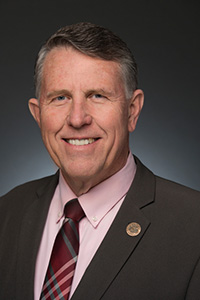
David Farnsworth

Sen. David Farnsworth, R-Mesa, introduced SB1694, which would withhold state funding from colleges and universities that offer courses that promote DEI. The legislation focuses on classes that foster the ideas that colorblind laws perpetuate racial oppression, differential treatment of anyone based on sex or ethnicity, and the idea that a student is biased because of their race or sex.

The law would also address classes that discuss ideas and practices such as critical theory, anti-racism, systemic bias and microaggressions.

The bill passed the Senate Education Committee 4-3 along party lines with Republican support.

“I think we should love each other and respect each other, because we’re all creations of God,” Farnsworth said. “Now, some of us are better than others about treating each other fairly, but I don’t think we should require teachers to be indoctrinated and divided by being taught that I’m a (white Anglo-Saxon Protestant) and you’re not, and I’m a bad guy, and I treat all women with disrespect.”

Farnsworth’s personal experience motivated him to introduce the bill after he enrolled in an online class at Rio Salado College and had to buy a text book titled “Multicultural Education in a Pluralistic Society.” 

After reading a few chapters of the book, Farnsworth said he believed the book, and the course, were biased. 

“We do not want to divide our culture,” he said.

Farnsworth said he was open to amendments to the bill and acknowledged the importance of recognizing diversity in society.

“A course in diversity … could be very beneficial, because we all know we have had discrimination in the past. We have discrimination today,” he said. “And it’s a benefit if you understand diversity and understand the fact that not everyone grows up the same.”

Alberto Plantillas, central regional director for the Arizona Students’ Association, testified against the bill during the Education Committee hearing, saying it could violate free speech on campus and hinder enrollment for groups such as veterans, disabled students and LGBTQ students.

“Research indicates that dismantling diversity initiatives leads to lower productivity, higher employee turnover challenges, attracting talent and a negative workplace atmosphere,” said Plantillas, a graduate student at Arizona State University. “It’s essential to recognize that diversity, equity and inclusion programs support a broad range of marginalized communities and not just one group.”

Two other Senate bills targeting DEI initiatives also have passed committees and are moving through the chamber. 

SB1584 would prohibit the state from prioritizing DEI programs in hiring practices and would ban employers from using tax money to implement the programs in job postings or required training. The bill would allow the attorney general, county attorneys or individual citizens to take legal action.

The measure passed the Senate Regulatory Affairs & Government Efficiency committee on Feb. 19.

Senate Majority Leader Janae Shamp, who sponsored the bill, said in a prepared statement: “Merit-based hiring ensures that the most qualified individuals are the candidates who are selected for positions within our government, ultimately leading to better services for the people of Arizona.”

Sen. Jake Hoffman, R-Queen Creek, also introduced a bill that would bar state agencies, boards and commissions from using DEI in hiring practices and requiring employees to participate in DEI programs.

The bill passed the Senate on Feb. 20. 

During the Senate Government Committee hearing on Feb. 5, Hoffman said the bill complied with Trump’s executive order, emphasizing individual skills and merit.

“We need to protect taxpayers from any progressive, radical policies that push back against professional competence and performance,” Hoffman said. 

However, Sen. Lauren Kuby, D-Tempe, highlighted the positives of DEI programs which allow for a variety of perspectives and backgrounds to flourish.

“I also look at diversity equity inclusion programs as really embracing the best of us to bring different perspectives to an office,” Kuby said.


GOP lawmaker wants to cap university president salaries

The head of the Senate Education Committee thinks the salaries of the presidents of state’s the three universities is “obscenely high.”

So Sen. David Farnsworth is proposing to cap their pay at $500,000 a year – far lower than any of them are now making.

His SB1453 also has a provision to prevent the Board of Regents from getting around that limit.

David Farnsworth

The legislation by the Mesa Republican would limit bonuses and benefits to no more than 15% of their salary. And those add-ons could be paid “only for performance that both exceeds the president’s assigned duties and directly benefits the institution’s students, staff or faculty.”

But the idea is getting a chilly reception from Gov. Katie Hobbs even though her $90,000 a year salary is just a fraction of what the university presidents get, and despite the fact she is responsible for a state general fund budget that is approaching $18 billion.

“I support cutting out expenses wherever we can, wherever possible,” she said Tuesday. But the governor said she wants to be sure the state is getting “the best of the best.”

“And I don’t think the Legislature should be in the business of kneecapping our universities in being able to do that,” Hobbs said.

At the heart of what Farnsworth is targeting is what the regents are paying.

Topping the list is Michael Crow of Arizona State University. He has a base annual salary of $892,532.

On top of that he gets $70,000 a year as a housing allowance, $10,000 for an automobile allowance and contributions to his retirement program equal to 21% of his base salary.

Then there is the possibility of $245,000 in additional compensation for meeting certain goals, at least one of which is measured by whether ASU sports consistently rank in the top three in the Big 12 conference.

University of Arizona President Suresh Garimella got a deal for a base salary of $810,000. There is no housing allowance as the school has a residence for its president, though he gets the $10,000 for a vehicle and retirement benefits equal to 18% of his base salary.

And Garimella is eligible for another $225,000 for meeting goals including bringing the university budget under control – at one point under former President Robert Robbins it was $177 million in the red – and establishing the university as a dominant force in revenue-generating sports and within the Big 12 conference.

Jose Luis Cruz Rivera, president of Northern Arizona University, has a base salary of $712,925 along with retirement contributions and allowance for housing and a car. And he can get another $190,000 for meeting goals.

Farnsworth acknowledged that he has “a skewed perspective” on people making that much because of how he grew up.

“I was raised poor,” he said.

“Then I got married young and my children grew up poor by today’s standards,” said Farnsworth. “And so when I look at these salaries in general I think they’re obscenely high.”

Hobbs did not dispute that her salary equals 10% or less than what any of the university presidents are paid. There also is no housing allowance nor a governor’s mansion, though she is driven around by her state-funded security detail.

But Hobbs said this isn’t a question of pure numbers. She said the only way to measure whether the salaries of the university presidents are too high is by results.

“Arizona is home to cutting-edge, world-class universities who are engaged in significant research that is keeping us on the cutting edge of medicine, on technology, on advanced manufacturing, on solving our state’s and our world’s climate crisis,” she said. But the governor sidestepped a question of whether those successes are the result of who is the president of each institution versus deans and professors who are actually involved in that work.

Farnsworth sniffed at the suggestion that paying higher salaries results in better-qualified candidates.

“I’ve heard that argument,” he said. “It doesn’t impress me because, quite frankly, I have not been impressed with the job the university presidents have been doing.”

He cited as one example the “big money problems” at UA.

But Farnsworth said his views about excessive salaries is not limited to the university presidents. Farnsworth said they also apply to those running public agencies.

“”I think if somebody wants a big salary they ought to be working in free market, not in government,” he said.

Ditto, Farnsworth said, of organizations that bill themselves as non-profit entities.

“When I come across one of them, I always ask, ‘OK, how much does your CEO make,’ ” he said.

“I kind of have a standard if you’re making a large salary you’re probably more interested in the money than helping people,” said Farnsworth. 


Hiking teacher pay a priority as lawmakers prepare to renew Prop. 123

With the general fund set to take on dollars previously provided by the state land trust through Proposition 123 at the end of the fiscal year, the goal of both the House and Senate Education Committee chairs is to create greater assurance that dollars go directly to the classroom.  

Orbiting a potential for a Prop. 123 renewal comes questions from sessions past on teacher pay and retention, “administrative bloat” and support, student performance and general accountability across the education spectrum. 

hotel, shelter, homeless, Scottsdale, Gress, David Ortega
Rep. Matt Gress, R-Phoenix

“Money needs to be directed to the classroom and to the teachers,” House Education Chair Rep. Matt Gress, R-Phoenix, said. “One of the challenges for student achievement is the lack of qualified teachers. We get vacancies, high turnover and it’s the hardest to recruit. Compensation is one major element in that calculus.” 

Proposition 123 is emerging as a lead issue this session as a fiscal lapse looms. Though schools will not lose money, as budget projections already outfit the general fund to cover dollars currently coming from the state land trust fund, a reimagination of the funding source offers the opportunity to increase teacher pay or otherwise supplement education. 

“I would rather have that money in the classroom serving Arizona students than being invested on Wall Street. And that’s the opportunity we have here with the renewal,” Gress said. 

Gress, and Sen. J.D. Mesnard, R-Coolidge, are spearheading the effort to renew Prop. 123 this session. For his part, Gress said he is making it a point to see the measure renewed “as soon as possible” and wants to see all the money spent on raising teacher pay.

Though Gress and Mesnard have yet to propose a formal plan, renewal of the measure could likely come with strings attached. In past legislative proposals for Prop. 123, lawmakers tied in teacher performance benchmarks to salary increases and required annual reports on spending.

“A lot of my Republican colleagues will not be happy with a blank check to K-12 education,” Gress said. “They would like to see it achieve certain policy objectives. Chiefly, we want to make sure that the money gets into the classroom, and that it’s not gobbled up by administration.” 

A similar theme is floating around the Senate too, with minted Senate Education chair David Farnsworth repeating the claim that dollars are not making it into the classroom as intended. 

David Farnsworth

“We spend billions of dollars towards K through 12 education every year, and the K through 12 education is the biggest expenditure in the state budget. One of my main concerns is that the money doesn’t seem to be getting into the classroom sufficiently, and that’s been a challenge for a long time,” Farnsworth said. “I think we have plenty of money already, but we need to reallocate the direction of those expenditures.”

As for Prop. 123, Farnsworth noted a lack of specifics at this juncture, but said he wanted to see the same distribution rate from the state land trust continued, not increased.Beyond funding, Farnsworth said for his committee, he noted the need for some “fine tuning” of school choice programs.

“If I had a number one priority, it would probably be just to make sure we don’t go backwards at all, but we maintain the excellent lead. Arizona needs to continue to offer parents as many high quality education options, because school choice involves the whole gamut,” Farnsworth said. 

“Public schools have challenges, and we need to strengthen them. We should have the best public schools in the nation, along with continuing the progress we’ve made with charter schools, private schools, homeschooling, and the ESA program. All those things are vital.”

Farnsworth said he had “utterly refused” to be a member of the Education Committee in the past session, deeming it a “controversial” and “extremely challenging” area. 

“I didn’t want to be in that pot that was continually stirred,” Farnsworth said. “However, when I was asked to be the chairman, I decided that, well, if I can stir the pot, instead of being stirred, I’m willing to do it. Obviously there’s nothing more important than educating our young people.”

He added that though he is fresh to education, he is open to new perspectives and said he replaced his desk with a large table. 

“If you, for instance, have wise people sitting around the table, you put a problem in the middle of the table, and then you discuss how to solve it,” Farnsworth said. “That’s my management style is to seek advice from people wiser and more experienced than I am.” 

At the House Education Committee, Gress said plans to take up three main categories of legislation: school safety, student achievement and accountability.

As chairman of the Audit Committee, Gress said he had seen districts failing to meet reporting requirements, prompting some “digging” into the question of assured accountability. Though Gress wants to focus on accountability for “districts in particular,” he did note concerns within the Empowerment Scholarship Account program, too. 

“In my view, the biggest concern is the time it takes to get reimbursements. Most reimbursement requests are legitimate. There are some fraudulent ESA requests,” Gress said. “So, we need to better understand what measures are being put in place by the Department of Education to ensure the dollars get to kids and that they are spent for the benefit of the child’s education.” 

The House Education Committee’s first meeting is scheduled for Jan. 14, with a presentation on school safety and a Sunset Review of the School Facilities Oversight Board on the docket. 


Hobbs unveils vision for flying cars and 3D travel in Arizona

For those who think traffic is bad and many Arizonans don’t know how to drive, here’s a thought to consider: Flying cars.

But Gov. Katie Hobbs is taking steps to have the Arizona Commerce Authority expand its role into looking at what it would take for the state to make such products available here. And that covers everything from being a place where the technology can be developed to how the state would license what are known as “roadworthy aircraft.”

And that’s just step one. She also is looking farther down the road at making things like flying taxis that can take off and land everywhere available in Arizona on a commercial basis.

To get there, the governor announced Wednesday she is revamping an existing agency division that now deals with things like autonomous driving vehicles into the Institute for Advanced Mobility, emphasizing the future is now about three-dimensional travel. And that, said Hobbs, could form the basis for making these technologies available here.

Lawmakers already have tried to take the first baby steps.

Sen. David Farnsworth, R-Mesa, introduced legislation earlier this year to make sure that when what some call “roadable aircraft” are available, the state will be ready to register them.

He proposed creating a one-stop process where the owners of these vehicles could get the necessary licenses both to drive on the interstate and soar at 12,000 feet. Farnsworth’s plan would allow them to be registered as a motorcycle – they have only three wheels – though motorists would not need a motorcycle license or to wear a helmet, as the cabin is enclosed.

And because they would be operated on Arizona roads, they also would need an Arizona license plate.

Only thing is, these vehicles need a length of runway. And nothing in what Farnsworth had proposed would allow them to take off or land on a street or highway, leaving airports as the only option.

But rather than having to leave your roadable aircraft at the airport and call an Uber, this would allow owners arriving at their location to simply fold up the wings and drive to their destination.

Still, hurdles remain.

One is that what is being advertised for sale now and delivery later actually is classified by the Federal Aviation Administration as “experimental aircraft,” which are not certified.

So, there’s no going to your local dealer to pick one up. Instead, under federal law, experimental aircraft can be entirely self-built.

Samson Sky is working to qualify under those regulations, with its proposed Switchblade vehicle with folding wings sold as a kit. That meets the FAA requirement that more than 50% of the assembly be done by the owner, though the company offers a “builder assist” program to allow buyers to complete their portion of the assembly using computer-driven machines to make their parts.

And anything build as an experimental aircraft needs 40 hours of flight testing by the owner in a limited airspace before he or she can take off for anywhere else.

For the moment, though, all that remains academic.

Samson CEO Sam Bousfield, who lobbied for the Farnsworth bill to clear the way for eventual sale of the kits for his vehicles in Arizona, said production and delivery will start in about two years, with would-be owners able to put down a non-refundable deposit of $500. So far, he said, more than 60 Arizonans have a place in line for the “Switchblade” vehicle.

But Marisa Walker, executive director of what the governor is revamping as the Institute of ADVANCED Mobility, said she doesn’t see these one-occupant, self-built vehicles as the future of technology. Instead, she said it is just an interim step in what is coming.

It starts with new rules from the FAA, which could pave the way for flying taxis.

In essence, the federal agency is now going to allow “powered-lift aircraft.”

That means vertical take-off and landing, referred to as VTOL. And it also means there won’t be a need to drive your experimental vehicle to an airport before using it in the air – and no need for state regulation as anything that occurs above ground is solely the purview of the feds.

Think of the scene at the end of Back to the Future where Doc Brown tells Marty McFly, “Where we’re going, we don’t need roads.”

Much of what’s involved here, said Walker, is developing the technology. But she said the decision by Hobbs to expand the role of the state Department of Commerce is designed to have Arizona play a role in all that, including providing places where that can be tested.

What she envisions next is the ability to call an air taxi as easily as summoning an Uber.

As passenger-carrying vehicles, they would have to be FAA-certified. And the federal agency also has to craft the rules for air traffic and who can use what airspace.

Still, there is a role for state regulation. After all, no one wants one of these air taxis just dropping in at a busy downtown intersection.

So, just like buses not making random stops anywhere, this new technology could mean creating certain “stops” where these vehicles are available.

“That’s trying to understand not only what our assets are, where are the best locations for these vehicles to go from Point A to Point B at the appropriate time but working closely with the local municipalities to have the capability of understanding their own land use and where they best see the need for mobility options for their particular communities,” Walker said.

She figures the first places likely to get such point-to-point transport are the major markets of New York and Los Angeles.

“Phoenix and Mesa are not too far behind,” Walker said.

Farnsworth said he is unsure whether he will pursue his original legislation when lawmakers reconvene in January. And he agreed with Walker that where the concept is now headed – and where the focus should be – is less about self-built flying cars and more about vertical take-off and landing.

Arizona has been on the edge of such technology being unveiled.

She pointed out that Amazon just got federal permission to use drones to deliver items of five pounds or less to customers within a few miles of its Tolleson distribution facility, with a one-hour turnaround on orders.

The only other place that Amazon has gotten such permission is College Park, Tx., where the company is now delivering prescription medications.

Childcare agency survives with tighter controls

The Department of Child Safety was put in the spotlight again this legislative session, but the agency was granted a lifeline – tied to stipulations – despite some lawmakers’ stance...

Get 24/7 political news coverage and access to events honoring top political professionals

GOP lawmakers want more oversight of child safety agency

A veteran state lawmaker says he wants more oversight of the Department of Child Safety, saying the agency is taking far too many children from their homes and then losing...

Get 24/7 political news coverage and access to events honoring top political professionals

Ex-lawmakers bring baggage to 2022 races

Ten former lawmakers, many of whom have personal or political baggage, are on the ballot for legislative seats this year. Two of them are running against each other. One once...

Get 24/7 political news coverage and access to events honoring top political professionals

Arson reminder of dangers that lurk in political world

When the Maricopa County Democratic Party headquarters burned down July 24, thoughts immediately jumped to political violence – an attack on the hub of a major party in one of...

Get 24/7 political news coverage and access to events honoring top political professionals

You don't have credit card details available. You will be redirected to update payment method page. Click OK to continue.




