Sign In


Upcoming Event
 Free Newsletter

State invests millions in medical schools, lacks enough physician residency programs
Luige del Puerto//September 14, 2015//
State invests millions in medical schools, lacks enough physician residency programs
Luige del Puerto//September 14, 2015//


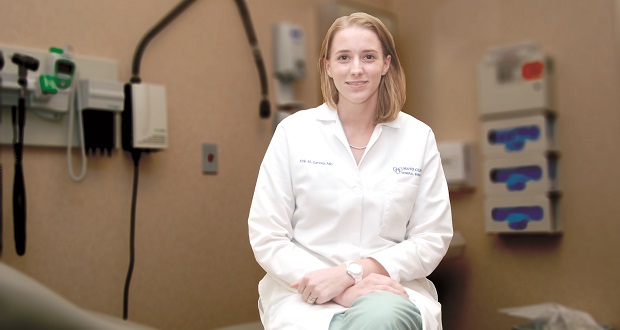
As far as Erin Garvey can remember, she always wanted to be a doctor.
She was drawn to her pediatrician, and to science.
“Before I could even spell the word pediatrician, that’s what I wanted to be when I grow up,” said Garvey, who is from Arvada, Colorado, a suburb of Denver. She pursued her passion, majored in molecular biology in Colorado and went to medical school in Vermont.
Fast forward several years later. Garvey is sitting at a Mayo Clinic office in Phoenix, wearing a white lab coat and green pants. She has 10 months left in her five-year residency training. After that, she’s off to Charlotte, North Carolina, where she’ll learn more about minimal invasive surgery.
Soon, she’ll be a full-fledged surgeon. But before then, she has one more crucial decision to make: Where to practice.
“I’m from Colorado. I love being here in Arizona though,” she says one August afternoon, and notes that her home state isn’t so far away. “I would be more than happy to come back here and try to establish my surgical presence here in the Valley – at Mayo of course.”
Garvey’s goal isn’t all that surprising. The Association of American Medical Colleges reported that 68 percent of doctors who get all their training in one state eventually end up practicing there. It’s obvious why. Residents make connections where they train, and acclimatize to the weather and local culture.
But for a state with a critical shortage of doctors and a historically robust population growth, there’s a crisis in the offing: Arizona doesn’t have enough residency positions, which are costly, for all of its medical graduates, particularly for specialized disciplines.
In 2014, Arizona graduated 499 medical students. But that year there were only 473 first-year residency spots here, the Pew Charitable Trusts noted.
“It’s a travesty to train them well here, and not have them stay within the state,” said Dr. Joseph Mikhael, head of Mayo’s residency program.
CLOGGING THE PIPELINE
The lack of residency slots for all medical graduates has become more pronounced as the nation has embarked on a massive effort to graduate more medical students. Reports indicated that if the trend was not reversed, the country would face a severe physician shortage that could grow to 150,000 by 2025.
Arizona’s leaders are well aware of the state’s physician shortage. They responded by investing heavily in the expansion of the University of Arizona’s medical school in Phoenix.
Since fiscal year 2006, the state has allocated roughly $156 million from the general fund for operations at the Phoenix campus. Additionally, when the state authorized university regents to enter into lease-to-own and bond transactions to raise $800 million for building renewals and new facilities, it earmarked $376 million of that amount for the Phoenix Medical Campus.
Last May, 54 medical students from the campus graduated.
But residency slots have not kept up, and partially because of that, roughly half of the medical school’s graduates each year go out of state to train.
Dr. Stuart Flynn, the dean of the medical campus in Phoenix, described the shortage of residency positions a “bottleneck” that’s clogging the pipeline.
“What we cannot afford as the state medical school (is) to become a farm system, where our graduates go to other states. We need them here,” he said.
Erica Brown, the manager of academic affairs at St. Joseph’s Hospital and Medical Center’s residency program, described the situation in Arizona and other states that also do not have sufficient residency positions for graduates as kind of a Catch 22: As states hunker down to graduate more doctors, their graduates are forced to flee in order to land a residency spot, and in the meantime, the states grapple with a shortage of physicians.
LOOKING FOR A CREATIVE SOLUTION
The residency bottleneck exists partly because of a 1997 federal law that limited the number of residency positions that Medicare would fund at teaching hospitals.
The other part of the equation is cost. Residency training is not cheap: A Rand study put the median cost per resident per year at teaching hospitals at roughly $135,000. The cost is greater or smaller, depending on the discipline.
But there is little enthusiasm on the part of the Obama administration to lift that cap or increase funding for teaching hospitals. Just the opposite, health care groups are fighting the government’s proposal to cut Medicare payments for graduate medical education by $16.3 billion over a decade.
That leaves hospitals, local governments and other stakeholders to look for creative means to solve a problem, whose solution really boils down to finding money.
Some states, like Georgia, are offering hospitals with startup costs. But convincing Arizona’s policymakers to increase residency slots is going to be a tall order. The issue is hardly on legislators’ radar, and addressing it will inescapably translate to allocating dollars for health care amidst competing choruses for limited resources.
Additionally, the Legislature’s GOP-led majority historically frowns upon anything that smells like more spending.
That wasn’t always the case. The state had provided matching funds to draw down federal cash, but policymakers pulled the money at the height of the recession. Since fiscal year 2010, no state funds have gone to fund the training of the next generation of doctors.
Interestingly, the state’s decision to defund residency training did not shrink the total funds for Arizona’s graduate medical education program.
In FY2007, when the state still funded the program, it received a total of $38.5 million, which included money from the federal government.
But in FY2016, the program will get $157 million, none of which comes from the general fund.
That’s likely because a law change in 2007 allowed local governments to volunteer additional money, which led to bigger matching amounts from the federal government. That law was expanded to public universities in 2010.
Local entities have stepped up, and in FY2016, their voluntary contributions stood at $50 million.
Rep. Kate Brophy McGee, R-Phoenix, still remembers when the state cut off its support for residency training.
“It was a huge fight,” she said. “To me, it was just another example of short-term cuts with long-term consequences costing us more. Was there a solution? I don’t know. I decry the short-term thinking that goes into cutting.”
A SIMPLE REMEDY
While no state money is appropriated for medical residency training, there is hope on the horizon.
The Ducey administration might have found a way to increase payouts to teaching hospitals without touching the general fund. Current law requires the Arizona Health Care Cost Containment System to develop rules on reimbursing a portion of hospitals’ indirect costs of training doctors.
Christina Corieri, the governor’s health policy adviser, told the Arizona Capitol Times that AHCCCS is seeking a rule change to modify the method of distributing funds for the indirect costs of training doctors. It’s a minor change, but once done, it will cover a greater portion of the expenses reported by hospitals, resulting in additional funding, she said.
“The end result is that every hospital receiving GME (graduate medical education) money will receive more, some of them a lot more,” Corieri said. “Everybody will get more than they had before and the total amount is estimated to be just over $80 million.”
Any additional funding would go a long way. Flynn said Arizona has a total of roughly 1,500 residency training slots. Here’s the challenge: To get Arizona to the median of the national physician to population ratio, the state needs another 1,000 residency positions, and if the average cost to train a doctor is somewhere between $100,000 and $150,000 per year, then the cost is staggering, he said.
“It is a big number that none of these hospitals by themselves can absorb,” Flynn said.
PERSUADING DOCTORS TO STAY
Mayo’s Mikhael said the challenge isn’t only how to increase residency positions, but also how to create a livable place for physicians.
That means having attractive positions available once doctors have completed their residency training, and providing assurances that their practice will thrive here, Mikhael said.
That also means having collegial support and an abundance of specialties present, so that a highly-trained internist knows he or she can readily call on the expertise of a cardiologist or gastroenterologist, for example.
Actually, once a doctor has established roots in Arizona, it doesn’t take a lot of convincing for him or her to stay here.
Mikhael, for example, is a transplant from Canada.
“I love living here, and I plan to live here for a very long time, and we want to be able to show that to a lot of people from out of state,” he said, adding that having a strong medical infrastructure and also a vibrant social life would help ensure that doctors who graduate and train in Arizona stay in Arizona.
Despite Arizona’s tendencies to be lampooned by comedians for its sometimes wild political tendencies, the state, if given the chance, would easily charm a doctor.
About a dozen years ago, Dr. Richard Gray, a surgeon, faced the same question that Garvin will soon have to grapple with: Where to settle.
Gray had grown up on the corner of a 4,000-acre cattle ranch in Gaylord, Michigan. He was exposed to veterinary medicine, but very little to “human medicine,” he said. But, like Garvin, he was drawn to science, and after talking to his family, teachers and mentors, it become clear that becoming a doctor was a solid option.
He went to Michigan State University to get his medical degree. A mentor later urged him to explore Mayo Clinic in Arizona. Initially, he had no interest in working here. But he decided to take a peek, immediately liked what he saw, pursued Mayo and was accepted into a five-year program.
That was roughly 20 years ago. Today, Gray practices surgical oncology in the area of breast cancer, melanoma and sarcoma, and is an associate professor of surgery at Mayo’s residency program.
While a resident, Gray also benefited from a scholarship program that provides stipends for additional training elsewhere in exchange for returning and later working at Mayo.
At the time, Gray said he and his wife, who was a prosecuting attorney in Maricopa County, were about to get engaged and had big decisions ahead.
“So, we started talking long term, and I said, ‘Write down the top five places in the U.S. where you’d like to live, and I’ll do the same and we’ll see how many match up’,” Gray said. “Both of us had Scottsdale, Arizona, No. 1 on our list.”