Sign In
Upcoming Event
 Free Newsletter

Reyna Montoya: An advocate for equal opportunity
Ellis Preston, Arizona Capitol Times//September 28, 2025//
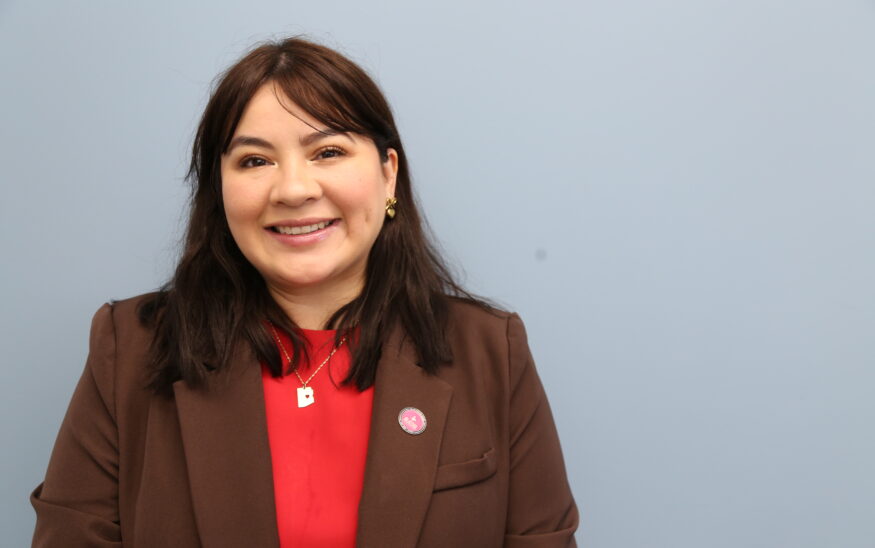
Reyna Montoya poses for a photo in the Aliento offices of the Helios Education Campus in Phoenix. (Ellis Preston / Arizona Capitol Times)
Reyna Montoya: An advocate for equal opportunity
Ellis Preston, Arizona Capitol Times//September 28, 2025//


Reyna Montoya has lived many lives. As a high school teacher, she learned how educational policies could intimately impact the lives of students. As a DACA recipient, she advocated for equal tuition for undocumented students in Arizona, landing her in Forbes’ 30 Under 30 list in 2018 and leading her to receive the ATHENA Young Professional award.
By teaching, lobbying and raising awareness, Montoya, the CEO and founder of Aliento, works to give undocumented students in Arizona the opportunity to obtain what she values most: an education. She sat with the Arizona Capitol Times to talk about her mission.
Answers have been slightly edited for clarity.
What brought you to the political and nonprofit world?
All my teachers told me, “Hey, if you have a really good GPA … you’re most likely going to be able to get scholarships to go to college.” And I did. I was part of the National Honor Society, and I was doing a lot of volunteer service at my church. As I was getting my scholarships, when it came down to signing the paperwork and accepting them, it asked for a nine digit number, which is a Social Security number — something that, as an undocumented student, I didn’t have.
It was this constant narrative that there were barriers in front of me.
There were other people who even had fewer opportunities than I did. Being a student at Arizona State University and getting involved in student clubs is when I started to realize that we can actually make a difference. We can share our stories. We can learn about policy and inform the larger community about these barriers, showing them that they don’t have to be this way. We can change them.
Is that how you came across Aliento? To assist in that mission?
I would say so. I never really dreamt about creating a nonprofit.
As a classroom teacher, I noticed that many of my students faced the same barriers. If they wanted to go to college, they still had to pay three times more.
That was really a wake up call, being 23 years old and seeing there was still a gap between the community’s needs and their ability to understand what resources they had available to them. When I launched Aliento, it was really with that spirit. It was an initiative never intended to be a full on nonprofit.
What’s something that you learned about yourself when you were in college?
I started as a political science major because I thought I was going to become an international human rights lawyer. As I was doing that, I stumbled upon my other major, which is Transborder studies, with an emphasis on immigration and economic policy. So I felt that I was able to have a unique experience where, on one hand, I was studying political science, and, on the other hand, I was seeing the theories and the reasons why people migrate. There was very little understanding about the real reasons why people migrate in the first place.
What I learned about myself was that when you’re doing things out of passion and they (have) a specific place in your heart, it’s really critical for you to follow it.
What has it been like to watch Aliento’s success and growth over the past decade?
It has been humbling and rewarding to see that there are so many people who care right now in this very divisive world. What I have witnessed with Aliento is that there are so many good people willing to support our children and our young people, regardless of where they were born.
For me, that’s the essence of the American dream – we are going to be investing in human potential, and if people work hard, there is still opportunity.
What do you see as the future of Aliento?
My hope for the future is that these young people will grow up and hold positions of power. From becoming teachers to becoming nurses, attorneys or maybe our future elected officials, that they don’t forget where they come from, and that they remember they have the power within themselves to really make Arizona and our nation a better place where all of us can belong.
What was your main takeaway from working with the Aliento Votes Campaign in the 2024 election cycle?
Young people are thirsty for action, contrary to what we read about the Gen Z generation. There’ve been a lot of challenges, and what I have witnessed is that they are willing to do really hard things to raise awareness about what is going on.
Young people are not only thoughtful, they’re ready to act. They’re willing to have those tough conversations if you coach them, support them, and show them an alternative.
What was your involvement with Proposition 308?
(Proposition 308 allows qualifying non-citizen Arizona high school graduates to receive in-state tuition at Arizona’s community colleges)
Back in 2018, we launched our campaign Arizona Futures, and we started going to every school, to every church, to every place that they would invite us to, to discuss how students right now are being impacted by the lack of institutions, and how much Arizona needs the students. Because we don’t have an educated workforce, we need more people who are working age, who have more post secondary credentials.
It took us three ideations at the state Capitol, where we talked to elected officials many times, to do a referral to the ballot, because at the end of the day, voters needed to be the ones deciding on this. That happened in 2021. In 2022, it was in the hands of the voters, and the voters thankfully sided with Arizona Dreamers.
Now that it has been reinstated, and I have seen many people who were impacted during my generation go back to school. It’s beautiful to see young professionals returning to university to complete their degree.
In everything you’ve done, you’ve centered yourself in education. What does education mean to you?
Education gives you the confidence and tools to remember that you have agency. Growing up as a kid who had to migrate without knowing why, education became my refuge.
Education gave me the power to make my own decisions and to know that I have value and that other people have value. If I (hadn’t) gone to university, I wouldn’t have had the opportunities of meeting other people who had similar stories that I did, but also had very different points of view.
Through education we can become bridge builders, even though we see the world very differently.
You mentioned dance was important in your life. When did you start dancing?
I started dancing when I was little. I was eight or nine, and then that’s when I had my first migration. So I had to stop dancing, since we were moving from Tijuana to Nogales. From there, I migrated here, and I was able to rekindle it in high school.
After I graduated, I danced professionally for a little while.
As a high school teacher, I taught all the subjects. I was a humanitarian teacher. I did English, Spanish, philosophy and dance.
(Dance) kept me going. Art is such a key component of the programming of Aliento, because we understand that art can have that dual purpose for students to reclaim their agency and also to heal.
Do you remember what life was like when you lived in Mexico?
What I mainly remember is going to school, playing soccer, and dancing, and being mad at my parents because they wouldn’t let me have sleepovers. But that was kind of what my life was like in Mexico.
My parents didn’t graduate high school. They come from very humble beginnings, but my dad has always been a hustler, so I grew up with a pretty normal life. I remember that around the age of nine or eight, that’s when things started making more sense. I remember having this feeling of a lack of safety.
What was the transition to the United States like for you?
It was very challenging. At the same time, it felt familiar. Being born in the borderlands, I always had access to the U.S.
When I migrated permanently to Mesa, Arizona, I was in middle school. Middle school is already a hard age for a transition. Kids would look at me differently. Kids would make fun of my accent.
When I came here, I felt that I was not really valued for what I could bring to the table. I was being judged for looking different and having an accent, which made it really hard for me as a kid.
When I tried to do my homework at that time, the internet wasn’t as accessible, so I would carry a huge dictionary to figure things out. I remember crying in my bedroom because I couldn’t do my homework by myself.
Is there anything else you would like people to know?
I want people to know that, especially right now in this world, we are seeing how our differences are being utilized to create division and create a sense of isolation in communities. Be reminded that we do have the power to create bridges. When they hear my story, to not only see me and my accomplishments, but to see in me those children and young people, those immigrant kids that love this country, they can see how much we’re more alike than we’re different.