Sign In


 Free Newsletter

Supreme Court delays resolution over death penalty deadlines
Kiera Riley, Arizona Capitol Times//November 28, 2025//
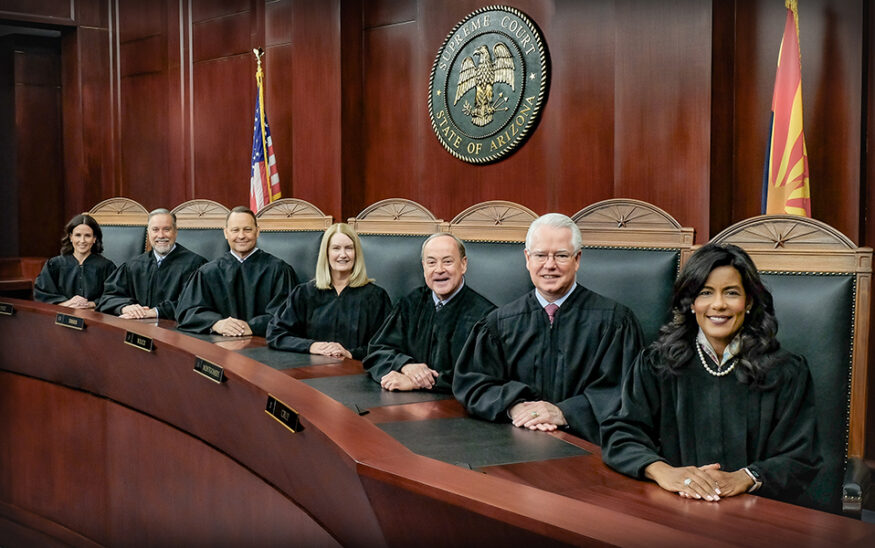
The Arizona Supreme Court. From left to right: Justice Kathryn H. King, Justice James P. Beene, Vice Chief Justice John R. Lopez IV, Chief Justice Ann A. Scott Timmer, Justice Clint Bolick, Justice William G. Montgomery, Justice Maria Elena Cruz. (Source: azcourts.gov)
Supreme Court delays resolution over death penalty deadlines
Kiera Riley, Arizona Capitol Times//November 28, 2025//


Key Points:
-
Court delays changing execution warrant briefing process until 2026
-
State seeks faster schedule, defense counsel warns of inadequate representation
-
Court declines to adopt its compromise proposal, reopens petition for comment
The Arizona Supreme Court put off making any changes to the execution warrant briefing process until next year, in hopes of balancing the state’s request for a faster, set schedule and capital defense counsel’s need for ample notice to provide thorough legal representation.
The Attorney General’s Office filed a rule change petition in January to set a more defined timeline for briefing motions for warrants of execution, citing a 90-day expiration date on the drug used in lethal injection.
Attorneys representing capital defendants claimed a quicker turnaround time curtailed the ability to provide fulsome constitutional counsel on clemency and related legal challenges to an upcoming execution.
The Arizona Supreme Court tried to strike a middle ground, proposing that the state provide 65 days’ notice if it needed to set an execution date, but neither side fully supported the idea. When faced with the petition again in the November rules agenda, justices decided to keep the conversation open and continued the issue to the August 2026 meeting, with public comment open until next May.
“It’s encouraging that the court is taking the time to get it right and not rushing to find just any solution,” Sam Kooistra, attorney for the Arizona Capital Representation Project, said.
The current briefing process for warrants of execution starts with a motion to set a briefing schedule, in which the state first floats its ideal timeline for briefing and completing an execution.
Defense counsel then has the opportunity to respond, the state weighs in again, and the Arizona Supreme Court then orders a schedule and notes the date the court anticipates conferencing the issue and issuing a final warrant of execution.
The Attorney General’s Office filed a petition to change the process.
Jason Lewis, section chief of capital litigation at the Attorney General’s Office, asked the state high court to start with the state’s motion for a warrant of execution and then set a rapid briefing process, with ten days for defendants to respond, five days for the state to reply and a decision from the justices at their next earliest conference.
The reason for the rush stems from the Department of Corrections, Rehabilitation and Reentry’s use of the lethal injection drug pentobarbital, which expires 90 days after it is compounded.
And, in line with a settlement agreement, the department must test drugs to be used in executions within 10 days of filing a motion for a warrant for execution.
A coalition of capital defense attorneys warned a shortened timeline threatens to curtail efforts by counsel to first respond to the warrant, while concurrently preparing for clemency proceedings and readying any additional challenges to the execution.
They argued, too, that the court should not change the schedule solely for the sake of accommodating the department’s drug of choice, noting the potential to change the drug protocol, or not use it at all, as 30 inmates can still choose to be executed by lethal gas.
The Arizona Supreme Court tried to strike a compromise. In its proposal, the state, if it needed a specific execution date, could file a notice 65 days before filing a motion for a warrant of execution, with two alternative future dates.
Defense counsel could respond to the notice within 21 days. And then, the justices would issue an order between 30 and 60 calendar days later setting deadlines for the state’s motion, the defendant’s response, the reply and the date the court plans to conference the issue.
Lewis claimed the new proposal from the court essentially “mirrors the current procedure,” but then restricts the state’s discretion in setting a 65 day notice period, which in the state’s opinion, is a bit too long.
And the amended proposal fails to account for response and reply times in the ultimate motion for a warrant of execution, and thus fails to address the problem the state sought to solve.
“While this time period is small in comparison to the length of time these cases have been pending, the State must always ensure that the victims’ rights to finality and a swift disposition are protected,” Lewis wrote. “More importantly, the State has an interest in reducing delay during the execution process to minimize the emotional impact on victims as they are thrust back into death penalty proceedings.”
Lewis clarified that he would support an amendment to shorten the notice period to 35 days.
Kooistra, writing on behalf of the Federal Public Defender in the District of Arizona and Arizona Attorneys for Criminal Justice, took issue with the fact that the state would not be required to issue the notice.
Kooistra asked to see the proposal include a provision requiring the state to explain why it needs a specific execution date.
“If the State believes there are circumstances that require extraordinary procedures, certainly it will know what those circumstances are at the time it files the notice, making it easy enough to provide an explanation,” Kooistra said.
He again made the case for the court’s discretion and warned against putting the warrant seeking process on “autopilot” by using mandatory language in setting briefing deadlines.
At bottom, Koositra said defense counsel would ultimately support the proposal with the requested changes, but absent the edits, would prefer to keep operating under the current system.
The Arizona Supreme Court took the issue under consideration at its rules agenda meeting on Nov. 25, and ultimately decided to leave the issue to next year.
In an order, Chief Justice Ann Timmer reopened the petition for public comment and put it up for consideration at the August 2026 Rules Agenda.
A spokesperson for the Attorney General’s Office declined to comment.
Kooistra said the Arizona Capital Representation Project and affiliated defense groups plan to stay involved and noted the likelihood for further discussion in the Capital Case Oversight Committee.
“They are waiting for a solution that respects the rights of all parties,” Kooistra said.