Sign In
Upcoming Event
 Free Newsletter

‘Independent’ candidate for governor survives legal challenges
Kiera Riley & Reagan Priest, Arizona Capitol Times//April 17, 2026//
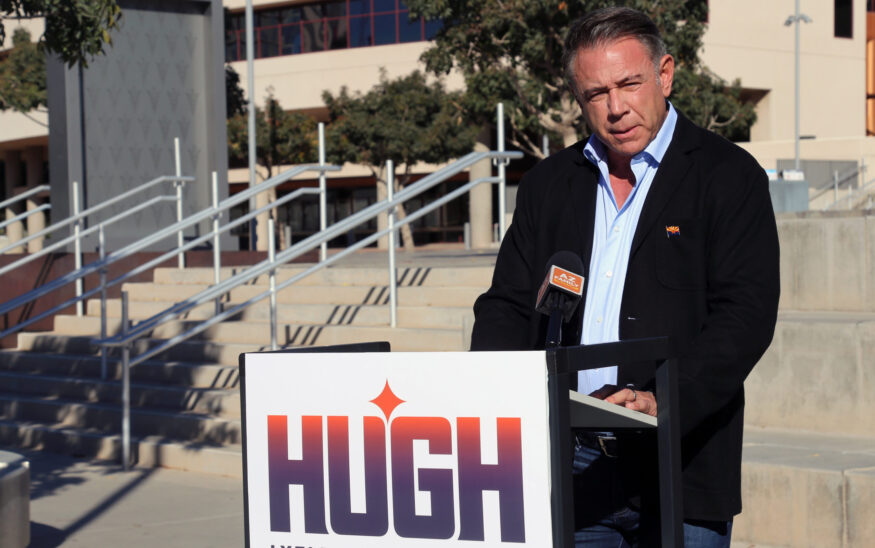
Hugh Lytle, a member of the Arizona Independent Party, delivers his candidacy announcement for the 2026 Arizona gubernatorial race at the Mountain America Stadium in Tempe, Arizona, on Jan. 27, 2026. (Reagan Priest / Arizona Capitol Times)
‘Independent’ candidate for governor survives legal challenges
Kiera Riley & Reagan Priest, Arizona Capitol Times//April 17, 2026//


Key Points:
-
No Labels candidate Hugh Lytle survives legal challenge, secures spot on ballot
-
Litigation over signatures and petition circulators, incorrect address fail
-
Lytle must now make it through primary to face off against Hobbs and a GOP candidate for governor
Hugh Lytle has survived several legal challenges to his candidacy and his party’s name, meaning Arizonans may soon have a chance to vote for an independent candidate for governor.
Lytle, a health care executive who entered the race in January, is running as a No Labels party — formerly the Arizona Independent Party — candidate, and said he’s ready to focus on the road ahead now that he will officially appear on the ballot.
“We feel like common sense prevailed,” Lytle said of the legal challenges to his candidacy. “We’ve had to take a lot of daggers to get here, and we’re finally here. So now I’m ready to get going and compete.”
Lytle faced two challenges to his candidacy, with one headed to the Arizona Supreme Court on appeal.
One lawsuit asserts Lytle’s decision to put down a business address on his petition sheets, as opposed to his actual residential address, was fatal to his candidacy. Another sought to strike him from the ballot over failure to secure enough signatures.
Lytle faced a claim from elector Craig Beckman, represented by Austin Yost and Bo Dul of Coppersmith Brockelman, a law firm with past work for Gov. Katie Hobbs.
State law requires candidates to put down their actual residence address. Alternatively, if a person does not have an actual address, they can provide a description and post office address. And if a candidates’ address is protected under state law, they can include a post office box or private mailbox address.
Yost argued Lytle failed to comply with state law by listing his business address.
In arguments on April 13, Yost argued that by doing so, Lytle deprived voters of information, and, if Judge Michael Mandell let the address switch slide, it would “eviscerate the framework the legislature has created.”
“He has a $7 million Scottsdale mansion, and he tried to hide that from voters,” Yost said. “Our position is that he was misleading electors by doing that and by verifying under penalty of perjury that that information was accurate when it wasn’t.”
Mandell asked if it would matter if he had a $300,000 house instead.
Yost said no, but added that the information still mattered to the voters and the Legislature.
“A candidate for statewide office could pluck any Arizona address out of the air and place that on their nomination paper and nomination petition sheets,” Yost said. “That cannot be the law because it would turn these requirements into a dead letter.”
Andrew Pappas, representing Lytle, stressed the address he used had been his private mailbox for 12 years, and he argued the Legislature truly aimed to ensure a candidate lives in the jurisdiction they seek to represent.
“Mr. Lytle, undisputedly, has resided in Arizona for 29 years. He is seeking statewide office. He has lived in Scottsdale throughout the entire relevant period,” Pappas said.
Mandell determined that, although Lytle should have included his residential address, he did not substantially mislead voters.
“No evidence in the record suggests that signers were confused about who was seeking nomination or about whether he had met the residency requirements for Governor,” Mandell wrote.
The case is now heading to the Arizona Supreme Court for final say. Yost and Dul, on behalf of Beckman, filed a notice of appeal on April 16.
Teri Hourihan, Lytle’s gubernatorial primary opponent, also sued, claiming 4,748 of the 6,013 signatures he submitted failed given invalid signatures and the use of circulators with past felony convictions.
But at an evidentiary hearing, Hourihan could not prove circulators alleged to be felons had any criminal record severe enough to discount the signatures collected.
She primarily relied on TruthFinder, an online database of public records, to support her allegations, but Hourihan could not prove arrest or criminal charges resulting in felony conviction.
“Lots of people are arrested for many different things,” Mandell said. “It doesn’t mean they were convicted of a felony.”
James Smith, attorney for Lytle, declined to put up a defense, claiming Hourihan had failed to meet her burden.
“My client has spent an incredible amount of money to chase down ghosts,” Smith said.
In addition to the legal challenges to Lytle’s candidacy, the Arizona Republican and Democratic Parties successfully sued to force his party, the Arizona Independent Party, to change its name back to the No Labels Party. Lytle maintains that the party should be able to call itself whatever it wants, but that the name change kerfuffle won’t negatively impact his candidacy.
“My candidacy is not defined by a label or party name, it’s ironically, No Labels,” Lytle said.
In his first campaign finance report of his candidacy, Lytle reported over $36,000 in individual contributions. He also contributed $1 million of his own funds to the campaign.
“I’ve got a lot of interest and a lot of support in the community, but … I’m not someone who feels right asking people for contributions if I’m not officially on the ballot,” Lytle said of his quarter one fundraising numbers.
Hourihan, meanwhile, is close to $6,000 in debt. In the first quarter, she raised about $17,772, though $17,500 came from her own pocket. She spent $26,105.
For comparison, Democratic Gov. Katie Hobbs brought in over $2 million in donations in quarter one. Congressman Andy Biggs, who is widely-viewed as the frontrunner in the Republican primary for governor, raised around $855,000 during the first few months of the year.
Lytle and Hourihan will face off in the No Labels primary on July 21. The winner will take on Hobbs and the winner of the Republican gubernatorial primary.
“This is the way it should be,” Lytle said. “We should be competitive and not have parties blocking people out and doing maneuvers and using courts and so forth to discourage what is an already big task and hard thing to step in and lead and do. So I mean, I look forward to that challenge.”