Sign In
Upcoming Event
 Free Newsletter

Mayes backs Pima County measure limiting ICE access to county resources
Howard Fischer, Capitol Media Services//May 7, 2026//
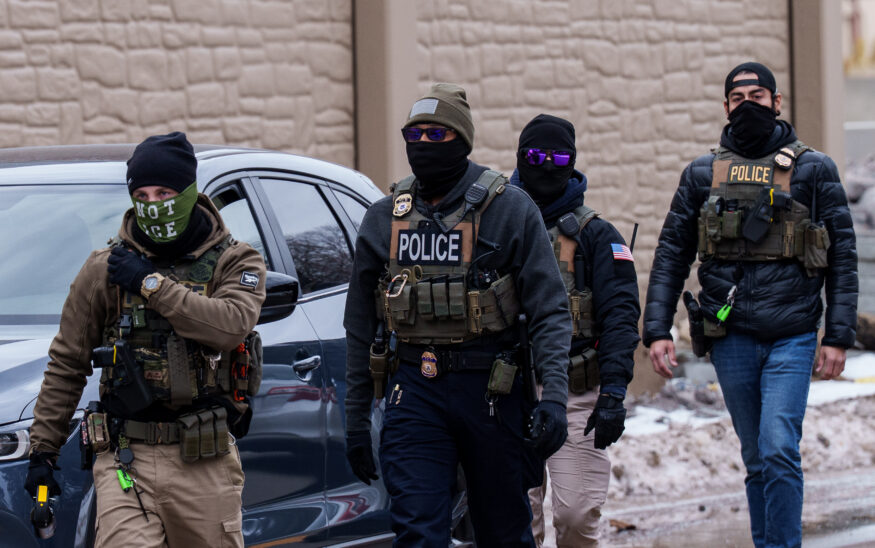
Immigration and Customs Enforcement (ICE) agents, including one wearing a 'NOT ICE' face covering, walk near their vehicles, Thursday, Jan. 15, 2026, in Richfield, Minn. (AP Photo/Adam Gray)
Mayes backs Pima County measure limiting ICE access to county resources
Howard Fischer, Capitol Media Services//May 7, 2026//


Key Points:
-
Pima County resolution does not violate state or federal law, Attorney General Kris Mayes concludes
-
State law does not mandate local governments to do more than what federal law requires
-
Pima County’s resolution does not prohibit federal immigration officers from parking in county lots
A Pima County resolution directing employees not to cooperate with immigration officials does not violate either state or federal law, Attorney General Kris Mayes has concluded.
In a 23-page written opinion, Mayes acknowledged tImmigration Enforcementhat a state law going back to 2010 prohibits local governments from adopting policies that “limit or restrict” federal immigration enforcement to less than what federal law permits.
But she also said it “does not mandate that political subdivisions do more than what federal law requires.” And that, Mayes said, means nothing in the resolution is illegal.
The opinion, while dealing only with Pima County, has broad effects, giving legal cover to cities and counties that have or want to enact similar immigration requirements. That includes Tucson.
In fact, Mayes, in a separate opinion — and using the same logic — already has rejected arguments seeking to void a comparable Phoenix ordinance.
Her ruling drew angry reactions from several Republican lawmakers who objected to the Pima resolution and had asked Mayes to use her powers under state law to block it. That includes Senate President Warren Petersen.
“Arizona law is crystal clear,” said the Gilbert Republican. “Local governments are now allowed to obstruct federal immigration enforcement.”
And Petersen, who is seeking to become the Republican nominee to go up against Mayes in November, said the county resolution crosses that line.
“Pima County clearly ‘restricted the enforcement of federal immigration laws to less than the full extent permitted by federal law,”’ he said.
Mayes, however, said that’s not what 2010 law says — at least not the part that is enforceable.
It is true, she said, that the statute does contain a legislative declaration that “there is a compelling interest in the cooperative enforcement of federal immigration laws throughout all of Arizona.”
The caveat, Mayes said, is that the verbiage “is not part of the enacted text.”
What is, she said, is the part barring local government from limiting or restricting federal immigration enforcement. And Pima County does not do any of that.
“Refusing to help is not the same as impeding,” Mayes said.
Senate Majority Leader John Kavanagh, for his part, sniffed at what he called the “legal jargon” that Mayes used to reach her conclusions, registering his objections to her opinion in political terms.
“Regular people understand exactly what this means,” said the Fountain Hills Republican in his own prepared comments. “Democrat politicians in Pima County don’t want immigration laws enforced, and Kris Mayes just gave them cover to keep doing it.”
The resolution adopted by the Board of Supervisors has three basic provisions.
First, it says that county employees cannot give consent for federal officials to access or use any county owned, leased, or operated buildings, facilities or property for purposes of civil immigration enforcement without a valid judicial warrant. That specifically excludes the kind of administrative warrants — those signed not by a judge but someone from Immigration and Customs Enforcement — typically used by the agency.
It also says county employees “shall not voluntarily assist, facilitate, or cooperate with civil immigration enforcement activities … except where such assistance is required by law.”
Finally, it spells out that no county owned and controlled property “shall be used as a staging area, processing location, or operation base for civil immigration enforcement.” And it even requires county officials to post signs to identify areas they say are off-limits to civil immigration enforcement and even use “physical barriers” to limit access to county parking lots, vacant lots and garages.
The GOP lawmakers, in asking Mayes to void the resolution, said all that “limits and restricts ICE’s ability to comply” with its congressional mandates.
Mayes said the problem with their objections is that they don’t match what federal law does — and does not — require of cities and counties.
On one hand, she said, federal law permits the federal government from contracting with state and local governments to further immigration enforcement. But what that also means, Mayes said, is that local governments can refuse to cooperate unless there is something in federal law that compels their assistance, something she said that does not exist here.
The attorney general also found no fault with the county refusing to grant immigration agents admission to county-owned or run facilities without a judicial warrant.
“Like other law enforcement, federal immigration officials are bound by general Fourth Amendment principles,” Mayes wrote. “This means that, absent exigent circumstances, immigration enforcement agents must obtain either a judicial warrant or voluntarily consent for entry into a non-public area.”
More to the point, the attorney general said that administrative warrants “do not grant unfettered access into dwelling and non-public government spaces.” Such access, she said, is within the power of the supervisors to decide.
“When the county acts as a ‘proprietor’ to prohibit certain activities on its own property, it does not violate federal law,” Mayes said.
Petersen said he found specific fault with Mayes’ reasoning. He said that immigration warrants — the ones signed by ICE officials and not by judges — are “authorized under federal law.”
That also is the contention of the Department of Homeland Security.
In its own publication, the agency said there is “broad judicial recognition that illegal aliens aren’t entitled to the same Fourth Amendment protections as U.S. citizens.” It also says the Supreme Court has said that the “touchstone of the Fourth Amendment is whether the search or seizure is ‘reasonable,’ not whether it is supported by a judicial warrant.”
The attorney general, however, said her conclusions are backed by more than her reading of state laws.
“Federal law governing immigration enforcement does not indicate any congressional intent to preempt the county’s authority to regulate access to its own property via the resolution,” she said. “To the contrary, the regulatory scheme contemplates that ICE administrative warrants would yield to private property rights.”
Still, she acknowledged, ICE agents would not need a judicial warrant for enforcement activities if they were in areas of government buildings and property that are normally accessible to the public at large
The attorney general also found no legal fault with language barring ICE from using county property as a staging area for its operations. She said the agency remains able to conduct its normal detention and removal operations within the county without such access.
“If ICE needs a parking lot to stage a civil immigration enforcement operation, it can simply choose a parking lot that does not belong to the county,” Mayes wrote.
“Indeed, the resolution places no affirmative restrictions on the federal government at all,” she said. The resolution instead dictates how county employees must respond to civil immigration enforcement activities on county property.”
And here, too, Mayes emphasized that the restriction is narrow.
“The resolution does not prohibit federal immigration officers from parking in county parking lots,” she said.
“It only prohibits county parking lots, among other property, from being ‘used as a staging area, processing location, or operations base for civil immigration enforcement,” Mayes said. “Nor does the resolution forbid federal immigration officers from entering the public area of a county building to ask for direction.”
The county resolution was pushed by Supervisor Jen Allen.
“Right now our community is struggling, struggling whether to go to school, whether to go to church, to get medical care,” she said in proposing the resolution. All that, she said “are the antithesis of what we as a body seek to create within our community.”
And she said that county-owned spaces should be “places that are safe, safe for people to escape from, find some ounce of respite against the terror that we’re seeing out on our streets and in streets across the country.”