Sign In


 Free Newsletter

Appeals court declines to order state study of San Pedro River
Howard Fischer, Capitol Media Services//April 30, 2026//
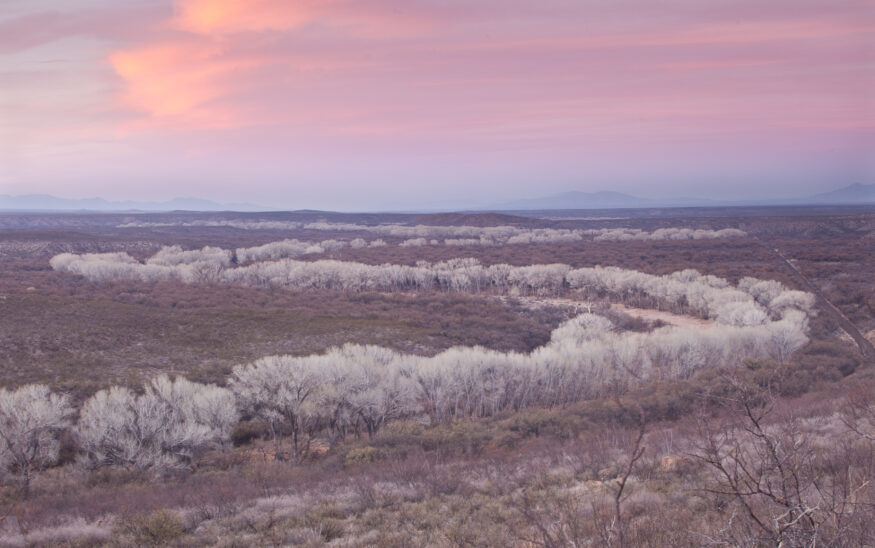
The San Pedro Riparian National Conservation Area contains nearly 57,000 acres of public land in Cochise County, Arizona, between the international border and St. David, Arizona. (Bob Wick / BLM California )
Appeals court declines to order state study of San Pedro River
Howard Fischer, Capitol Media Services//April 30, 2026//


Key Points:
-
Judges say law requires periodic groundwater studies, but doesn’t define how often
-
Lawsuit filed by biological diversity group claims area is going dry
-
Group official accuses governor of failing to act
Arizona judges won’t force the state to determine if there needs to be greater state oversight of water use along the upper San Pedro River — a move that could ultimately lead to a limit on groundwater pumping.
In a new ruling April 29, the state Court of Appeals acknowledged that Arizona law requires the Department of Water Resources to “periodically review” whether to create what are known as “active management areas” in parts of the state which now have minimal to no limits on the pumping of groundwater. Such a designation would give the state the power to impose new restrictions.
And the court did not dispute arguments by two environmental groups that it has been more than 20 years since the state agency conducted such a review of the San Pedro Basin.
But appellate Judge Kent Cattani, writing for the unanimous three-judge panel, pointed out that the Legislature, in crafting the law, never spelled out how often such reviews must be conducted. Nor did they define the term “periodically” in the state Groundwater Code.
“This phrasing thus leaves the department discretion to determine how frequently to conduct reviews,” Cattani wrote.
The ruling drew an angry reaction from Robin Silver, a co-founder and board member of the Center for Biological Diversity, one of the groups that filed suit.
“We understand why the court ruled,” he said, even if, as he contends, it is “laughable that ‘discretion’ is more than 20 years.”
But his harshest comments were reserved for Gov. Katie Hobbs who has oversight of the Department of Water Resources, even able to replace Tom Buschatzke, its director.
“Why would a governor who professes to care about water fight an active management area for an area whose central area is going dry and whose aquifer is over-allocated,” Silver asked. “The governor has made a choice to aggressively try to help the river die. That’s on her.”
He also said that Hobbs has sided with developers on other issues in the area, fighting efforts over whether there is sufficient water for a planned 7,000-home development in Sierra Vista.
“What has she done environmentally?” Silver asked. “She’s done absolutely nothing.”
There was no immediate response from the governor.
The 2024 lawsuit contends that the Department of Water Resources has failed to carry out its ‘mandatory duty” to conduct a review to determine if there needs to be some sort of state management to “preserve long-term, reliable groundwater supplies” in the San Pedro basin. And the lawsuit separately says that the governor, by failing to tell the agency to conduct a review, has violated her constitutional duty to “take care that the laws be faithfully executed.”
What a study would determine, the lawsuit says, is if the basin needs to be designated as an “active management area.”
The 1990 groundwater code initially set up four such AMAs in the Tucson, Pinal, Phoenix and Prescott areas. There are now eight, with one formed by a vote of residents of the Douglas area and the others designated by the Department of Water Resources based on studies about things like water use and potential water quality degradation.
In filing suit, the Center for Biological Diversity and the San Pedro Alliance said those conditions are present in the area. More to the point, they argued that the law requires the state to act.
Cattani, in the eight-page opinion, agreed that the San Pedro River, at the heart of the basin, is unique, being the last undamned, free-flowing river in the desert Southwest.
“It is an arid region, and groundwater is the sole source of water for inhabitants of the basin, which includes Sierra Vista, Benson, Bisbee, Tombstone, Huachuca City, and the Fort Huachuca Military Reservation,” he wrote. “Pubic and private water use over the past century has contributed to the degradation of the San Pedro River ecosystem and the alteration of the river’s flow.”
Cattani also pointed out that the basin includes the San Pedro Riparian National Conservation Area, designated by Congress in 1988 “to protect the riparian area and the aquatic, wildlife, archeological, paleontological, scientific, cultural, educational, and recreational resources of the public lands surrounding the San Pedro River.” And he noted that Congress reserved water “sufficient to fulfill the purposes” of the conservation area.
But none of that, the judge noted, entitles the challengers to what is known as “mandamus” relief, essentially a court order to compel a public official to perform an act that is specifically required by law.
The key to getting that legal relief, he said, is that the act that someone wants a court to enforce has to be purely “ministerial.” And that means the law specifically describes what the official must do and “nothing is left to the public official’s discretion.”
But Cattani said the law requiring the director of the Department of Water Resources to “periodically” conduct a review to look for areas to regulate hardly meets that test. And the key is the failure of lawmakers to define how often that has to occur.
“The Legislature did not specify a frequency for review under (the law), although it could have done so,” he wrote. “The omission of a fixed time period thus indicates that the Legislature did not intend to prescribe a particular frequency and instead left the matter to the department’s discretion.”
Challengers said that may be true. But they argued that the responsibility of the Department of Water Resources to control and supervise Arizona’s groundwater, coupled with worsening water conditions in the basin, means that the court should conclude that “periodically” in this case necessarily denotes something more frequent than what the agency has done — or not done for more than 20 years.
The appellate court was not convinced.
“Nothing in the statute requires the department to take into account area conditions before it decides whether to conduct a review to determine if conditions in the area meet the criteria for active management,” Cattani wrote. “And we may not read such a requirement into the statute.”
And there’s something else.
The judge noted that even if the Department of Water Resources won’t create a new active management area, that isn’t the only option. Cattani said the law allows the Legislature itself to do that — or even local voters, as happened in the Douglas area.