Sign In
Upcoming Event
 Free Newsletter

Request to Speak allows thousands to weigh in on Arizona law
Jordan Gerard, Arizona Capitol Times//January 3, 2026//
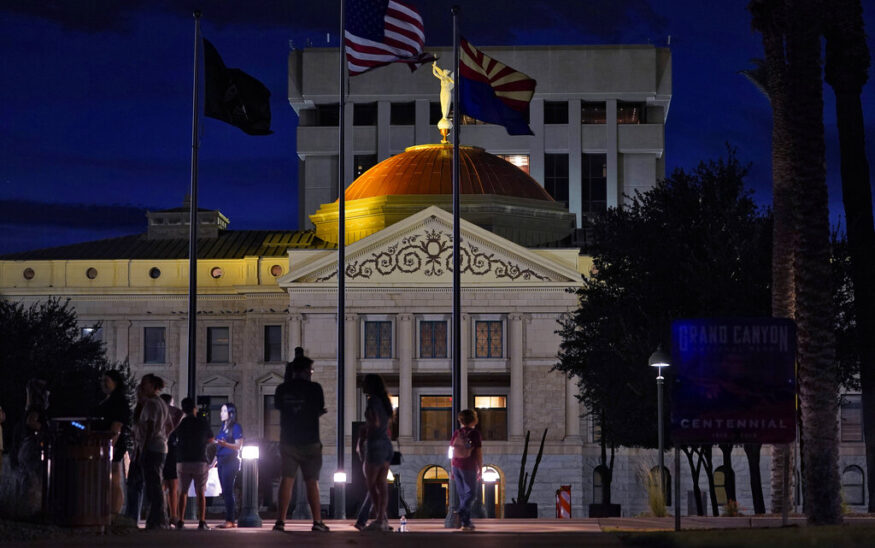
Protesters gather outside the Capitol to voice their dissent with an abortion ruling, Friday, Sept. 23, 2022, in Phoenix. (AP Photo/Matt York, File)
Request to Speak allows thousands to weigh in on Arizona law
Jordan Gerard, Arizona Capitol Times//January 3, 2026//


Key points:
- Arizona’s Request to Speak program has been modernized
- More than 110,000 user accounts have been created since 2015
- Program allows everyday people to weigh in on Arizona law
Ten years ago, Arizona modernized its Request to Speak program at the state capitol, allowing thousands of people to weigh in and address the Legislature.
Since 2015, a total of 110,807 user accounts have been created and 90,060 are active, the Arizona Capitol Times found after a data request. A total of 73,013 users made a Request to Speak or gave their position on proposed legislation in the last decade.
The system was digitized in 2015, replacing the paper slip method, in which people used to fill out a slip of paper, give it to the committee chair, and wait to speak. That system required them to be in person at the Capitol, which was often a disadvantage for Arizonans in rural communities. Now, people can file a position on a bill or sign up to speak during committee meetings from home, once their account is activated, in person at the state Capitol or at state offices in Tucson.
In 2015, a total of 7,334 users created accounts, and only 4,165 submitted a request to speak or filed a bill position. But both actions have increased over the last decade.
The most significant increase took place in 2021, when 16,136 users registered an account in a single year, during the height of the Covid pandemic. That was a jump from just 9,368 accounts created in 2020. Of the 16,000 people who created an account, slightly more than half (about 8,315) wanted to speak or filed a bill position.
Another jump in user accounts occurred in 2023, with 11,388 accounts created and 8,970 users creating a Request to Speak or filing a bill position. That was right after the 2022 midterm elections.
Users can choose to identify themselves as registered Arizona voters, but only a small percentage do so, according to the data. Over the past 10 years, just 8,923 users have verified they are registered Arizona voters. The accounts are not audited, said Kim Quintero, Senate Republican director of communications.
‘Gateway drug to activism’
Melinda Iyer, co-founder of Civic Engagement Beyond Voting, said the program is incredibly important to Arizonans because there’s an incredible amount of power in joined effort and collective impact. It’s also hard to look away once you see what’s happening at the Legislature, she added.
“We call it the gateway drug to activism,” she said. “I use the analogy that our voices are like drops of water on a rock. Individually, they don’t do much, but together, water is what carved the Grand Canyon.”
Many people looked for ways to get involved after the 2016 presidential election, so Iyer registered herself and, through social media, offered to register friends and others. She registered about 60 people the first time. Then she got together with future co-founder Catherine Sigmon, who was trying to do the same thing. They formed Civic Engagement Beyond Voting in January 2017 and, since then, have registered more than 20,000 people.
“Realizing that so much of politics actually happens on the state and local level and not the national level, we threw ourselves into a focus on this and began registering people for requests to speak,” she said.
While the system allows people to use it from home, the account still has to be activated at the state Capitol in Phoenix or at a kiosk in Tucson, located at 400 W. Congress Street, Suite 201. It still creates a disadvantage for Arizonans in rural communities who might not have a way to get to either location in person, but that’s where Civic Engagement Beyond Voting helps out, Iyer said.
People can fill out a form to have the organization create their account. Then, volunteers go to the Capitol to activate users’ accounts for the first time and instruct them to change their passwords.
Taking their efforts a step further, the co-founders offered bill summaries and training on how to use the Request to Speak program. Today, the nonprofit organization provides free training on just about anything government related, including media literacy, Arizona politics and history, Arizona’s judiciary system, ballot measures, boards and commissions and even local government.
They also created a conversation series where they invite speakers on various topics. During the legislative session, they host “Happy Hour,” a weekly call on Sunday afternoons that explains what happened over the past week at the Legislature and what will set the stage for the coming week. They also issue calls to action and help people understand how they can be involved. Iyer said she’s proud of what the organization has become.
“Everyday citizen involvement in our local government is so important and it’s the only way to ensure that government works for us,” she said.
The best way to make an impact is to understand the bills, lawmakers and positions, then contact your legislators, write a letter to the editor and testify before a committee, Iyer said, adding that layering your actions helps ensure your voice is heard.
The issue Iyer currently sees with the system is that regular citizens are rarely heard, while lobbyists are listened to more than everyday people. While many people sign up to speak and committee chairs have to keep meetings moving along, people often feel they are discarded, Iyer said.
“To the committee chairs, I would say it’s maybe tempting to try to streamline these meetings, but please don’t do that at the expense of everyday Arizonans who are looking to have an impact in how their state government works for them,” she said.
Just 5,007 of the registered users are lobbyists, but they are more often heard than regular everyday people, Iyer said.
And though perhaps some lawmakers do not want to hear the opinions of citizens, it’s incumbent upon them to hear their constituents’ opinions, Iyer added. “That’s the entire point of their job.”
People are also encouraged to verify their status as Arizona voters within the system, because it undermines the argument that Iyer has heard from more than one legislator – that there are bots in the system.
“These are not bots. These are real, everyday Arizona voters and registering your account, verifying it as a registered Arizona voter is a great way to prove that,” she said.