Sign In


 Free Newsletter

New Mesa and Surprise ordinances will increase electric bills and chance of power outages
Autumn Johnson, Guest Commentary//January 7, 2026//
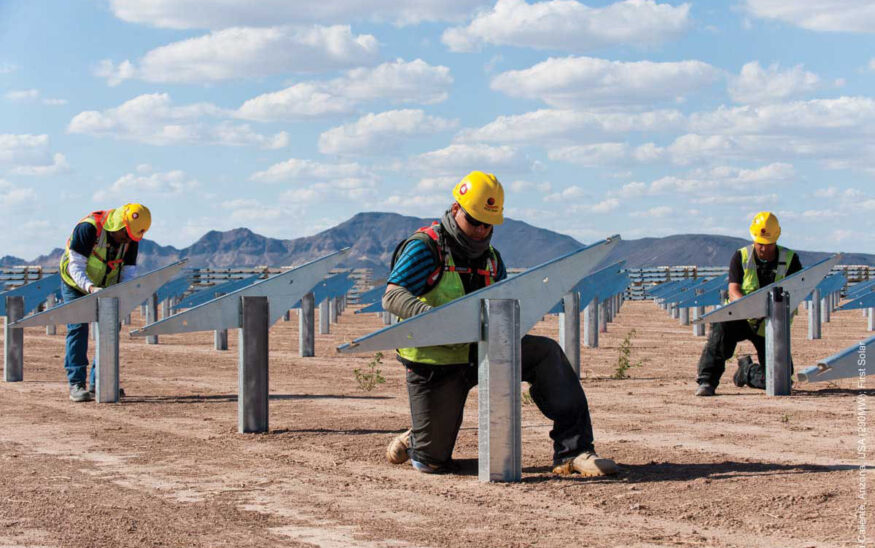
Workers install solar photovoltaic panels at the 290-megawatt Agua Caliente solar project in Arizona. (Photo courtesy of First Solar, via AP)
New Mesa and Surprise ordinances will increase electric bills and chance of power outages
Autumn Johnson, Guest Commentary//January 7, 2026//



Arizona is on the brink of a self-inflicted energy crisis.
Electricity demand is rising faster than at any point in decades, yet several cities and counties are advancing ordinances that make it harder, slower, and more expensive to build the resources our grid needs most. Mesa and Surprise are now considering sweeping restrictions on battery energy storage systems. Similar barriers to solar and storage have already appeared in Chino Valley, Eloy, Coolidge and Yavapai County.
Together, they send a dangerous message: Arizona is putting obstacles in front of its least-cost, fastest-to-deploy energy resources at exactly the moment we need them most. They will make power more expensive, the grid less reliable, and outages more common. In Arizona summers, that is not an abstract policy debate. It is a public-safety issue.
Solar and battery storage are now the lowest-cost sources of new electricity in the United States. Independent analyses such as Lazard’s Levelized Cost of Energy show that new utility-scale solar is cheaper than new gas, coal, or nuclear generation. Battery storage, which shifts electricity to evenings and emergencies, has fallen rapidly in cost and is now essential to grid reliability.
These resources are also fast. Solar and storage projects can be planned, permitted, and built far more quickly than traditional power plants or major transmission upgrades. That matters because Arizona utilities are already breaking peak-demand records. Population growth, electrification, data-center development, and extreme heat are driving sustained load growth across the state. Demand is rising whether we prepare for it or not.
Yet instead of streamlining the clean resources that can meet this demand quickly and affordably, local governments are layering on extreme setbacks, zoning barriers, and noise standards that are not grounded in engineering or national safety codes.
Mesa’s draft battery ordinance would impose what may be the largest setback requirement in Arizona. Surprise’s proposal goes even further, while failing to clearly exempt residential or small commercial systems. The result is uncertainty for everything from home backup batteries to systems that protect schools, hospitals, and businesses during outages.
These rules do not eliminate risk. They eliminate sites.
When viable sites disappear, competition disappears with them. Projects are pushed farther from where electricity is needed, require longer interconnection, and often become financially infeasible. Utilities still must meet demand, so they turn to higher-cost alternatives or delay projects altogether. Those costs ultimately show up on customers’ bills.
The result is predictable: higher electric rates and a grid with fewer tools to manage heat waves, storms, and equipment failures.
In Arizona, air conditioning is not a luxury. It is survival. Extreme heat already kills hundreds of people each year, particularly seniors, people with medical conditions, and families facing high energy bills. When electricity becomes more expensive or less reliable, the harm is not evenly distributed. Households that cannot afford rising bills or that lose power during heat waves are the ones who suffer most.
Local governments should be asking a simple question: does this ordinance improve safety without undermining affordability and reliability? In many cases, the answer is no. Modern battery systems are governed by national fire and electrical standards and are subject to detailed engineering and emergency-response requirements. Developers already conduct site-specific safety analysis. Arbitrary distances and blanket restrictions do not make projects safer. They make them rarer.
Arizona has long benefited from affordable energy as a foundation for economic growth. Undermining that advantage at the local level will ripple across the entire state. Electricity markets do not stop at city limits. When projects are blocked in one jurisdiction, the cost and reliability impacts are shared by everyone.
Mesa is scheduled to vote on its battery ordinance on January 12, and Surprise is moving quickly behind it. Residents who care about their power bills, grid reliability, and community safety should speak up now. Contact your city council members. Ask them to vote no on a storage ordinance with a 1,000-foot setback and to base energy policy on data, engineering, and statewide needs, not fear or arbitrary numbers.
Arizona does not have the luxury of slowing down its clean-energy transition. The resources being restricted today are the same ones that keep the lights on tomorrow. If we make them harder to build, we will all pay the price.
Autumn Johnson is the executive director of the Arizona Solar Energy Industries Association (AriSEIA).