Sign In
Upcoming Event
 Free Newsletter

Arizona Democrats divided over plan to ban corporate and billionaire contributions
Mary Jo Pitzl, Capitol Media Services//January 22, 2026//
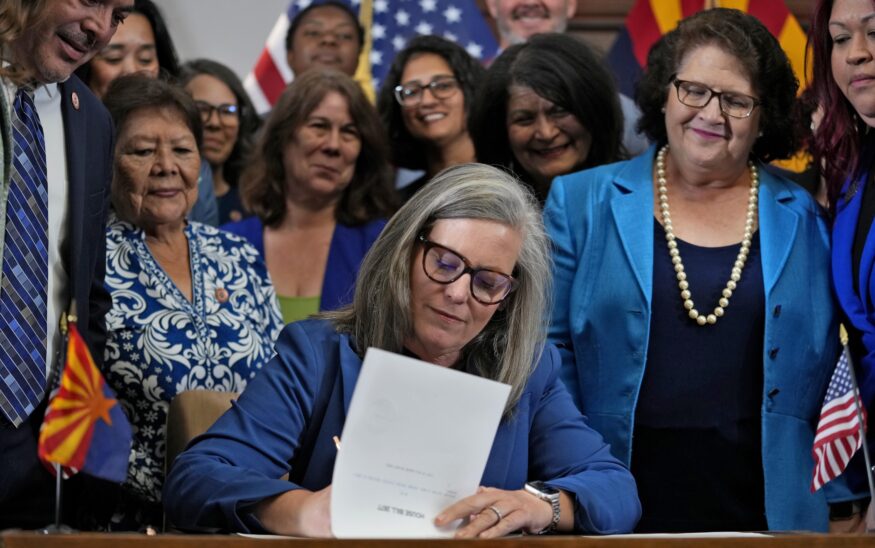
Arizona Gov. Katie Hobbs, flanked by Democrats, signs the repeal of the Civil War-era near-total abortion ban, Thursday, May 2, 2024, at the Capitol in Phoenix. (AP Photo/Matt York)
Arizona Democrats divided over plan to ban corporate and billionaire contributions
Mary Jo Pitzl, Capitol Media Services//January 22, 2026//


Key Points:
-
Arizona Democrats propose “People’s Primary” to bar big money in primary elections
-
The proposal would impose penalties on candidates who don’t reject outside spending
-
Arizona Democrats would be the first party to enact such a policy nationwide
Arizona Democrats want to bar corporate and billionaire contributions in their primary elections, an appealing idea that has been bogged down in the details as the August primary looms.
The proposed “People’s Primary” could set a national precedent and may come up for a vote at the party’s general meeting on Jan. 24.
But some Democrats worry the proposal, which would impose stiff penalties for candidates who don’t take the anti-big money pledge, would handicap Democratic candidates. Others, while supportive, say key details still need to be worked out.
Still others, such as Jeanne Lunn, a party committee chair, say the pledge is not the right solution to the admitted problem of big money in campaigns.
“I would love to get this unfair advantage out,” Lunn said of independent expenditures. “However, this is not the mechanism to do it.”
The pledge would put the burden on candidates to rebuff any ads that rich individuals and corporations might run to favor or disparage them.
There would be no limits on the donors. Instead, it would require the candidates targeted by that spending to decrease their own expenditures by half as much.
Potentially more significant, however, is that candidates could not ask or demand that others don’t spend on their behalf. That’s because state laws make it illegal for them to coordinate in any way with a committee making independent expenditures.
But proponents contend the idea has strong support and they’re intent on establishing the practice ahead of the Aug. 4 primary.
To bolster their pitch, they commissioned a poll that found 72% of Arizona Democrats back the idea, although the support slips to 65% when informed of the details, such as financial penalties for non-compliance and loss of party backing.
The survey by Public Policy Polling also indicated the Democrats would be viewed more favorably by enacting constraints on outside spending, although a majority of the 765 Arizona voters polled Dec. 12-13 said it wouldn’t make any difference in their party registration. The poll had a margin of error of plus or minus 3.5%.
“Voters are getting sick of this big-money corruption and it’s getting worse,” said Kai Newkirk, co-chair of the party’s Progressive Council. “As Democrats, we need to draw a clear contrast.”
That contrast, if enacted, would pertain only to the primary election, where the party has some sway over its candidates. But the restrictions would not apply to the general election. It would be suicidal to impose them, Newkirk has said.
“Any big donor who wants to help in the general election and join the anti-fascist coalition — they are welcome to,” Newkirk said.
Penalties for noncompliance
Candidates who take the “People’s Primary” pledge would agree to reject any outside spending greater than $5,000 from an independent expenditure committee on their campaign — whether that spending was supportive or critical of them. Failure to do so would trigger a requirement to give half of the amount spent by the outside group to a charity designated by the state party.
Candidates who reject the pledge would lose party support, including access to the all-important voter registration lists the party manages and to the party’s financial support.
The pledge is aimed at curbing the independent expenditures which have blossomed in the wake of the U.S. Supreme Court’s Citizens United case in 2010.
Devil in the details
Last June, Arizona Democrats supported the concept of creating the anti-big money policy, a first in the nation. But hammering out the details has been long and tedious and has resulted in compromises to get broad support.
For example, supporters are now pitching it as a pilot program for the 2026 primary. The policy would apply only in districts and jurisdictions with heavy Democratic registrations, leaving out critical swing districts where Democrats perennially hope to prevail.
It would not apply to statewide races, such as this year’s contests for governor, secretary of state and attorney general.
Newkirk said it was a concession to those worried about unintended consequences for the general election, such as limiting a candidate’s ability to build name ID and support. Besides, the state as a whole is not heavily Democratic, as the pilot program requires.
Former Attorney General Terry Goddard supports the policy. It aligns with the transparency requirements in Proposition 211, a ballot measure voters approved in 2022 to require disclosure of the key contributors to independent expenditure committees — a move that could curtail large-dollar donations.
Absent any federal legislation to rein in spending from independent expenditure committees, it makes sense to turn to the state party to impose its own restrictions, said Goddard, a Democrat.
“He’s got something here that should be a defining difference between Republicans and Democrats,” Goddard said of Newkirk’s efforts.
But there has been quiet opposition from some fundraisers, he said, as worries about “unilateral disarmament” persist.
Former state party chair Raquel Teran also supports the concept. It might have made a difference in her hotly contested 2024 primary contest against Yassamin Ansari for a congressional seat, where Ansari benefited from at least $1.3 million in independent expenditures from crypto companies.
The policy details need more work before being embedded in the party’s bylaws, Teran said. Making concessions, such as limiting the program to only heavy Democratic districts, makes sense.
“Until we end Citizens United, we can at least start with blue districts,” she said.
Meanwhile, Republicans are sitting back and shaking their heads.
Can candidates control donors?
Republican consultant Chris Baker said the policy is hypocritical, applying only to primaries but allowing the outside expenditures for the general election.
More importantly, it puts candidates in a bind, Baker said. It assumes candidates have control over independent expenditure committees, which by law must not have any coordination with the candidates they support or oppose.
“How do you go to a candidate who legally cannot coordinate with the big money and tell them you cannot coordinate with a campaign you have no control over?” he said.
Newkirk dismisses such arguments, contending candidates have ways of knowing who is working in their favor and therefore can call on them to stop their support.
Besides, he said, the current proposal would consider exceptions for candidates who are attacked in their primary campaigns by an independent expenditure committee.
He is hopeful the recent polling showing support for the primary pledge will move party leadership to bring it up for a vote. If that doesn’t happen, Newkirk said he has the necessary signatures to force a special meeting in the near future to consider the policy.
He pointed to a memo that Harvard University law professor Lawrence Lessig wrote in response to the Arizona Democrats’ policy.
“I think it is clear that a political party has the freedom, as an aspect of its associational rights, to identify the values that are central to it and to require candidates in the party to affirm those values,” Lessig wrote.
Lessig is a supporter of the policy, which draws on the example set by Massachusetts U.S. Senate candidates more than a decade ago. In 2012, Sen. Scott Brown, a Republican, and challenger Elizabeth Warren, a Democrat, each took the “People’s Pledge” to reject outside money, or suffer a financial penalty on their own campaign coffers.
While neither had to pay a penalty, there was still evidence that outside groups got involved in the race through activities such as direct mail.
Newkirk acknowledged that political players may find ways to work around the Arizona proposal, and those could be addressed down the road.
“We can’t solve everything with one stroke,” he said.
But the Democrats’ solution, if enacted, might not change much of anything.
“Big money’s not going away,” Baker, a veteran of GOP campaigns, said. “There’s too much at stake.”