Sign In
Upcoming Event
 Free Newsletter

Arizona Senate panel votes to limit police use of license plate readers
Howard Fischer, Capitol Media Services//February 11, 2026//
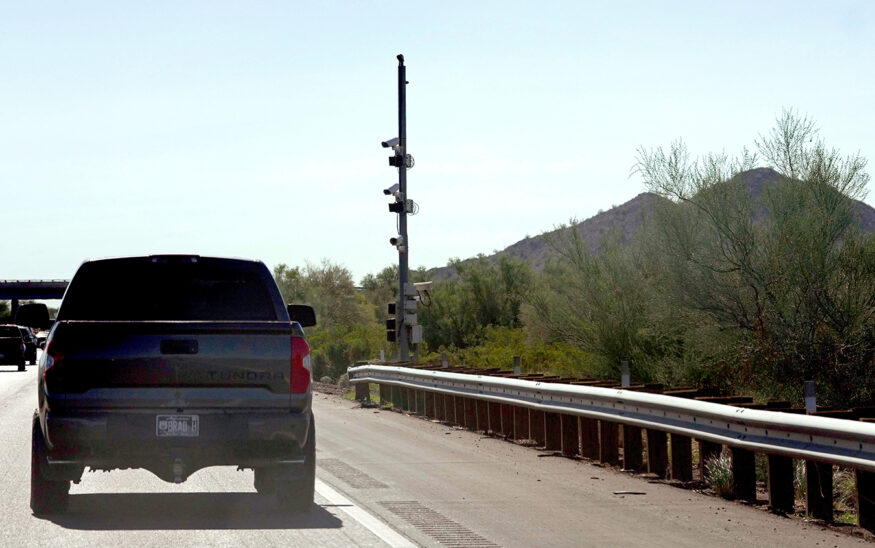
A license plate reader used by U.S. Border Patrol sits along Interstate 10, Tuesday, Oct. 21, 2025, in Sacaton, Ariz. (AP Photo/Ross D. Franklin)
Arizona Senate panel votes to limit police use of license plate readers
Howard Fischer, Capitol Media Services//February 11, 2026//


Key Points:
-
Senate panel votes to restrict police use of license plate readers
-
SB1111 sets storage and access requirements for license plate reader data
-
Police chiefs argue that license plate readers can help solve otherwise cold cases
A Senate panel has voted to impose the first-ever restraints on police use of license plate readers to locate and track people.
Senate Bill 1111 would put into law new requirements for how license plate data collected by law enforcement must be stored, who can access it, and what penalties there are for unlawful disclosure. And legislators acknowledged that, for the moment, police departments are already using all that and more — all without any guidance or limits other than those they impose on themselves.
Yet it is what is absent from the measure that worries opponents more.
Sen. Lauren Kuby, D-Tempe, pointed out that, as written, it does not allow people to access the information the police are collecting about them. Nor is there any limit on how long all that tracking information can be kept, allowing police to create a database on where people have been and where they go for months — if not longer.
“I’m having a hard time seeing where there’s actual guardrails,” Kuby said.
Consider, she said, reports that a law enforcement agency in Texas tapped into a network of 83,000 license plate readers owned by Flock Safety, a company that contracts with local police, to try to track down a woman who was trying to get an abortion and had fled to another state where the procedure is legal.
And that’s not all.
“There’s a string of scandals over data being accessed by immigration authorities racing to fulfill Donald Trump’s deportation agenda,” Kuby said. “Why not safeguards that would prohibit that from being used by ICE or being used by anti-abortion states to track women who are coming to Arizona for a lawful abortion.”
Senate Majority Leader John Kavanagh, a former police officer, was not sympathetic to Kuby’s ideas and took particular exception to restricting local police from sharing their databases with ICE.
“When you say ‘protections,’ would you also protect illegal immigrants who have criminal warrants on them?” the Fountain Hills Republican asked.
But it was Sen. Mark Finchem, another former police officer, who pointed out the difficult decision facing his colleagues who are not happy with the level of restrictions being proposed: There are currently no laws at all limiting how police can deploy the fixed and mobile readers, how long they can keep the tracking data, and with whom they can share that.
“This is something, setting up guardrails and standards for something that’s already out of the barn,” said the Prescott Republican.
“It’s the Wild West,” Kuby conceded.
Paul Avelar, an attorney with the Institute for Justice, did not dispute any of that. But he said that shouldn’t force lawmakers to accept a plan proposed by police chiefs and sheriffs from around the state, simply because it might be better than nothing.
The problem, he said, starts with the fact that these automated license plate reader cameras are indiscriminate, noticing — and recording — everything that they see.
Consider, he said, a lawsuit brought by the Institute for Justice against the city of Norfolk, Va., over cameras that recorded the locations of multiple residents multiple times, often on the same day.
“The city effectively built a virtual police force of cameras operating silently all the time,” Avelar told lawmakers.
“That’s not routine law enforcement,” he said. “It is mass surveillance and it is unconstitutional.”
Avelar later conceded that the lawsuit was thrown out but remains on appeal.
Several police chiefs and officers told lawmakers how the cameras can help solve crimes that might otherwise go unresolved.
One involved someone in a truck stolen from Flagstaff that was driven through Sedona.
But it was stopped only in Cottonwood, a city with license plate readers that alerted police to the stolen vehicle. And the result was not just the recovery of the truck but also an underage girl who said she had been kidnapped.
Finchem also dismissed the idea that there should be some hard-and-fast deadline by which police would have to erase the records and information gathered with the cameras.
He said there is national data saying that it takes anywhere from 61 to 326 days to close out an investigation of a missing child. And that’s just part of the problem.
“Sometimes you don’t even know the person is missing for weeks, until somebody reports them missing,” Finchem said. He said police need to be able to access the records for as long as needed — though he indicated a 90-day limit might be acceptable.
And there’s something else.
Kavanagh said many people who are concerned about being tracked and about what information is being gathered think nothing of signing up for an “affinity” card at a grocery chain. Using that identification allows customers to get discounts and other specials.
“People go into supermarkets to get a couple of bucks off their grocery bill and enter their phone number and let the store know how much alcohol they buy, how much beer they buy, what nonprescription medicines they buy,” Kavanagh said. “People go on Amazon and they know everything you’re buying, even more personal on that thing, no one cares about that.”
And consider not just phones that can be tracked but even someone’s computer location if they don’t protect themselves with a “virtual private network.”
“This is like virtually nothing in the overall scale,” he said of the use of license plate cameras.
“It doesn’t mean we shouldn’t put reasonable safeguards around it,” Kavanagh said. But if the bill dies, that means “no limits, everything goes.”
There will likely be negotiations among the various interests to see if a deal can be crafted before the measure goes to the full Senate.