Sign In
 Free Newsletter

Arizona seeks fair share of Colorado River water in negotiations with upper basin states
Bob Christie, Associated Press//January 31, 2026//
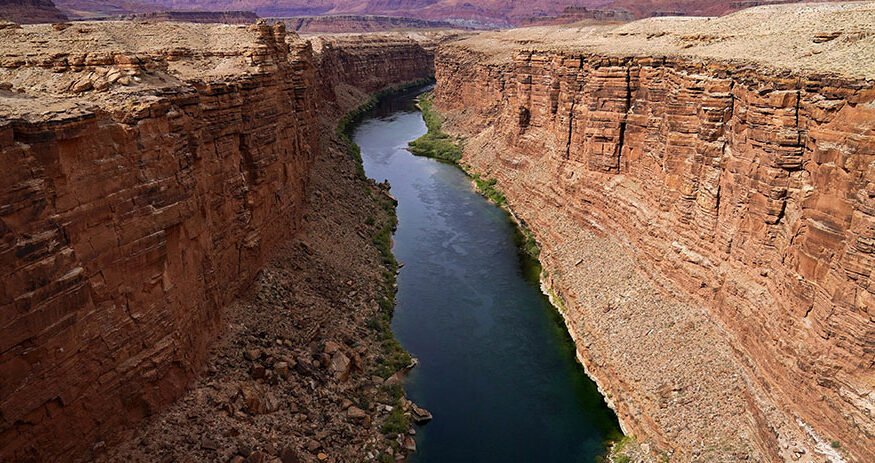
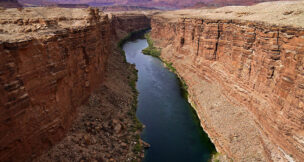
The Colorado River in the upper River Basin is pictured in Lees Ferry, Ariz., on May 29, 2021. (AP Photo/Ross D. Franklin)
Arizona seeks fair share of Colorado River water in negotiations with upper basin states
Bob Christie, Associated Press//January 31, 2026//


Key points:
-
Arizona Governor Katie Hobbs in Washington to make case for Colorado River cuts
-
Seven states missed November deadline for new agreement on river’s water allocation
-
Arizona has conserved nearly 9 million acre-feet of water over 15 years
Gov. Katie Hobbs and the state’s chief water official head to Washington to make their case to a top official in the Trump administration and other governors that Arizona already has taken major cuts in its Colorado River supply even while Upper Basin states like Colorado have taken none.
The meetings with Interior Secretary Doug Burgum come as the seven states that use the river have blown past a November deadline set by the Interior Department to reach a new agreement on how to split the river’s flow, which is a lifeline for all of them. The river supports 40 million residents and farms that grow the bulk of the nation’s winter produce, much of that in Arizona.
The U.S. Bureau of Reclamation has set a new date of Feb. 14 for the states to reach a deal on how to operate lakes Mead and Powell after this year or it will step in. Both Arizona and Colorado are gearing up for litigation if necessary.
Hobbs, in an extensive statement to Capitol Media Services, said the meetings come “at a pivotal moment” for the Colorado River, that “the status quo is not sustainable” and “the stakes couldn’t be higher.”
“I am going to Washington because I believe a path forward is still possible,” Hobbs said.
“I appreciate Secretary Burgum convening Basin state governors for this conversation after my calls for stronger federal engagement,” the governor continued. “That level of leadership is necessary, overdue, and essential if we are going to break the logjam and reach a durable agreement.”
The big sticking point is the four Upper Basin states’ refusal to take any cuts in their supply, despite Arizona, California and Nevada taking cuts in recent years as the river’s flow diminished, Department of Water Resources Director Tom Buschatzke said this week. He said the Lower Basin states are sticking together.
“The Upper Basin wants us in the Lower Basin to take 2.1 million acre feet of cuts before they put anything real on the table, and then they want the ratio to be two units of Lower Basin cuts to 1 (unit) of Upper Basin cuts,” Buschatzke told the House Committee on Natural Resources, Water and Energy. Lower Basin states want a 1:1 ratio.
Upper Basin states are arguing that they’ve never taken their full allocation, that Lower Basin states should be on the hook for evaporation losses, and that they should count Arizona tributary rivers as part of their allocation, he said. That’s despite a 1963 U.S. Supreme Court decision that said evaporation and Arizona tributaries do not count under the 1928 Boulder Canyon Project Act, which created what is now the Hoover Dam.
Buschatzke expects the Arizona delegation headed to Washington — backed by both Republicans and Democrats in the Legislature — to stick to their guns and argue that Arizona has already taken more than its fair share of cuts. He’s going along with Hobbs.
Hobbs took a similar tack.
“Arizona is a leader in common sense water conservation policies and we are at the table and ready to compromise, but every state that relies on the Colorado River must share in its protection, not the Lower Basin alone,” she said. “I will not accept a deal that endangers the advanced manufacturing and agricultural economy that is vital to our country’s national security or shortchanges Arizona farmers, businesses, and families.”
The state is currently losing more than 500,000 acre-feet of water per year from its 2.8 million acre-feet allocation. Most of those cuts are coming out of Central Arizona agriculture and underground storage programs. An acre-foot is generally enough water to supply three households.
The original 1922 deal between the states, known as the Colorado River Compact, allocated 7.5 million acre-feet each to the upper and lower basin states and 1.5 million acre-feet to Mexico.
Drought has cut the river’s flow, and Arizona and the other Lower Basin states have conserved nearly 9 million acre-feet of water over the past decade and a half to keep Lake Mead’s water levels from dropping so low that no water flows past the Hoover Dam. Nearly 3 million acre feet of that has come in the past three years alone.
“We would be in a tremendous crisis situation right now if we had not done all of this conservation,” Butchatzke told the panel.
Nearly half of the water that Lower Basin states have given up to prop up Lake Mead since 2014 has come from Arizona, even though Arizona is entitled to less than 17% of the 16.5 million acre-feet the current compact allocates among the seven states and Mexico.
“So we have’ done the heavy lifting,” Buschatzke said. “We’ve done the heavy lifting for the last decade plus.”
Arizona must take cuts first because it has the lowest priority under the 1968 deal that authorized the Central Arizona Project, which brings Colorado River water to Phoenix and Tucson.
Buschatzke said the demands from the Upper Basin states of Colorado, Utah, New Mexico, and Wyoming that they be held harmless while Lower Basin states take all the cuts are what’s holding up a new deal.
And he points to reservoirs in those states that are at relatively high levels compared with lakes Powell and Mead, and argues that water should be allowed to flow downstream to the Lower Basin states.
“I believe it’s a pretty tough thing for the state of Arizona to ask our people to take cuts based on the elevations in the volume of water in Lake Powell alone,” he said. “One of our big points of negotiation is that a substantial amount of water from these reservoirs above Lake Powell has to move to Lake Powell and then move down to Lake Mead so that we can access it.
“There are legal arguments that both sides are making about the purposes of these reservoirs when they were authorized in 1956 in a federal Colorado River Storage Project Act,” he said. “We believe not only is that water designated for movement down into Lake Mead, into the Lower Basin, but that the federal government has an affirmative obligation under that law to do so.”
Upper Basin states – amplified in recent comments by Colorado’s attorney general — say Lower Basin states are overusing their water, Butchatzke said. They point to the evaporation and Arizona rivers that don’t count towards the state’s Colorado River allocation.
That’s not Buschatzke’s view.
In 2014, Lower Basin states received about their full allocation, 7.5 million acre-feet, he said. In 2024, they got 6 million acre-feet, and just 5 million the year before.
“Remember, we get to use seven and a half million acre feet of consumptive use,” he said of the Lower Basin states.
Hobbs pointed to Arizona’s leadership in the data center technology sector, its massive new microchip plants, and its major role in feeding the nation leafy greens in the winter.
“By striking a deal that protects Arizona’s fair share of Colorado River water, we can continue to onshore critical supply chains and ensure our country’s strength for the next 100 years,” she said. “I look forward to making these points to Secretary Burgum and my fellow governors, and highlighting what is at stake in Colorado River negotiations for the people of Arizona and our country.”