Sign In


 Free Newsletter

Historic neighborhoods fear demolition, seek protection from development under new law
Jakob Thorington, Arizona Capitol Times//February 27, 2026//
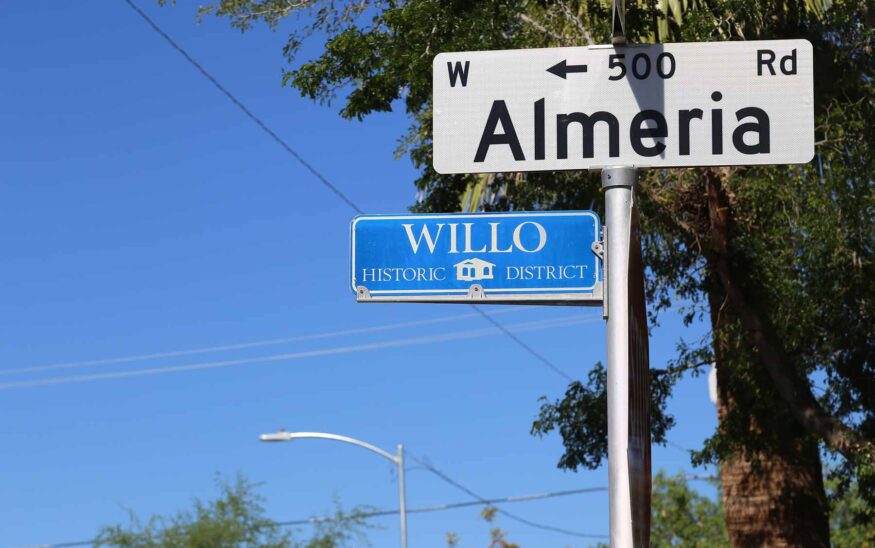
Signage at an intersection in the historic Willo Historic District in Phoenix. (Jakob Thorington / Arizona Capitol Times)
Historic neighborhoods fear demolition, seek protection from development under new law
Jakob Thorington, Arizona Capitol Times//February 27, 2026//


Key Points:
-
Bill could give historic neighborhoods protection from demolition
-
Measure has generated mixed bipartisan support and opposition
-
Residents worry their neighborhoods could lose historic designation from new middle housing law
A recently enacted state law allowing the development of higher density housing options in downtown areas could see some changes this year given a newfound momentum to protect historic neighborhoods.
The House Government Committee earlier passed House Bill 2375 4-3, a bipartisan measure requiring middle housing in historic areas to be compatible with the character, scale and setting of historic neighborhoods.
The bill is a response to the state’s middle housing law from 2024, House Bill 2721, which requires cities with a population of 75,000 or more to allow the development of duplexes, triplexes, fourplexes and townhomes within one mile of a city’s central business district.
Since then, residents in historic neighborhoods have been seeking protections from any potential new developments they claim could harm their protected status. And so far, the only real action to aid that effort has been from a Democrat-sponsored bill by Rep. Aaron Marquez, D-Phoenix, which went unheard.
After the 2025 session, the Willo Historic Neighborhood in central Phoenix announced it was hiring a lobbyist to help its efforts to get a historic neighborhood protection bill passed at the Legislature. Since then, Rep. Matt Gress, R-Phoenix, has picked up HB2375 as a primary sponsor.
“These are prizes of history that we should be seeking to protect,” Gress said. “(The middle housing law) isn’t about affordable housing. You’re going to buy a parcel in Willo and it’s a million dollars and then the developer is not going to create affordable housing out of that million dollar acquisition. They’re going to create luxury townhomes and condos to increase the profitability of that parcel.”
A historic district must have at least 51% of its buildings designated as contributing structures or buildings with the area’s historic architecture. Residents in these neighborhoods are worried that the state’s middle housing law will lead to enough historic homes being demolished to lose the designation.
“You can grow without sacrificing the small number of historic neighborhoods that define its character,” said Mary Crozier, president of the North Central Phoenix Homeowners Association. “Growth should be thoughtful, not destructive.”
But it’s not all about history.
Losing a historic designation would result in the homeowners of those properties losing a tax break supported by the designation — a break Crozier said historic homeowners receive to cover the higher costs associated with maintenance.
For instance, one property in the Willo neighborhood, valued at $1.5 million on Zillow, has a 5% assessment ratio with the Maricopa County Assessor’s Office, and is designated as a historic noncommercial property. The assessor has assessed a $33,000 property value from its limited property value of $675,000. Because the property has a historical designation, its assessment ratio is 5% rather than the 10% that’s assessed to most homeowners in non-historic neighborhoods.
Historic homeowners in Phoenix can also apply for grants through the city’s Exterior Rehabilitation Grant Program, which reimburses homeowners on a 50-50 matching basis for pre-approved work between $5,000 and $20,000.
“Many property owners in historic districts already benefit from substantial tax advantages unavailable to other homeowners — including, in some cases, property assessment ratios that are half what non-historic owners pay,” the conservative Goldwater Institute wrote in a letter to the city of Phoenix in November when it was considering its middle housing ordinance.
While HB2375 has a Republican sponsor and bipartisan support, it also has bipartisan opposition. Reps. Rachel Keshel, R-Tucson; John Gillette, R-Kingman; and Betty Villegas, D-Tucson, all voted against the measure in the House Government Committee.
“I’m not sure of a protection for certain groups of people who are pushing the middle housing on everyone else while trying to exempt themselves from it — that doesn’t sit well with me,” Keshel said.
Villegas, the ranking Democrat on the Government Committee, offered an amendment that would allow cities to adopt objective criteria that prohibits demolishing a neighborhood’s contributing historical structures, but she said she wouldn’t support a bill that gives blanket exemptions to the middle housing law for historic districts.
“The middle housing bill was passed in a bipartisan fashion two years ago to work on housing solutions and we should not forget that,” Villegas said. “Preservation was never meant to be a tool to exclude. It was meant to protect history, culture and architectural integrity.”
Rep. Sarah Liguori, D-Phoenix, represents Willo and central Phoenix with Marquez. Liguori has sponsored an alternative bill in House Bill 4074. Her measure didn’t get a committee hearing, but it would complement Villegas’ amendment by increasing the civil penalty against someone who improperly demolishes a historic property to $5,000.
Some residents in central Phoenix’s historic neighborhoods have expressed disappointment that Liguori, like their other two legislators, Marquez and Sen. Lela Alston, D-Phoenix, has not been able to secure passage of the bill. Both Marquez and Alston are cosponsors of Gress’ bill.
Willo resident Rebecca Masterson said she didn’t believe Liguori’s bill was enough of a deterrent to potential developers who could make more than a $1 million with a Willo parcel.
“There’s no criminal penalty. The financial penalty is nominal and I just don’t think the (law) supports affordable housing,” Masterson said.
Liguori told the Arizona Capitol Times she has language for amendments that would add civil penalties and believes a $5,000 fine is not insignificant. She said she’s trying to find a solution that addresses residents’ concerns about mass demolition while avoiding a blanket exemption.
Some cities like Flagstaff and Tucson have adopted middle housing ordinances that extend through their entire boundaries rather than just the central business district as required by law. Liguori said she would support extending the law to cover a city’s entire jurisdiction.
“I don’t want to see historic neighborhoods go away. Middle housing that’s built in our historic neighborhoods I think should be something that other neighborhoods should be able to experience,” Liguori said. “What middle housing does is help incrementally build in these spaces and give homeowners more flexibility.”
Rep. Stephanie Stahl Hamilton, D-Tucson, expressed some reluctance with her “aye” vote in committee and said she voted to pass the bill to help get it out of committee. She said she believed zoning should stay at the municipal level.
“It has placed some of us in the crosshairs of groups who wield a lot of that power,” Stahl Hamilton said.