Sign In
Upcoming Event
 Free Newsletter

Hobbs vetoes state contract transparency measure amid GOP ‘pay-to-play’ allegations
Howard Fischer, Capitol Media Services//June 23, 2026//
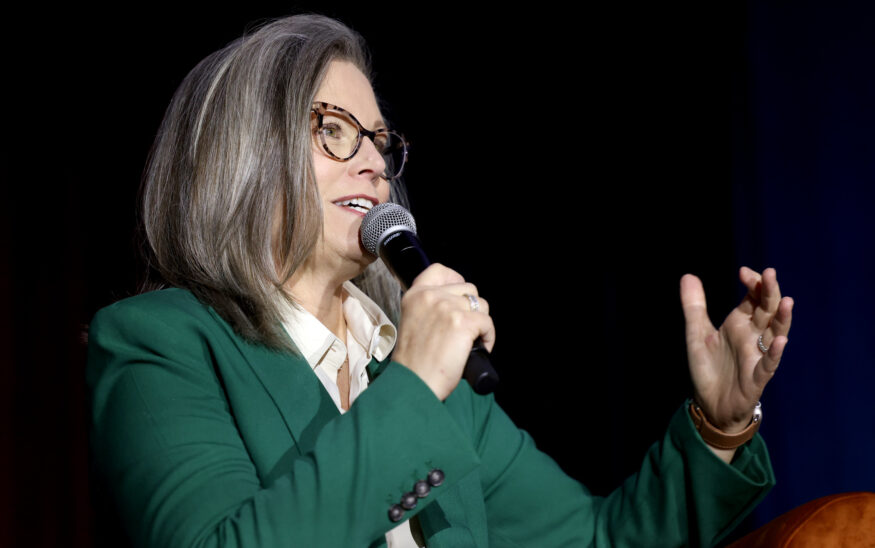
Gov. Katie Hobbs speaking with attendees at the 2026 Legislative Forecast Luncheon hosted by the Arizona Chamber of Commerce & Industry at the Phoenix Convention Center in Phoenix, Arizona. (Gage Skidmore / Flickr)
Hobbs vetoes state contract transparency measure amid GOP ‘pay-to-play’ allegations
Howard Fischer, Capitol Media Services//June 23, 2026//


Key Points:
-
Gov. Katie Hobbs vetoes financial disclosure measure
-
Measure would have required companies to disclose donations to governor and her allies
-
Hobbs’ veto leaves gaps in laws on contractor donations and transparency
Calling it a “political stunt,” Gov. Katie Hobbs has quashed a financial disclosure measure that was inspired by a state contract controversy within her Department of Child Safety.
The measure crafted by Sen. T.J. Shope would have required any company bidding on state contracts to immediately disclose any donations made to the governor, any campaign committees or inaugural funds, and any entity that “advocates for the election of the governor or for the defeat of an electoral opponent of the governor.” That requirement would extend to a company’s officers, directors and their family members, covering donations made in the prior five years..
The Coolidge Republican first introduced the measure last year after a public disclosure statement proved that Sunshine Residential, which provides group homes to children in the state’s foster care system, had donated $400,000 to Hobbs and the Arizona Democratic Party. It was later awarded a more than 60% increase for the same services — a rate that ultimately climbed from $140 to $234 per bed.
That led to ongoing investigations of what Shope has called a “pay-to-play” scheme by both Attorney General Kris Mayes and Maricopa County Attorney Rachel Mitchell.
The governor made no reference to any of that in her veto message.
“This proposal is a political stunt that applies only to one elected official,” the governor wrote in her veto message. “What we really need is real transparency and accountability for all elected officials, campaigns, and affiliated political committees.”
Shope, for his part, told Capitol Media Services that it is the governor who is playing politics.
The proof, he said, was that the governor, with the help of Senate Minority Leader Priya Sundareshan, sought to add new restrictions about donations from those bidding on state contracts — restrictions that would apply not just to state officials but to lawmakers.
“The Legislature, in and of itself, is not involved in procurement,” Shope said. He said decisions on who gets a contract, the terms of the contract and any amendments are strictly within the purview of the Governor’s Office and the department heads who report to her, making any proposals to add verbiage on donations to legislators a diversion.
Even so, Shope said the veto accomplished something.
The veto, he argued, puts the pay-to-play issue squarely before voters in November.
“It is now truly the proverbial political football in the sense that the voters will get their opportunity to weigh in in November,” Shope said.
Hobbs has been on the political defensive since it was first revealed that Sunshine Residential gave $100,000 to her 2023 inaugural fund. Close to $1.7 million was raised for the event, and everything not spent on the fundraiser can legally be used for political purposes, including Hobbs’ efforts to elect Democrats.
It ultimately turned out that Sunshine, owned by Paradise Valley businessman Simon Kottoor, also gave $300,000 to the Arizona Democratic Party.
All this came as the state was deciding whether to increase the amount of money the Department of Child Safety, run at the time by David Lujan, a Hobbs appointee, was paying Sunshine for out-of-home cases for foster children.
An agency spokesman said Sunshine’s initial bid for more money in 2023 was rejected.
Agency spokesman Darren DaRonco said Sunshine threatened to shift beds to house federal immigrant children unless it received more funding — a move that would have reduced placements for Arizona foster children. DCS agreed, raising the rate from $140 to $195 per bed, then later $234 under a new contract.
Hobbs had already vetoed Shope’s first disclosure bill in 2025, but said earlier this year she would consider the issue if the approach were more comprehensive — including a blanket ban on registered lobbyists covering food, beverages, lodging and speaking engagements for state officials, employees and legislators.
Gubernatorial spokesman Christian Slater said Hobbs agreed to scrap that language after Shope showed no interest in including such a blanket ban in contract disclosure legislation.
But he also acknowledged that Shope is not alone among lawmakers in having no particular desire to cut off lobbyist largesse: Not a single Democrat, including Sundareshan, offered a similar proposal this session.
Sundareshan said there may be a time to discuss such a ban. But not now.
Sundareshan, who noted she relies on her $24,000 lawmaker salary, said she finds herself attending lobbyist receptions to help offset expenses — something, she said, a salary hike approved by voters could change.
Still, she was willing to vote for Shope’s original plan for that five-year lookback disclosure — with some additions.
Most significantly, she wants to outright bar any contribution, gift or other item worth more than $50 to any candidate for legislative or statewide office or political action committee from anyone connected with a bidder from the time a bid is submitted through 90 days after the award of a contract. That, said Slater, is far more comprehensive than simple disclosure.
Shope, however, got the Republican-controlled Senate to reject Sundareshan’s addition.
“I look forward to chatting with the sponsor at a future date,” he said. But Shope conceded he never contacted Sundareshan, instead sticking with his original plan which got through the House — unamended — and sent to the governor where he acknowledged it would be rejected.
So, knowing that his plan was headed for yet another veto, why didn’t he reach out?
“I think that that’s a fair question,” Shope acknowledged Monday. But he said that Sundareshan’s amendment “was also equally a political statement” and not an honest effort to come up with an acceptable plan.
The veto leaves intact the gaps in disclosure law that allowed the Sunshine contract increase to go largely unscrutinized — and hands voters a live issue heading into November.