Sign In
Upcoming Event
 Free Newsletter

Hobbs sees bipartisan budget, tax cuts as her election-year legacy
Reagan Priest, Arizona Capitol Times//July 10, 2026//
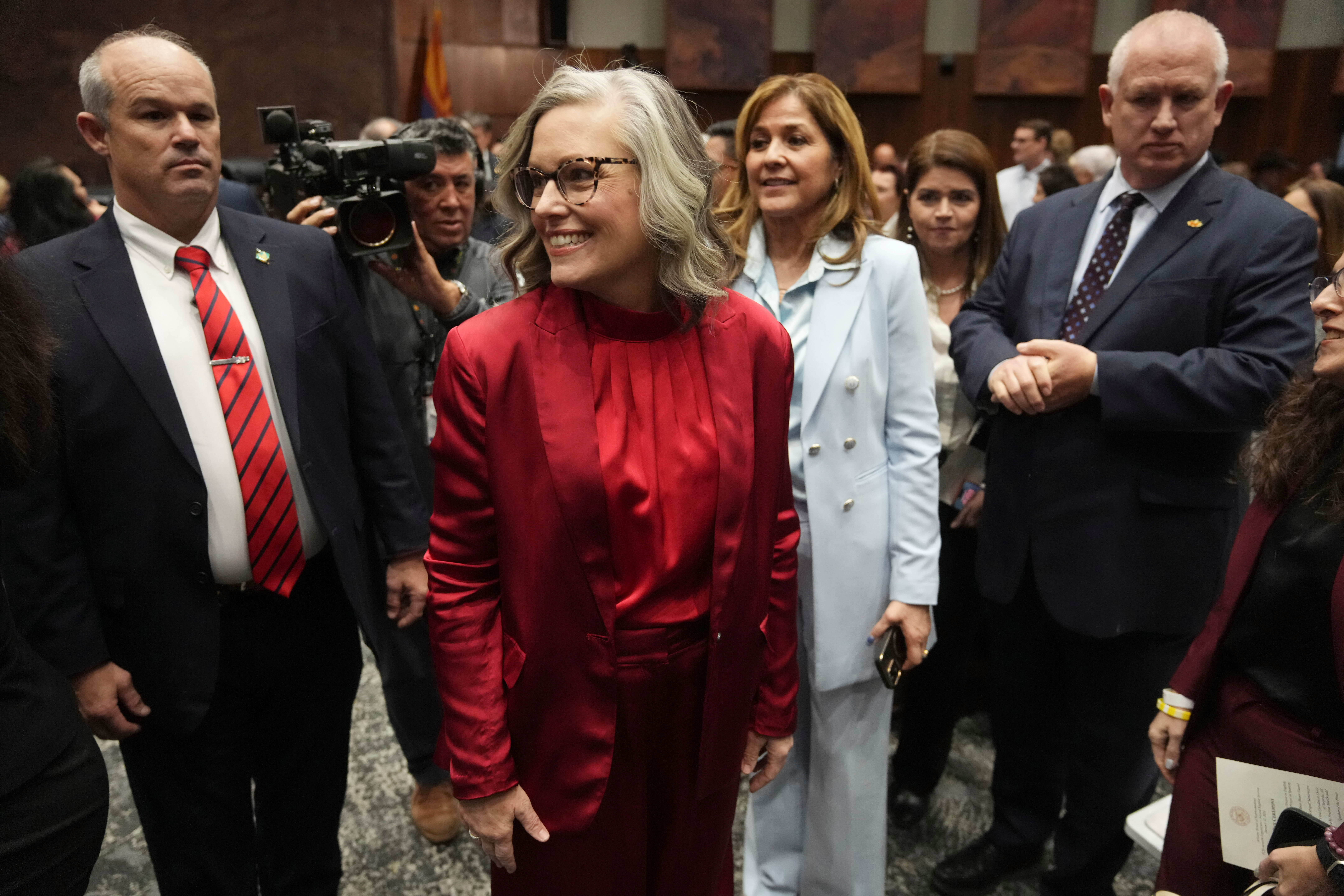
Arizona Democratic Gov. Katie Hobbs smiles as she leaves the House of Representatives at the Capitol after giving her State of the State address, Monday, Jan. 12, 2026, in Phoenix. (AP Photo/Ross D. Franklin)
Hobbs sees bipartisan budget, tax cuts as her election-year legacy
Reagan Priest, Arizona Capitol Times//July 10, 2026//


Key Points:
-
Gov. Katie Hobbs is already campaigning on $1.4 billion tax cut from bipartisan budget
-
She managed to secure a data center tax moratorium and avoid setting a new veto record
-
The governor will now set her sights on the Nov. 3 election in which she hopes to be reelected
For Gov. Katie Hobbs, the fourth and final legislative session of her first term in office serves as a model for how Arizona’s divided government forces state leaders to work across the aisle and compromise.
“I think the election year politics were a little more challenging this year, but at the end of the day we got the right thing done,” Hobbs, a Democrat, told the Arizona Capitol Times while sitting in her office on the Ninth Floor of the Executive Tower on June 30.
She is hoping voters will grant her another term in that office on Nov. 3, a date she swears to reporters she is not thinking about even as Republicans in the Legislature did their best to prevent her from coming away from the session with wins she could tout to voters.
“What’s going to happen in the general election? I’m not focused on that right now,” Hobbs said during a press conference on July 7.
Nevertheless, Hobbs is already campaigning on the $18.3 billion budget she signed in June after it passed out of both chambers of the Legislature with bipartisan support. Her campaign hopes the successes of this session will bolster the governor’s image as a pragmatist who works alongside Republicans to craft moderate, common sense legislation and state budgets.
Hobbs said her proudest accomplishment of the session was the budget, which will cut taxes for Arizonans by $1.4 billion over four years. The tax package included elements of a proposal the Governor’s Office dubbed the “Middle Class Tax Cuts,” but which contained only cuts imposed federally by President Donald Trump’s “One Big Beautiful Bill.”
In addition to provisions eliminating taxes on tips and overtime and increasing the standard deduction, the budget also featured a Republican proposal increasing the child tax credit and adding a credit for child care.
“This (budget) had the most support on both sides of the aisle and delivered a huge win for Arizonans with the tax cut,” Hobbs said.
Republicans have lambasted the governor for taking credit for the tax cuts, which she did at a June 23 press conference featuring three signs celebrating “Hobbs’ $1.4 billion Middle Class Tax Cut.” They found it especially confounding considering Hobbs vetoed three similar tax conformity proposals before signing a budget that fully conformed the state’s tax code to the federal cuts — making Arizona the first state in the nation to do so.
Hobbs does not see that as a contradiction. The governor and her staff were careful to note throughout the session that she would support full federal tax conformity if the Legislature could demonstrate a responsible way to pay for it during budget negotiations.
And if you ask the governor, the bill moratorium she instituted in April — effectively grinding the Legislature’s work to a halt for a month — only helped bring the tax conformity plan to fruition by delaying negotiations until updated May revenue estimates demonstrated the state could afford it without shortchanging other spending areas like education.
“Ultimately, the last revenue report that came out right before we finalized the budget was really helpful in making sure that we could keep schools whole … and that was to me the biggest priority,” Hobbs said.
But that brings the governor to what she sees as the biggest missed opportunity of the last four legislative sessions: the Legislature’s failure to renew the education funding mechanism known as Proposition 123. Originally passed in 2013, Prop. 123 allowed Arizona to make a 6.9% annual withdrawal from the state land trust to fund public education before it expired in 2025.
“It is still a priority for me to fight for a Prop. 123 renewal,” Hobbs said on July 7. “I don’t think that conversation is off the table.”
And while the governor may not have influenced the tax conformity plan, she did secure a data center tax moratorium that few thought could be possible and that Republicans have also attempted to take credit for. For the next three years, Arizona will not grant new tax incentives to data center developers, a move Hobbs’ office says will save the state $57 million while it evaluates the industry’s impact on water and energy supplies.
Congressman Andy Biggs, the frontrunner in the Republican race to unseat Hobbs in November, attempted to attribute the data center tax moratorium to GOP leaders in the Legislature. However, the Republican majority largely opposed any adjustment to the incentives, which take $38.5 million in potential revenue away from the state’s coffers annually.
The governor also signed 264 pieces of legislation into law this year, almost beating her 2025 record of 265 bills signed in one session. Hobbs has signed 993 bills in her four years as governor and vetoed 541.
Perhaps most importantly, Hobbs did not set a new veto record this session after previously setting two new records in 2023 and 2024. She vetoed 151 bills this year, surpassing her 2023 record of 143 bills, but falling short of her 2024 record of 174 bills.
That gives Republicans a bit less fodder to use against her in the upcoming election. She has previously accused GOP lawmakers of intentionally running up the score on her veto record by sending her bills she has already rejected.
An Arizona Capitol Times analysis shows 90 of the governor’s 541 vetoes came from bills that Hobbs rejected twice or even three times in the past four years.
“I don’t know how many veto letters we issued that said, ‘when I vetoed this last year…’” Hobbs said. “It just shows there was no interest in working with us to get whatever they were doing to a place where it was workable or actually solved a problem. It was just people trying to make political statements.”
The governor also did not shy away from signing bills members of her own party protested, a habit she has kept throughout her tenure on the Ninth Floor. This session, Hobbs signed the controversial “Don Lemon” bill, which Democrats in the Legislature argue weakens free speech protections in order to crack down on religious discrimination.
With the legislative session behind her, Hobbs can begin to look toward her reelection bid and a potential second term. She didn’t give many hints about what her priorities could look like for the next four years, instead pledging to keep moving the needle on the issues most important to Arizonans.
“The things I’m hearing from Arizonans haven’t largely changed, they’re still focused on higher costs, probably different reasons for it this time around than four years ago,” Hobbs said. “And we still have work to do on water, border security, continuing to create good paying jobs, and making sure Arizonans are equipped for those opportunities. So I will continue to focus on those issues and find ways to work with whoever is in the majority at the Legislature to get those done.”
In the meantime, Hobbs said she’s particularly proud of her administration’s work on water policy, touting the state’s advocacy for its position in Colorado River negotiations, the passage of 2025’s “Ag-to-Urban” groundwater bill and the creation of two new active management areas in rural Arizona.
And until then, the governor plans to stay the course she charted after being sworn in as governor in 2023.
“I’m going to continue to focus on ways to work across the aisle and come to common sense solutions for some of the biggest challenges we’re facing,” Hobbs said.