Sign In
Upcoming Event
 Free Newsletter

Hobbs declares bill moratorium until Republicans publicly produce a budget plan
Reagan Priest, Arizona Capitol Times//April 13, 2026//

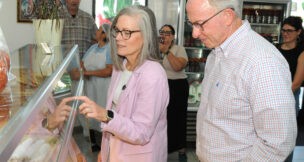
Gov. Katie Hobbs in the Executive Tower at the Arizona state Capitol in July 2025. (Reagan Priest / Arizona Capitol Times)
Hobbs declares bill moratorium until Republicans publicly produce a budget plan
Reagan Priest, Arizona Capitol Times//April 13, 2026//


Key Points:
-
Gov. Katie Hobbs is pledging to veto all bills until Republicans release a budget
-
The moratorium comes three weeks after Hobbs called off negotiations
-
Republicans say Prop. 123 is off the table despite Hobbs’ pressure
Gov. Katie Hobbs will not sign any bills until Republican lawmakers publicly release their own budget proposal.
Hobbs’ office announced Monday that every bill heading to her desk in the coming days will be vetoed unless Republicans produce their plan to pay for federal tax conformity, address education funding without Proposition 123 and shoulder the burden of federal cost shifts from programs like Medicaid and SNAP.
“The legislative majority needs to put forward their budget proposal and then join me at the negotiating table so we can pass a bipartisan, balanced budget just like we’ve done the past three years,” Hobbs said in a statement. “But until the legislative majority shows us their plans for a balanced budget that works for middle-class Arizonans, their bills will be dead on arrival. I know we can get big things done when we work together, but that isn’t possible when one side refuses to show us their plans.”
The bill moratorium comes a few weeks after the Democratic governor called off budget negotiations and accused Republican leadership of holding education funding hostage by flat-out rejecting any extension of Prop. 123, the voter approved funding measure that expired last year.
Hobbs told reporters on April 9 that “nothing has changed” in the negotiation process since her office called off talks.
“You can’t negotiate with only one side at the table,” Hobbs said.
Republicans in both chambers seem to have a low appetite for a Prop. 123 renewal measure, with Rep. Matt Gress, R-Phoenix, telling the Arizona Capitol Times on April 8 that the odds of finalizing a deal this session are “almost zero.”
Hobbs has argued a balanced budget hinges on a Prop. 123 extension, because it will allow the state to remove the $300 million backfill included in last year’s budget after the measure expired. Between 2016 and 2025, Prop. 123 allowed the state to withdraw 6.9% annually from the state land trust to fund Arizona public schools.
However, Hobbs’ executive budget, released in January, proposed extending Prop. 123 and keeping the $300 million backfill to increase school funding. Gress and other Republican lawmakers say the state budget cannot be balanced on the back of Prop. 123.
“We do not think that’s a responsible play,” Gress said on April 8. “We’re talking about a $300 million question mark that will have to be resolved at the ballot.”
Republicans have widely criticized the governor’s budget proposal for its reliance on the creation of new revenue streams through ideas like a data center tax repeal and an event wagering fee. It also depends on a $760 million reimbursement from the federal government for border security funding, which is unlikely to arrive before the state’s June 30 budget deadline.
The state also has to address the ripple effects of House Resolution 1, or the “One Big Beautiful Bill,” which is already straining Arizona’s budget and state agencies.
The Joint Legislative Budget Committee estimates it will cost the state around $1.1 billion to fully conform Arizona’s tax code to federal tax cuts imposed by H.R. 1. Additionally, Hobbs’ office says it will cost anywhere from $125 million to $175 million to adjust the state to new Medicaid and SNAP requirements while also backfilling federal funding cuts to emergency management, air quality and victims’ services programs.
For their part, Republican leadership says they have presented a balanced proposal to the governor’s office, while also pledging on March 19 to build a budget “in the next several weeks.”
This is not the first time Hobbs has used a bill moratorium to force Republicans to the negotiating table. During the 2025 session, Hobbs pledged to veto all legislation until lawmakers sent her a bipartisan emergency funding plan for the state’s Division of Developmental Disabilities.
That moratorium lasted one week, and Hobbs ended up signing the bipartisan funding measure without having to strike down any other bills as collateral damage.
Hobbs’ office said this year’s moratorium comes with two exceptions. She will sign a Department of Public Safety supplemental funding measure and a bill expanding death benefit eligibility for first responders if either crosses her desk.
The governor took action on all the bills sent to her desk before the moratorium was announced, signing 32 measures and vetoing another 20. Whether or not Republican lawmakers will continue to send her bills in the wake of the moratorium announcement is currently unclear.