Sign In
Upcoming Event
 Free Newsletter

State AI deepfake laws face first big test in 2026 midterm elections
Austin Jenkins, Pluribus News/State Affairs//July 21, 2026//
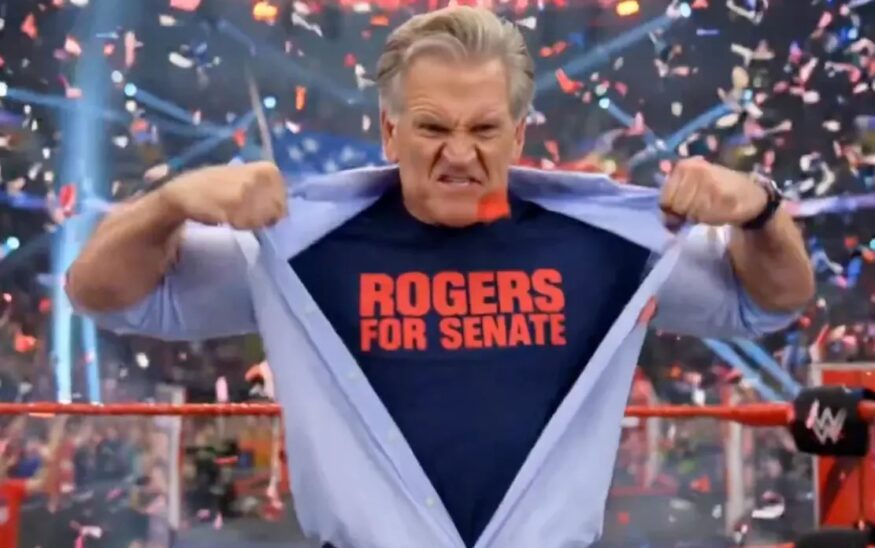
A screenshot of an AI-made campaign video from U.S. Senate candidate Mike Rogers, a Michigan Republican, posted on X.
State AI deepfake laws face first big test in 2026 midterm elections
Austin Jenkins, Pluribus News/State Affairs//July 21, 2026//


-
Thirty-one states implemented laws requiring disclosure of AI-generated content
-
Disputes between candidates and state officials highlight enforcement difficulty
-
Some state laws have been successfully challenged on constitutional grounds
The midterm elections represent the first major test of a raft of state laws passed in recent years to police the use of artificial intelligence in campaign materials.
Election deepfake laws are on the books in 31 states as of this month, according to tracking by Public Citizen. The laws typically dictate when disclosure of AI’s use is required and often give candidates targeted by non-compliant AI ads recourse in the courts.
ChatGPT’s debut in late 2022 triggered the lawmaking frenzy, as generative AI suddenly reached the masses and made it easy to create synthetic images, video and audio that can be confused for the real thing.
“We are going to see [the laws] tested and stretched to their limits this year,” said Michigan Rep. Penelope Tsernoglou, a Democrat who passed a pair of election deepfake laws in 2023.
Concerns were realized in January 2024 when some New Hampshire voters received an AI-generated robocall urging them to sit out the primary election. The voice sounded like then-President Joe Biden.
This election year has already produced multiple examples of AI campaign content — some labeled, some not.
Last month, controversy erupted when Michigan Senate Minority Leader Aric Nesbitt, a Republican who was then a candidate for governor, posted an AI-generated video to Facebook that depicted Democratic Gov. Gretchen Whitmer about to be run over by a tractor.
The ad was labeled as AI-generated, but Tsernoglou said using AI in a “hostile, threatening way” deserves a closer look by lawmakers.
Nesbitt’s campaign dismissed concerns about the video at the time and described it as a “parody.”
Another Michigan candidate, former U.S. Rep Mike Rogers, a Republican running for U.S. Senate, released an unlabeled AI video last month depicting him as a Hulk-like crime-fighting superhero.
Michigan’s law requiring labels on AI-generated political content includes exemptions for satire or parody.
So does Oregon’s law, which is currently being put to the test by a series of unlabeled videos from a former Republican candidate for Congress who lost in the May primary.
Oregon Secretary of State Tobias Reed, a Democrat, is investigating whether Jonathan Lockwood violated the state’s 2024 AI disclosure law when he produced and posted unflattering synthetic videos depicting his opponent, U.S. Rep. Janelle Bynum, a Democrat.
Lockwood defended his right to distribute the videos, which were not labeled as AI-generated, in a statement to Oregon Public Broadcasting.
“This is a frivolous censorship complaint filed by another congressional candidate in an effort to weaponize Oregon’s unconstitutional synthetic media law, which was passed by the Democrats to stifle protected speech,” Lockwood said.
In Kentucky, a conservative political action committee ran an ad in the May primary that used AI to depict Republican U.S. Rep. Thomas Massie as part of a “throuple” with Democratic Reps. Alexandria Ocasio-Cortez of New York and Ilhan Omar of Minnesota. The ad contained a disclaimer that it was satirical and created with AI.
Massie, who lost the primary to Ed Gallrein, said the ad contributed to his defeat.
“They used artificial intelligence to create a video — lifelike video — that showed me checking into a hotel room with AOC and Ilhan Omar — and holding hands with them. It was actually very effective on the Boomers,” Massie said on NBC’s “Meet the Press” after his loss.
Gallrein was himself the subject of an unlabeled AI ad funded by a pro-Massie PAC. The ad showed Gallrein, a former Navy SEAL, retreating from a battlefield scene as President Donald Trump, with rifle in hand, fights the enemy.
After the ad aired, the Gallrein campaign issued a statement from a military veteran supporter who called the ad a “Disneyland AI cartoon” and an “act of cowardice and treachery,” according to Louisville Public Media.
AI content also showed up in last year’s New York City mayor’s race and this year’s mayoral primary in Los Angeles.
Ilana Beller, director of state AI governance and tech policy at Public Citizen, said most AI election laws require labeling within a certain number of days of an election. They also give candidates the right to seek injunctive relief in court to get an offending ad taken down quickly.
Minnesota and Texas go further, prohibiting the distribution of deepfakes within a certain number of days of an election, according to the National Conference of State Legislatures. Maryland bans them year-round.
Beller said the laws typically target AI-generated election content that is intended to harm a candidate’s reputation or deceive voters, and that is realistic enough to lead a reasonable person to believe what they are seeing is real.
“These laws really zero in on the harmful content,” she said.
So far this year, Beller said, most of the AI content has either been labeled or was clearly satirical and “mostly not been anywhere near the nightmare scenario content.”
The focus on deception and persuasion feels misplaced to Scott Babwah Brennen, director of New York University’s Center on Technology Policy, who has been tracking AI’s use in elections. Brennen questioned the value of labeling, especially if the most common use of AI is to create satire that depicts real politicians.
“I’m not opposed to labeling requirements at all,” Brennen said. “My concern is: Are they going to be effective? And are they up to the task of addressing the problems that we’re seeing?”
While political speech and satire are broadly protected by the First Amendment, Brennen said using AI to depict candidates could raise questions about name, image and likeness protections.
A 2020 American University Business Law Review blog post explored whether politicians could use publicity rights to “shut down deep fakes,” noting that if an ad is deemed “commercial speech,” it has fewer free speech protections.
Brennen said more empirical research is needed into how AI is being used in campaigns, including robust tracking of enforcement of deepfake laws.
Enforcement has so far been spotty. In May, a Republican state Senate candidate in Michigan sought $150,000 in damages from a political activist who allegedly produced damaging AI videos about him.
An Arizona congressional candidate sued a super PAC this month over unlabeled billboards and signs that include “unflattering AI-generated images” of him, according to reporting by the Phoenix New Times.
The New Hampshire deepfake robocall using Biden’s voice resulted in a $6 million fine, but the political consultant responsible for the deception, Steve Kramer, was acquitted of criminal charges.
Some state laws have been successfully challenged on constitutional grounds.
Laws regulating election deepfakes were struck down in California and Hawaii, although a California labeling law is still in effect.
Montana’s law is currently being challenged by a political committee that is the subject of complaints for sending unlabeled digitally altered mailers in a pair of state legislative races.