Sign In
Upcoming Event
 Free Newsletter

Arizona’s water law was built for abundance. Scarcity is exposing it.
By Cami Cadell//August 6, 2026//
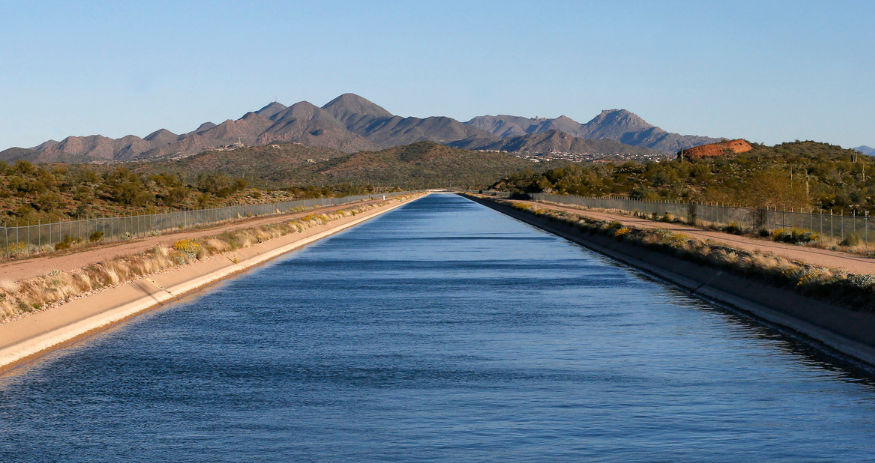
The Central Arizona Project (CAP) canal, Friday, March 6, 2015 near Fountain Hills, Ariz. The 336-mile long system is the largest single resource of renewable water supplies in Arizona. (AP Photo/Matt York)
Arizona’s water law was built for abundance. Scarcity is exposing it.
By Cami Cadell//August 6, 2026//


Arizona’s next water fight is not simply about drought. It is about what happens when a legal system built for abundance is forced to govern scarcity. For decades, Arizona treated water as if fragmented rules could hold because the resource itself would remain available. That assumption has reached a breaking point. As rivers shrink, suburbs grow, and rural groundwater levels fall, every gap in the law becomes a fault line. The law is no longer abstract. It determines whose wells are protected, whose communities are heard, and whose water can be moved. McMullen Valley is where that failure became visible.
The rural basin in western Arizona relies on an aquifer that has lost half its supply since 1990. Water Asset Management, a New York investment firm, owns farmland there and became the face of a proposal that House Bill 2758 would have made legally possible: pumping groundwater from McMullen Valley and transporting it toward areas searching for new supply. For residents whose wells depend on that aquifer, this was not an abstract policy dispute. It was the state nearly authorizing a private firm to profit from moving what little water remained beneath a community that depends on it to survive.
HB2758 should not be remembered only as a fight over one hedge fund or one rural valley. It should be remembered as a governance failure. Water Asset Management did not create Arizona’s groundwater crisis. It revealed the incentives Arizona law already created. The deeper issue is not private investment itself, but a system that leaves rural groundwater weakly protected, rural communities legally exposed, and capital able to move through the gaps before the people most affected can stop it. A hedge fund showing up was not the anomaly. It was the logical outcome.
Groundwater outside Active Management Areas is the clearest example. The state’s 1980 Groundwater Management Act created strong regulation inside designated AMAs, where conservation requirements and state oversight apply to major urban and agricultural centers. Much of rural Arizona sits outside those boundaries, governed instead by a loose reasonable use doctrine with few meaningful extraction limits. Arizona has proven it knows how to regulate groundwater. It has chosen not to do so evenly. Regulated basins live under one legal reality while much of rural Arizona lives under another.
Existing rights matter. The issue is that Arizona’s framework often treats existing legal interests as the only interests worth hearing. In Arizona Department of Water Resources v. McClennan, the Arizona Supreme Court interpreted the language meant to give “interested persons” a voice in transfer disputes so narrowly that it effectively excluded broader communities from objecting. Not rural residents. Not people whose future depends on the water being moved. Just existing legal rights holders. Those most exposed to loss are not always those the law allows to speak.
The legislative process should have been the correction. If existing law gave rural communities little recourse, the legislature should have debated that legal vulnerability. Instead, protective groundwater bills were introduced but never given a hearing by Rep. Gail Griffin (R-Arizona), chairwoman of the House Natural Resources, Energy and Water Committee. Arizona’s process allowed one committee chair to stop the debate before it reached the House floor. Rural communities were not just denied a legal remedy. They were denied the forum where that remedy could be argued. Visibility did not become voice.
That is why the public versus private framing misses the point. McMullen Valley residents are not asking for a government handout. They are asking for the legal power to protect their own resources. Before groundwater can be moved out of a rural basin, affected communities should have notice, hydrological review, public interest protection, and standing to object. A community should not have to wait until its aquifer becomes profitable to be heard.
HB2758 failed by a single vote in the House. The Colorado River continues to shrink. Phoenix suburbs still need water. Rural basins remain legally exposed. The question Arizona must answer is whether water belongs to whoever can afford to move it, or to the communities whose survival depends on it. Arizona has never formally answered that question. The longer it waits, the market will answer it instead.
Cami Cadell is an undergraduate student at Georgetown University in Washington, D.C., studying business and global affairs.