Sign In


Upcoming Event
 Free Newsletter

One year after Charlie Kirk: What he meant to Black America
By Rev. Jarrett Barton Maupin, Jr.//September 10, 2026//
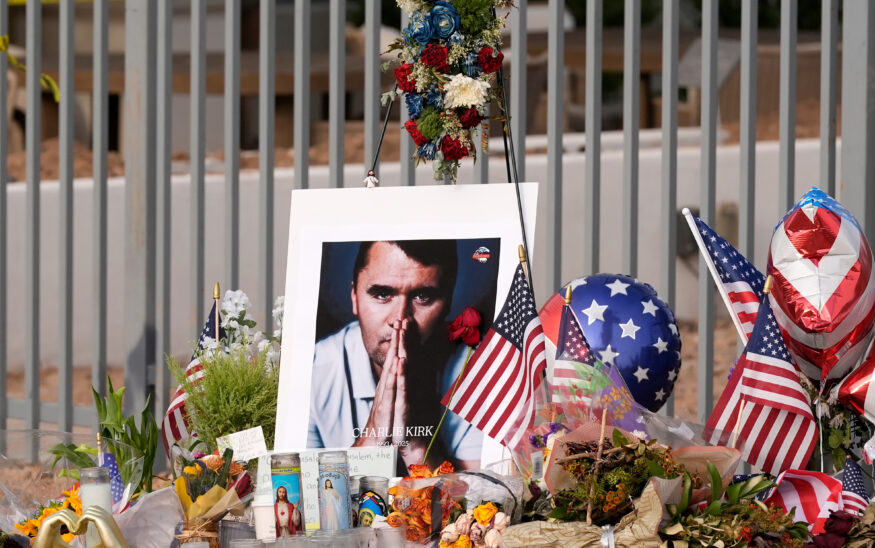
A makeshift memorial grows in size at the Turning Point USA headquarters after the shooting death at a Utah college of Charlie Kirk, the 31-year-old founder and CEO of the organization, Sept. 17, 2025, in Phoenix. (AP Photo/Ross D. Franklin, File)
One year after Charlie Kirk: What he meant to Black America
By Rev. Jarrett Barton Maupin, Jr.//September 10, 2026//


One year ago this week, a rifleman ended Charlie Kirk’s life under a tent at Utah Valley University and meant, by that single shot, to end his argument with it. The country has had these twelve months to decide whether the proper memorial is only a wreath or a reckoning.
I write as a Baptist minister formed in the Black pulpit and in the civil rights tradition. I supported President Donald J. Trump because he treated Black prosperity as an achievement to be won, not a grievance to be leased. Charlie Kirk spoke that same language.
On this anniversary, his meaning to Black Americans is not a sentiment. It is a summons that outlived him. He told the young they were not condemned by history and not excused by it. The opposite sentence is that skin is destiny, and destiny is the state’s to administer. Kirk named that doctrine what it is: the soft bigotry of low expectations. He insisted that “all communities will do even better when we stop living under” it.
The year since his death has been loud with eulogy. He was offering a sequence older than any platform. “Three things that will almost assuredly keep you out of poverty,” he wrote: get a job, graduate high school, and do not have children before marriage.
Brookings and the Institute for Family Studies measured the same path and called it the success sequence. Among millennials who finished high school, worked full time, and married before bearing children, 97% were not poor in their early thirties. Among Black millennials who kept that order, 96% were not poor. Half of those who kept none of the three steps were poor. The numbers do not flatter ideology. They honor conduct.
Look at the ledger of the last sixty years. In 1959 the official poverty rate among Black Americans stood near 55%, yet more than three quarters of Black children were born to married parents, and two thirds lived in two-parent homes.
By 2023, the poverty rate had fallen to roughly 18%, a gain no honest man will despise, yet 69.3% of Black births were to unmarried mothers, and only about 45% of Black children lived with two parents. The Heritage Foundation set the figures side by side: as legal racism receded, the family fractured.
“When Lyndon Baines Johnson came in through the Great Society program and started to subsidize single motherhood, it hurt all communities,” Kirk said. “We should be doing the opposite. We should be instead subsidizing nuclear families and families that are staying together and that are loyally married.” Kirk refused the claim that this collapse is “systemic” in the fashionable sense: a hidden machinery of white malice still grinding after the statutes were repealed. He asked what law now on the books actively discriminates against Black people, then named the laws that pay for a father’s absence and call the payment justice.
He did not deny the American crime of slavery or the long insult of Jim Crow. He denied that a nation which elected a Black president twice and spent trillions in the name of uplift is still best understood as a plantation with better manners.
Faith was not an ornament on Kirk’s politics. It was the load-bearing wall. “There is a God,” his friends remembered him saying, “and it is not us.” He told men to love their wives and lead their homes as men worth following. The Black church has known that grammar for generations. I have preached it over open graves and at kitchen tables. It is why his campus tours and the BLEXIT partnership through Turning Point USA found an audience among young Black conservatives tired of piety being treated as a lullaby for the oppressed.
At Kirk’s memorial, President Trump said what the record already showed: “Charlie was actually a master builder of people. It was Charlie who first started organizing young Black conservatives hungry for support and leadership.”
Between 2020 and 2024, the Black share of the Trump vote rose, and among Black men it rose further still. Kirk helped build that turn. I worked in that same vineyard. I had given speeches with him in support of candidates, standing in the same heat and the same hope.
I think now of the joy and the fellowship of that last Arizona afternoon at the Arizona Biltmore, the ballroom loud for Andy Biggs in his race for governor and for Warren Petersen in his race for attorney general, the room full of neighbors who still believed a state could be ordered toward family and work. We laughed. We prayed. We left certain the afternoon was ordinary. In hindsight, it was not.
Kirk moved through that hall, and later through those last public hours under the Utah tent, with a composure that, looking back, carries the same grace Martin Luther King Jr. showed on the eve of his death in Memphis, when he said he had been to the mountaintop and was not afraid. It is surreal to write that sentence.
A year later, I can still hear that afternoon at the Biltmore, and I can still see that he had already given the speech away to the people who would have to finish it. One may dispute the party. One cannot dispute the hunger for a word other than grievance.
What, then, does Kirk mean on this first anniversary of his assassination? He means that love does not flatter a people. Love tells the truth about the home, because the home is where a people is made or unmade. He means that the first civil right is the right to be expected to be good. A boy in Phoenix or Baltimore is not a metaphor in a seminar. He is a soul. Souls are not funded. They are formed.
The unfinished work of this anniversary is not another bureau and not another statue. It is the recovery of the household, the school that teaches letters instead of racial liturgy, and the pulpit that still dares to say that God is God and that a man who begets a child owes that child his name.
Kirk did not invent that creed. He had the nerve to speak it in rooms taught to call it hate. President Trump honored the man who organized the hungry. If Black America takes him at his word in this twelfth month, it will not be because a white activist conferred permission. It will be because the data, the churches and the memory of better order already knew he was right, and because a people tired of being pitied has decided, at last, to be free.
The Rev. Jarrett Barton Maupin, Jr., is a Baptist minister, civil rights leader, public intellectual, and political commentator and consultant from Phoenix. Find or follow him on X: @ReverendMaupin.