Sign In


 Free Newsletter

Polls don’t vote. Voters do.
By Gibson McKay//September 17, 2026//
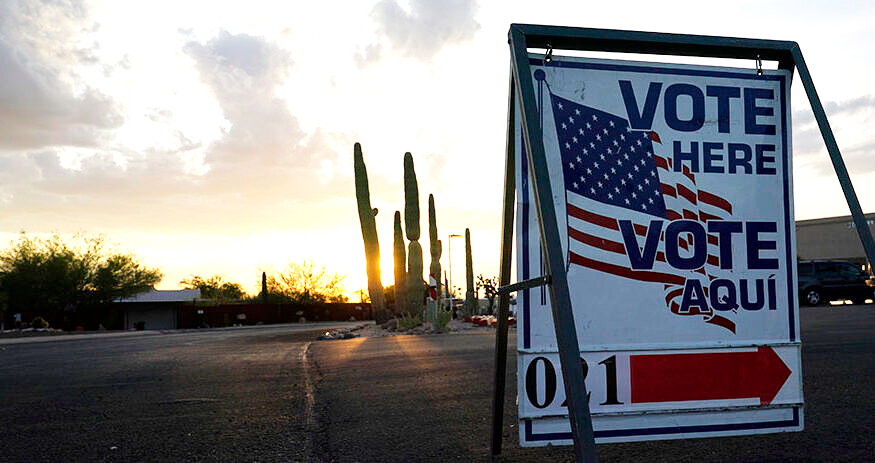
The sun sets at a local polling station Tuesday, Nov. 3, 2020 in Tucson, Ariz. (AP Photo/Ross D. Franklin)
Polls don’t vote. Voters do.
By Gibson McKay//September 17, 2026//


Arizona has entered polling season, with six surveys measuring the governor’s race this week, followed by a chorus of instant statistical experts — many using numbers the way a drunk uses a lamppost: more for support than illumination.
Every recent poll shows Gov. Katie Hobbs leading Congressman Andy Biggs. Most show a competitive race. Two local polls placed Hobbs ahead by 13 and 15 points.
Maybe they are right.
I do not pretend to be the smartest guy in the room. I have, however, been in the room for more than 30 years.
Back when we drank from garden hoses, polls stayed in the field for two weeks. We worked from voter lists, set quotas based on actual voting history and kept calling until we filled them. It was slow, expensive and difficult.
However, we were usually within two to four points of the final election result. Election Day was generally confirmation, not discovery. I can remember being materially surprised only once—and that was not by a poll I conducted.
Polling is harder now. People screen calls, ignore texts and guard their attention like the scarce commodity it has become. Modern pollsters compensate with speed, online panels and increasingly elaborate weighting.
Noble Predictive Insights surveyed 923 self-identified likely voters through screen questions and an opt-in online panel, then weighted the results by demographics and a projected turnout model.
HighGround Public Affairs conducted 400 live interviews drawn from a voter file and used likely-voter quotas—a firmer starting point—but also weighted the completed sample.
Weighting is not dishonest. Modest weighting can correct modest imperfections. My concern begins when mathematics is asked to replace human beings we never interviewed.
There is another recent concern, separate from methodology.
A poll should be a thermometer, not a thermostat. Its job is to measure public opinion—not manufacture momentum or change the political temperature. Call me a purist, but a poll should discover the story, not become it.
That distinction became painfully clear this month when a mysterious company released fabricated polls in three states. One was promoted by a mayoral campaign, repeated by news outlets and followed by movement in election-prediction markets before being exposed as fake.
I am not suggesting that any Arizona polling firm fabricated its results. But polling has become part of campaign messaging.
I tell clients: You will never read about my internal polls in the newspaper. A poll is intelligence to develop a battle plan, not advertising.
Today, surveys commissioned by campaigns, political organizations and interested parties can be released selectively, amplified breathlessly and used to create the very momentum they claim merely to measure.
A poll does not have to be fake to function as propaganda. Sometimes it only needs a favorable result, a professional-looking press release and an audience eager to believe it.
Then there is the problem with weighting human behavior.
Weighting works beautifully when measuring the volume of gas in a cylinder. Gas obeys the laws of physics. It does not get stuck at work, lose its ballot, become disgusted with both candidates or decide Election Day would be better spent golfing.
Voters are not molecules. Voting is a behavior.
Imagine a high school wants to know what students eat for lunch. Past receipts show that 60 regular customers buy pizza, 25 buy hamburgers and 15 buy salads. One method interviews those actual buyers in those proportions.
The other interviews whoever happens to be near the cafeteria door. Only five salad buyers respond, so the poll counts each of them three times.
The spreadsheet now shows 15 salad buyers. The cafeteria still contains five. We did not find 10 additional students; we handed five teenagers three lunch trays apiece and congratulated ourselves on the head count.
That is the distinction between using quotas to build a representative sample and using weights to reconstruct one afterward. One uses mathematics to describe the people interviewed. The other asks mathematics to impersonate the people who are missing.
Increasingly elaborate weighting has coincided with some spectacular polling misses. That does not prove weighting caused them. It should, however, encourage humility—and prompt a basic question: Did we talk to the right human beings?
That is why I start with the voter file.
Asking, “How likely are you to vote?” is like asking a bar patron whether he intends to tip. You will usually receive the respectable answer. The receipts are more useful.
Did the person vote in the last midterm? The one before that? Does the person vote only in presidential years, or also in quiet municipal, school and bond elections?
I would weight the predictive value of those elections—not give additional mathematical weight to individual respondents. For a 2026 midterm, voting in 2022 and 2018 tells us more than voting in a presidential election.
Then look for the ballot ritual: the same voting method, consistent ballot returns, a stable address and other habitual voters in the household.
Stability creates the conditions. Repetition creates the ritual.
But voter history is only half the equation. A habitual voter will show up for almost anything. A Civic Localist may skip statewide contests but vote when the ballot includes a school-voucher measure, water issue or local tax proposal.
Past behavior establishes the baseline. This ballot may activate it.
Taken together, the current polls tell us something useful: The race presently leans toward Hobbs. But “leans” is not the same as “decided.” Some polls place Biggs within striking distance, and a meaningful number of voters remain undecided with more than two months until Election Day.
Those voters are not blank slates. Many are Republicans or Democrats who are dissatisfied, distracted or not ready to commit. As Election Day approaches, partisan voters tend to go home.
Independents are different. Current polling suggests many may be open to moving away from Republicans—but preferring a candidate and showing up for a midterm are two different behaviors.
That makes the elections in which an Independent has actually voted especially important. An Independent who participated in the last two midterms may be a valuable persuasion target. One who routinely skips them may be an expensive theory.
Registration tells us how a voter identifies. History tells us whether that voter is likely to participate.
The important questions remain: How many partisan voters go home, when do they go, and how many Independents show up at all?
Finally, a 400-person poll has a margin of error of about plus or minus 4.9 points for the overall sample. But cross-tabs are smaller polls hiding inside the larger one.
If that sample contains 208 women and 192 men, the margin of error is approximately plus or minus 6.8 points for women and 7.1 points for men—before weighting or design effects. Divide the sample again by age, party or region, and the uncertainty grows quickly.
That is why I have always preferred at least 600 interviews. It lowers the overall margin of error to about four points and makes the cross-tabs less fragile. It is more expensive and takes longer. Precision usually does.
Of course, a larger sample cannot rescue the wrong sample. Six hundred of the wrong voters merely produces a more precise description of the wrong electorate.
The evidence says Hobbs leads today. It does not say she will win by 15 points — or that Biggs cannot close the distance as Republicans return home and the campaign becomes real.
So, one more time: Stop asking voters, “How likely are you to vote?” We already have the voter file. Spend more time examining what people have repeatedly done and less time asking what they currently intend to do.
Intentions answer polls.
Behavior casts ballots.
Gibson McKay is principal of Sherpa Public Affairs, an Arizona public affairs firm. He has advised more than 150 campaigns over a career spanning three decades.