Sign In


Upcoming Event
 Free Newsletter

Fontes and Kolodin trade insults with some policy sprinkled in
Jordan Gerard, Arizona Capitol Times//September 30, 2026//
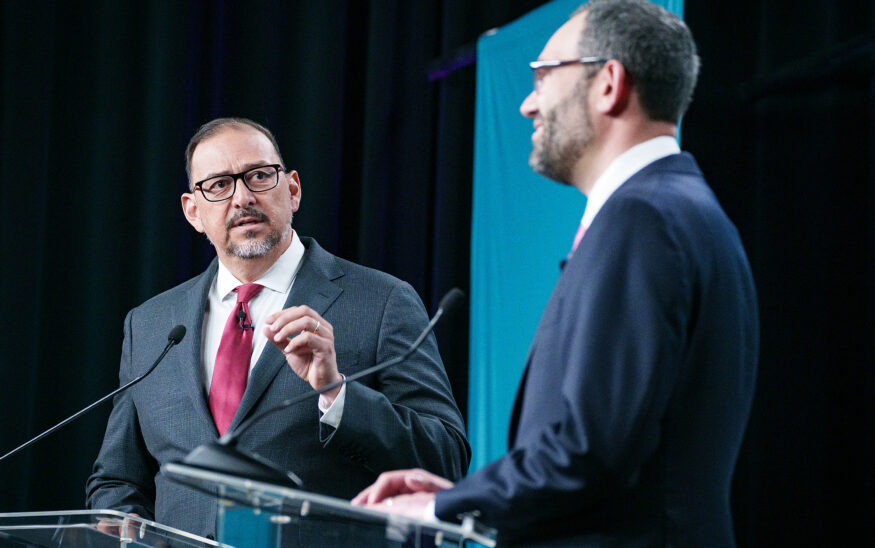
Democrat Secretary of State Adrian Fontes, left, argues Wednesday night with Republican challenger Alexander Kolodin. (Pool photo by Megan Mendoza/Arizona Republic)
Fontes and Kolodin trade insults with some policy sprinkled in
Jordan Gerard, Arizona Capitol Times//September 30, 2026//


Key Points
-
Secretary of State Adrian Fontes and Republican state Rep. Alexander Kolodin debated in the race for Arizona’s top elections official
-
The debate mostly consisted of attacks and insults
-
Many of the policy points were overshadowed by interruptions and political barbs
Democratic Secretary of State Adrian Fontes and Republican state Rep. Alexander Kolodin faced each other on the debate stage Wednesday night and clashed over how best to administer elections, sparred over their leadership records and, at times, exchanged pointed personal attacks.
Kolodin, who represents Legislative District 3, repeatedly raised Fontes’ handling of a case involving an alleged member of the Mexican drug trafficking organization known as the Sinaloa Cartel. Fontes eventually shot back, saying the two would have personal problems if he brought it up again. He added the attack is “weak sauce.”
Fontes also ran a real-time fact-checker website during the debate with two fact-checkers named “krakenslayer” and “Raspberry Rosé.” The usernames referenced a 2020 election lawsuit filed by Kolodin and a 2020 traffic stop in which Kolodin was a passenger and officers saw someone throw an object from the vehicle that was later identified as a Smirnoff Sparkling Raspberry Rose, according to previous news reports.
Kolodin skipped out on the media availability after the debate. Fontes spoke to reporters afterward.
Prop 144
The candidates briefly discussed policy disagreements before turning to personal attacks.
Kolodin, the author of Proposition 144, said the measure would make voting easier for all Arizonans, allow for faster election results and prevent foreign funding of elections.
Fontes argued it would make voting less convenient and reduce voter access. He said his office has expanded voting locations.
The candidates also disagreed over the relationship between the secretary of state and county recorders.
Fontes said it should be based on building partnerships among county officials and organizations that help elections run smoothly.
Kolodin pointed to a recent dispute over felony voter files provided by the U.S. Department of Justice that he said Fontes was withholding. But Fontes said the data his office received was unusable and they had to get it in another format.
Voter rolls and the federal government
Fontes defended his decision not to turn over voter rolls to the Trump administration, arguing it wasn’t legal.
Kolodin said he would ensure the voter rolls are accurate and implement the SAVE Act if it became law.
Throughout the debate, Fontes characterized Kolodin’s approach to elections as “pick your own voters.”
“He wants to make it harder for you as a citizen to vote because that way he can try to pick his own voters,” Fontes said.
Non-citizen voting
The candidates also debated the recent finding from Maricopa County Attorney Rachel Mitchell that eight noncitizens voted in Arizona’s elections. Over 200 names had been referred to Mitchell for an investigation.
“We’re talking about eight votes out of 60,000 because that was the limited sample that was run, which means in most likelihood there’s a lot more that we can’t see,” Kolodin said. “But frankly, one is too many. Every time an unlawful vote is cast, it dilutes the lawful votes of Arizonans.”
Fontes said the findings show that noncitizens voting in Arizona’s elections is largely a myth, adding, “The election-denier people, like Mr. Kolodin, want to whip all of this nonsense about untold hundreds of thousands of illegal voters, which is a lie.”
The two also disagreed on e efforts to fix the voter rolls and improve elections. For years, Fontes has argued that lack of funding from the Legislature has hindered his office’s ability to make any real change. He said the ballot tracking system has increased voter trust.
Kolodin promised to make sure elections are “smooth” and would go through rigorous testing before Election Day, which already happens.
Speediness of election results
Fontes defended Arizona’s counting system and its speed.
“You can have them fast, you can have them accurate, you can have them cheap, but you can’t have all three,” Fontes said. He added that if races come down to a few hundred votes, that won’t be decided on Election Day. “We can get quicker results, but we’re never going to have final results on election night.”
Kolodin said his legislation allowing voters to take mail-in ballots to the polls on Election Day has led to faster counts.
Fontes also said he’s confident in the state’s election system.
“In 2020, when I didn’t get reelected in Maricopa County, I didn’t complain because I had confidence in the people who were running those systems,” he said. “In 2024, I had the great honor of presiding over Arizona’s electoral college, and while my preferred candidate didn’t win … I happily signed off on the certificate and sent it off to the clerk of the House of Representatives.”
Kolodin didn’t explicitly say he would accept the results.
“I’ve won elections, and I’ve lost elections,” he said. “When I’ve won, I’ve tried to win with grace. When I’ve lost, I’ve tried to lose with grace. And this time around, we will win with grace.”