Sign In




 Free Newsletter
Tag: John Kavanagh
Republican lawmakers propose flat tax, $12.8B budget

House and Senate leaders and Gov. Doug Ducey have agreed on a roughly $12.8 billion spending plan, including the state’s largest tax cut in recent memory – but the budget lacks the Republican votes it needs to pass in its current form.
The budget proposes to cut nearly $3 billion in taxes over the next three years, mostly through collapsing income tax brackets to a single 2.5% rate in 2023. It would cut taxes for all Arizonans, though higher-income taxpayers would see significantly bigger benefits.
“I like the tax cut and I like that it’s balanced,” said House Speaker pro tem Travis Grantham. “Those are my most important asks.”
While legislative leaders and the governor have reached an agreement, rank-and-file Republicans are still viewing the budget plan with skepticism.
“Do I think I will be on it in the end? Absolutely,” said Rep. David Cook, R-Globe.
But for now, Cook said, he needs answers to a number of questions, including whether the state is spending enough to repair or demolish decrepit state buildings before he can accept the huge cuts to revenue included in the tax plan.
He also wants to reach an agreement on increasing unemployment benefits and replenishing the state’s unemployment fund, one of his top priorities for the year that GOP leaders and the governor said needed to wait for budget negotiations.
Cook’s seatmate, Sen. T.J. Shope of Coolidge, said he’s a “no” on the budget in its current form because it doesn’t include funding to widen I-10 between Casa Grande and Phoenix. He asked for $50 million for the project this year, but his bill stalled in the House and the money is not included in budget documents shared with Republican lawmakers and obtained by the Arizona Capitol Times.
Other Republicans are skeptical of just how much spending is included in the plan. Sen. J.D. Mesnard, R-Chandler, said he likes some of the new funding, including plans to spend $50 million annually on special education and new spending on universities, which will receive an ongoing $35 million as well as a one-time $30 million for university operations.
“There’s just a truckload of a lot of items that might be a million dollars here or there and it adds up,” he said.
Mesnard is also skeptical of new tax credits proposed in the budget, arguing that they run counter to the goals of streamlining the state’s tax code by moving to a single income tax rate.
Beginning in the 2022 tax year, the state would collapse its current four tax brackets to two brackets, one paying 2.55% and the other paying 2.98%. Taxpayers now pay between 2.59% and 4.5%. The following year, all Arizonans would pay a single 2.5% rate.
Some Arizonans would still end up paying more than 2.5% of their taxable income, but the plan also calls for a top marginal tax rate of 4.5% that would protect the wealthiest Arizonans from paying as much as they otherwise would have because of a new education surcharge of 3.5%. Instead of paying their full tax rate and the surcharge, wealthy Arizonans would be able to pay no more than 4.5% of their taxable income to the state each year, and the state would make up the missing education spending through its General Fund.
The shift to a flat tax alone is expected to cost the state $1 billion in FY23 and $1.5 billion in FY24.
That alone will prevent Republican leaders from getting any support from Democrats, said Sen. Sean Bowie, D-Phoenix.
“There are some good things in there, but overall the size of the tax cut as currently constituted, I don’t think any democrats could support that,” Bowie said.
Without any support from Democrats, threadbare Republican majorities in the House and Senate require every Republican to vote for the budget proposal. Bowie said several of his Republican colleagues are opposed to the idea of a flat tax, which could reduce revenue received by cities and help wealthy urban Arizonans more than poorer rural residents.
Sen. Paul Boyer, R-Phoenix, has led a charge over the past several weeks to amend the flat tax proposal to ensure cities see no cuts to funding. Arizona cities can’t enact local income taxes, and in return the state agreed to share 15% of state income tax revenues among cities and towns.
Boyer proposed increasing that shared revenue to 20% if the Legislature insisted on moving to a single income tax rate, but other Republicans aren’t on board. Mesnard said doing so would result in people who live in unincorporated areas subsidizing cities.
“If you are giving even more, a higher percentage to those cities, that’s even more these folks are paying into the cities they don’t live in,” he said.
While there are some holdouts, Rep. John Kavanagh, R-Fountain Hills, insisted that most Republicans favor the plan to cut nearly $3 billion in taxes over the next three years.
“The tax cut is well supported,” he said. “It’s a Republican thing to do.”
One challenge to passing a budget may come from a Republican senator who described the budget plan as “the last thing on (her) mind.” Sen. Kelly Townsend, R-Apache Junction, has a single-minded focus on election security legislation she was stymied in passing earlier this year, and she said she won’t give Republican leaders a vote on a budget until her election bills get a vote.
Townsend expects a vote in the House could happen as early as this week, but if it doesn’t happen and leaders try to push a budget through the House and Senate, they won’t have her vote.
“I’m definitely not voting on the budget until my issues are taken care of, for sure,” Townsend said.
- Staff writers Dillon Rosenblatt and Nathan Brown contributed to this report
Lawmakers winnow down sentencing bills

As the Legislature enters what are likely the waning weeks of the 2021 session, a few bills meant to make Arizona’s system of criminal sentencing more lenient have already been signed into law, while more ambitious measures have stalled.
A bill that has been in the works for years to require a criminal conviction before police can seize someone’s property through civil asset forfeiture passed the Senate this week and awaits Gov. Doug Ducey’s signature or veto. And supporters of a proposal to expand the state’s earned release credit system still hope to pass it this year, albeit with some amendments to appease law enforcement officials and lawmakers who worry its terms are too generous.
While Sen. J.D. Mesnard, R-Chandler, is still working on possible amendments to SB1064, the earned release credit expansion bill is expected to pass the House if a deal can be worked out – that same chamber easily passed an even more generous earned release credit bill earlier this year. The real question is whether it will pass in the Senate, which is where the previous bill stalled.

“I think it will have a better chance, but I will be candid, I don’t know how really in the loop my Senate colleagues are,” Mesnard said. He said he plans to talk to other senators, including Warren Petersen, R-Gilbert, who heads the Senate Judiciary Committee and who didn’t schedule a hearing on the House bill.
But while earned release credit expansion could still become law, a bill that would have created an independent corrections ombudsman won’t be moving forward, according to its sponsor.
“Haven’t heard, and it looks like it’s probably dead,” said Rep. Walt Blackman, R-Snowflake. “And that’s unfortunate.”
HB2167 passed the House 38-14 on March 1, and was assigned to Senate Judiciary, where it never got a hearing. Blackman blamed opposition from the Department of Corrections, Rehabilitation and Reentry for its demise.
“DOC says there are too many issues with the bill, and that they are not prepared to execute the provisions in the bill, and it died,” Blackman said.
Blackman, a longtime advocate for changes in criminal justice policy, chaired the new House Criminal Justice Reform Committee this year, advancing numerous bills with bipartisan support. What opposition there was usually came from a minority of other Republicans. However, some of the more-controversial bills stalled after passing the House, an outcome which has frustrated Caroline Isaacs, the program director of the American Friends Service Committee of Arizona.
“I don’t think it’s about the particular bills. … it’s about the obstructionism and the kinds of ridiculous distractions that our state leaders are more engaged in,” Isaacs said. She said Arizona has fallen behind many other states, including some very conservative ones, when it comes to criminal justice reform.

“This is not a radical concept, and so the kind of dialogue, ‘Oh, we’ve got to slow this down, and it’s too much, too soon,’ this is baloney,” Isaacs said. “If you look at states like Mississippi and South Carolina and Texas, this is old news. This is like a shrug. Why would you not do something that works better and saves money?”
Grover Norquist, who is best known for his anti-tax activism but who has become a criminal justice reform advocate in recent years, made a similar point during an Arizona Capitol Times Morning Scoop on Mesnard’s bill April 22. He noted that conservative states such as Texas passing legislation to reduce the number of people in prison can provide a model for Republicans in other states who might be leery of being seen as soft on crime. Norquist said criminal justice reform can be part of a conservative approach to government by reducing spending.
“You can step forward comfortably if you’ve seen other states do something and nobody died and nobody lost an election and the world didn’t end,” he said.
Mesnard’s bill would make earned release credits, which could be earned by taking part in programs such as drug treatment and some work and self-improvement programs, retroactive for drug offenders but not for others. Mesnard said there is “less consternation” about letting drug offenders get earned release credits retroactively, but “ultimately, the biggest issue is going to be outside of the drug side of the bill, the non-drug, non-violent offender side of the bill.”
While Mesnard’s bill would only let them qualify for earned release credits prospectively, and at a slower rate than drug offenders. He said “some folks have a general discomfort with touching that population at all” and would rather stick to the current requirement that they serve 85% of their sentences. Mesnard said this requirement merely incentivizes not breaking prison rules, without giving them a reason to improve themselves. He said discussions include narrowing the scope of which non-violent offenders qualify for earned release credits.
Rep. John Kavanagh, R-Fountain Hills, who voted against Mesnard’s bill in committee, said he fears going back to the days of less consistent sentences that preceded the ‘80s and ‘90s, when most states enacted the tougher sentencing laws that are largely still in force today.
“I don’t think that this is really close to what I could support,” he said. “I have real concerns about any bill that would allow a sentence to be cut pretty much in half.”
Another bill that appears to have stalled is HB2673, which would have let judges go below a statutory mandatory minimum sentence in some cases. It passed the House 50-9, but nothing has happened since it was assigned to Senate Judiciary in February.
However, not every bill that hasn’t gotten a hearing is dead. House Majority Leader Ben Toma, R-Peoria, said he expects his bill to let some felons get their records sealed, which passed the House with only one “nay” vote in February but hasn’t moved in the Senate, to be included in this year’s budget deal. The bill includes a $500,000 appropriation to set up the petition process.
Ducey, who typically does not comment on bills until they reach his desk and he signs or vetoes them, has in the past been supportive of proposals to reduce recidivism but skeptical of other more far-reaching efforts to change the system. On April 26, Ducey vetoed SB1261, which would have expanded the use of justification as a defense against any criminal offense.
“I appreciate the sponsor’s intent with this bill,” Ducey wrote in his veto message. “However, I have heard from several county attorneys that this bill could make the prosecution of DUIs nearly impossible. The safety of our highways and roads is of utmost importance, and I am concerned of the unintended consequences this bill may have.”
However, Ducey has signed a few other bills that went through the House Criminal Justice Reform Committee, such as ones relaxing the state’s repetitive offender sentencing law; creating new data collection requirements for police use of force; prohibiting most state agencies from denying people occupational licenses based on drug convictions; letting some low-level felons have their charges recorded as misdemeanors; and ending the requirement that a driver’s license be suspended for nonpayment of a fine. Isaacs said she was pleased to see these “baby steps.”
“These passed, the governor signed them, and lo and behold, the sky has not fallen and hopefully our elected officials will see that this is good policy and people support it and there are not negative consequences for supporting criminal justice reform,” Isaacs said. “In fact, it’s the opposite. This is what people want.”
Sex education bill goes to governor

State lawmakers gave final approval Wednesday to legislation that will require special parental permission before a student is taught anything about sexual orientation, gender identity or gender expression.
The 31-28 party-line vote by the House also spells out that sex education of any type is forbidden before the fifth grade. And SB1456 would mandate yet another special permission — beyond what parents need to provide for their children to take sex-ed classes — to be taught anything about AIDS and the HIV virus that causes it.
Approval of the measure came as proponents said this ensures that parents know — and approve — what their children are being taught. SB1456 specifically gives parents more specific rights and time than they have now to review the instructional materials and activities before deciding whether to opt-in to such instruction.
And it specifically requires governing boards to not just review and approve what is in the sex-ed classes being offered.
“This is huge,” said Rep. David Cook, R-Globe.
But foes pointed out that parents already have to opt-in to all sex education courses. Rep. Diego Rodriguez said requiring a separate opt-in for discussions about things like sexual orientation is both unnecessary and discriminatory.
“It’s clearly meant to highlight that there is something different about gender identity and gender expression,” he said. “And that difference is something that should be feared.”
More problematic, Rodriguez said, is the admission by Sen. Nancy Barto, R-Phoenix, during hearings that the wording of the measure means that parents would have to opt in any time the question of sexuality or sexual orientation came up anywhere in the curriculum. That would include historical events like the 1969 Stonewall Riots in New York that gave birth to the modern gay-rights movement, and any discussion of LGBTQ individuals in literature.
Rep. Athena Salman, D-Tempe, said it even could impair discussion of the suffrage movement where some of the leaders argued for the right to love people of the same sex.
But Barto said that, as far as she’s concerned, existing law already requires such parental permission for such discussions.
“We’re not doing anything different,” she said, with the language seeking to clarify what’s required. “We’re just making it work.”
House Minority Leader Reginald Bolding, D-Laveen, noted that Wednesday’s vote comes two years after lawmakers voted to repeal sections of sex-ed law that prohibited teachers from promoting homosexuality as a positive lifestyle. That same law also said that if teachers talk about “safe sex” they cannot say there is any such possibility when it involves homosexual conduct.
But that overwhelming vote came only after Equality Arizona filed suit to challenge the law — and Attorney General Mark Brnovich saying he would not defend it in court.
This step backwards, Bolding said, is “fear-mongering among what our educators are teaching our kids.”
The ban on sex-ed before fifth grade concerned Rep. Jennifer Jermaine, D-Chandler. She said that could lead to more cases of sexual abuse.
“The fifth grade is absolutely too late for a lot of these children,” she said.
“It is too late for them to learn good touch/bad touch because they have already been molested, they have already been abused,” Jermaine continued. “And, more than likely, it was from somebody within their own household.”
And Rep. Pamela Powers Hannley, D-Tucson, said that absolute ban will leave younger children without information to protect themselves.
“Leaving out information puts them at risk because they don’t know what’s happening to them,” she said.
Rep. Amish Shah, D-Phoenix, objected to imposing a new written permission requirement to teach about AIDS and HIV.
“That really leads to more sexually transmitted diseases,” he said, leaving students ignorant about how one contracts the disease and how to prevent it.
In the end, however, the measure which now goes to the governor, was approved because supporters see it as an issue of parental rights.
“I do appreciate teachers and what the schools have done and what public schools offer our kids,” said Rep. Walt Blackman, R-Snowflake.
“But at the end of the day, it’s the parent’s right or not to include their child in whatever type of curriculum they want to do for them, based on the values of their home,” he said. “Why is it, as a parent, I am forced to do something that I see differently in my family?”
Rep. Jennifer Pawlik, D-Chander, said no one is being forced to do anything. She said parents already have the right to review curriculum and can opt their children out of any sort of sex-ed classes.
But Rep. Jacqueline Parker, R-Mesa, said more is needed.
“The purpose of this bill is to provide transparency to parents and allow them to determine what’s best for their child,” she said. And Parker rejected arguments that singling out issues of sexual orientation, gender identity or gender expression for special mention — and special parental permission — that the measure is discriminatory.
“No rights are being denied to any group of people,” she said. “It’s just requiring the schools to get parents involved in sensitive topics
Parker said it’s no different than anything else that already goes on.
“When I was in school, we were learning about one of the world wars and one of my teachers wanted to show an R-rated movie,” she said, something that required parental permission, including a form that had to be signed.
“If parents denied permission we went to another room and got our homework done for that day,” Parker said. “It wasn’t really that big of a deal.”
Nor was she alarmed by comments that this legislation sets a precedent where parents would now be getting involved in what their children are taught in math, science or history.
“Parents should have a say over all of those subjects,” Parker said. “Parents already have that level of control and should keep that level of control.”
Rep. John Kavanagh, R-Fountain Hills, said updating the laws on sex education are necessary.
“Today’s sex-ed has morphed into sex indoctrination,” he said. And he said arguments about providing “scientifically correct” sex-ed have become a mandate to teach what is “politically correct.”
Ducey vetoes first bill this year

For the first time since 2019, Gov. Doug Ducey brought out his veto pen today saying no to an election bill from Rep. John Kavanagh that passed both chambers unanimously.
HB 2360 would give complete authority to the Secretary of State’s Office to operate and maintain the online voter registration system, removing it from the Arizona Department of Transportation.
Kavanagh had pitched the bill as putting the voter registration system in its rightful place under the Secretary of State’s Office, but Ducey‘s office panned it as unnecessary.
“The Arizona Department of Transportation has developed a site and a system that Arizonans recognize and appreciate,” Ducey wrote in his veto letter.
Ducey has not used his veto pen often, and this is his first veto since 2019.
In total, since 2015, Ducey has signed 2,016 bills and vetoed 80 — including today’s veto. His predecessor, Gov Jan Brewer, also a Republican, vetoed bills at much higher rate (141 vetoes to 1,782 bills signed into law).
“This falls under the category of it ain’t broke don’t fix it,” Ducey spokesman CJ Karamargin said.
A spokeswoman for Secretary of State Katie Hobbs said the office is “perplexed.”
“Especially considering it passed both chambers [unanimously]. This has been a deeply partisan session, this had support. We just don’t have a good explanation for it,” Hobbs’ spokeswoman Murphy Hebert said.
The bill says it would not have gone into effect until December 31, 2023, which would be plenty of time before the 2024 presidential election and under whoever becomes the secretary of state in 2022.
Ducey complimented county election officials in his veto letter and signaled that he could be signing more election bills, with plenty of controversial measures on the horizon.
“There are many changes to the laws governing elections in this state that could continue to improve Arizonans’ confidence in our election system,” he wrote.
Kavanagh told Capitol Times there were some problems with the way the bill divided power between the Secretary of State’s office and the county recorders and that it needed more detail. He said he expects to work on the bill during the interim and reintroduce it in 2022.
“I don’t really have a problem with that (Ducey’s veto),” Kavanagh said. “Some issues with the way the bill was structured came up and I agreed it probably needs some sort of rewrite. Maybe next year.”
Kavanagh said he introduced the bill at the behest of a county recorder who “didn’t think it was appropriate to have the election stuff in the Department of Transportation.”
It’s still possible the Legislature could opt to override the veto. Overrides only need two-thirds vote in both chambers – which has yet to happen while Ducey is governor – and it passed the House 58-0 and the Senate 30-0 already.
Reporter Nathan Brown contributed to this story.
Ducey signs controversial bills

Gov. Doug Ducey signed two controversial bills late Friday — one that exempts businesses from following mask mandates and another that bans private funds for election administration.
The first bill is HB2770 from freshman Rep. Joseph Chaplik, R-Scottsdale, who argued in favor of the legislation on the House floor that masks were unnecessary because they weren’t needed for viruses in the past like the HIV/AIDS crisis. That virus, however, did not spread through respiratory droplets like Covid, but through bodily fluids, typically sexually transmitted.
It passed the Senate April 1 also along party lines. The bill does not become law until the state’s general effective date at the end of August.
Ducey wrote a note to the bill along with his signature saying that he will work with Chaplik on another bill this year to fix what he called “an error in drafting.”
“The state needs to be able to enforce long-standing workplace safety and infection control standards, unrelated to COVID-19,” he wrote, while also seizing every opportunity to take a shot at Democratic mayors Kate Gallego, of Phoenix, and Regina Romero, of Tucson.
“Our largest cities opted not to enforce their mandates, leaving the responsibility up to local businesses,” he said, after reminding everyone that Arizona never had a statewide mandate, but local mandates existed across about 90% of the state.
Most of the bill’s language was moot by the time it reached the governor’s desk due to the fact he had already lifted the executive order allowing local governments to enact their own mask ordinances, but Chaplik’s bill makes the rule permanent.
Mask wearing at the Capitol, let alone in general, has been a heated topic as most Republican lawmakers feel it is a breach of their individual freedoms while most Democrats say it’s common decency and a minor inconvenience to wear a mask to protect others — especially the vulnerable and elderly.
Still Republican lawmakers refused to wear masks on the House floor (or wore them improperly exposing their noses), and the senators who refused could participate via Zoom in their offices. Once the chambers revoked their mask requirements nearly every Republican in both chambers emphatically removed their own masks.
There has also been some confusion over Ducey lifting the mask order, despite Phoenix, Flagstaff, Tempe, Tucson and Pima County opting to keep theirs in place.
At a Trader Joe’s in Central Phoenix, a maskless man claimed Ducey’s order allowed him to walk freely throughout the store without a face covering. He was captured arguing with employees and patrons saying he was allowed to cough on anybody because “it’s a free country.”
Ducey was asked about the incident on KTAR after the video had already circulated for more than a day and said people should listen to businesses.
“When private businesses are asking people to wear a mask, let’s respect the private business and wear a mask. They’re a good idea. Arizonans have been among the leading states in the nation in mask participation and compliance. Let’s keep that up as we move through this,” he said.
Ducey also signed HB2569, a controversial election bill from Rep. Jake Hoffman, R-Queen Creek, and is viewed as an anti-Mark Zuckerberg bill.
But the bill would also block counties from applying for private grants to make up for shortfalls in what they say they need to properly run elections.
Ducey also wrote a note while signing this bill.
“I was proud to partner with you on the AZ Vote Safe Program allocating more than $9 million in discretionary federal relief dollars to state and county agencies in support of the 2020 primary and general election to prioritize the safety of poll workers and voters,” he wrote to Secretary of State Katie Hobbs, a Democrat. “When private monies were offered, our election officials used these dollars with integrity for which they’ve become known. This may not have been the first time election officials relied upon private monies to conduct elections, but it should be the last.”
Hobbs opposed the bill.
“Lies, conspiracy theories, and disinformation pose a real threat to our democracy,” she tweeted after the bill passed the Senate 16-14. “Until the legislature is willing to commit to funding robust public education efforts around our elections, open and transparent partnerships like this will continue to be vital.”
During debate in the Senate, GOP lawmakers said that the more than $6 million in grants that nine counties got from Center for Tech and Civic Life in 2020 was really just a thinly disguised effort by Zuckerberg to turn out more Democrats. The center gave out about $400 million to about 2,500 jurisdictions nationally, with reports by the organization showing the lion’s share came from Facebook founder Zuckerberg and his wife Priscilla Chan.
While the bill went through the tense House Government and Elections Committee, Democrats Athena Salman and Kelli Butler said the bill would diminish efforts to combat the spreading of misinformation.
They said that it benefits Hoffman, the bill’s sponsor, who spread misinformation through his “troll farm” Rally Forge that resulted in his permanent suspension from Facebook and Twitter.
Rep. John Kavanagh, the chairman of House Government and Elections Committee, while arguing in favor of the bill said, “One person’s disinformation is another person’s truth.”
It was characterized as a “troll farm” because teenagers would write posts on social media on behalf of Turning Point Action, a conservative group working to elect Republicans.
Ducey also wrote, “If third party groups want to engage in advocacy and encourage people to vote that’s great, but the mechanics of all elections cannot be in question and therefore, all third-party money must be excluded going forward to avoid any possible allegations of wrongdoing.”
Capitol Media Services contributed to this report.
Republicans have votes in House for flat income tax

While House Republican leaders are optimistic that a major tax overhaul that would shift Arizona to a flat income tax will get 31 votes in that chamber, it may need changes before it becomes something that can pass the Senate.
Rep. John Kavanagh, R-Fountain Hills, said that while not every Republican is on board yet, he expects they all will be in the end and he supports the proposal personally.
“It’s a very strong Republican bill,” Kavanagh said. “It doesn’t go as far as many of us wanted to. Many of us wanted to have no income tax in the state so we can better compete with Nevada, but this brings us a good distance closer to that.”
However, Sen. Sean Bowie, D-Phoenix, said Thursday morning that the House plan, which includes switching to a flat 2.5% income tax rate over the next three years, doesn’t have the votes in the Senate to pass.
“I know from conversations with my Republican colleagues here in the Senate that it does not have 16 votes,” Bowie said on the Capitol Times’ Morning Scoop panel on the tax climate. “So, I know there’s going to be time for negotiation and arm-twisting, but the support is not there yet.”
Sen. J.D. Mesnard, R-Chandler, a longtime flat tax supporter who has been closely involved with negotiations with House Republicans over this year’s tax cut package, said there is support for the big picture of the House plan but not necessarily on the details.
“I don’t want to suggest that there’s total agreement on everything, but I think, from what I’m seeing, it reflects general ideas that we talked about,” Mesnard told the Capitol Times. “We were in agreement that we wanted quote-unquote go big, which is what the governor also said. We wanted it to be comprehensive, addressing different areas of our tax code. We wanted to make sure it would help advance Arizona’s competitiveness relative to other states.”
Mesnard said there is agreement among Republicans on getting as close to a single income tax rate as possible, but not over how long to take to phase it in. Mesnard said he would like it to happen more quickly, but that negotiations or other budgetary considerations could impact the final proposal.
“I think that’s the biggest unknown right now,” he said.
The proposal which is being shopped around among House Republicans also includes a reduction in property taxes and a response to Prop 208, the voter-approved law that increased taxes on higher-income Arizonans to fund K-12 education. House Majority Leader Ben Toma, R-Peoria, who has been the leading House member crafting the proposal, said the proposal would, in addition to the flat tax, decrease the commercial property assessment ratio from 18% to 17%, and set an effective 4.5% rate cap, incorporating an idea from SB1783, a bill which would let some taxpayers get around the education funding surcharge in Proposition 208. Toma said the education funding called for in Prop 208 would still be covered, although it would come from a mix of tax revenue and the general fund.
Democrats have opposed cutting taxes this year, saying any extra money should be used to address needs such as infrastructure, education and helping people who are struggling due to the Covid pandemic.
“We know in Arizona we need to be building for the long haul,” House Minority Leader Reginald Bolding, D-Laveen, said in March.
During Capitol Times’ Morning Scoop, Bowie noted that 43% of state revenues come from the individual income tax and questioned whether the proposal will be sustainable.
“I know there’s a lot of one-time dollars right now from the federal government, but if we’re looking to make permanent long-term changes to our tax code, how are we going to make the investments that we need to make to stay competitive?” he asked. “How are we going to invest in education or universities or infrastructure or healthcare — all the things that we need to invest in?”
Toma said the total fiscal impact is difficult to calculate since some of the tax cuts will be offset by revenue increases, but it will probably be a little more than $1 billion over three years. He said ongoing revenues are also coming in higher than expected and that their plan doesn’t use any of the federal Covid relief money the state is getting as an offset.
“We’re not contemplating including anything associated with the federal money,” Toma said.
Kavanagh also said the state can afford it.
“We’ve got good, strong revenues coming in that we can afford to do spending restorations and increases that are needed, but also give relief to the taxpayer and also stimulate the economy,” he said.
Effort to regulate vacation rentals dies

State lawmakers quashed the last remaining measure to rein in short-term vacation rentals Thursday concluding that it did so little as to not be worth the effort.
SB1379 would have allowed communities to impose fines on owners who fail to provide information for police and others to contact them if there are problems with the tenants. It also would let them mandate owners maintain minimum liability insurance.
Potentially most significant, it would have meant an owner would lose a state license to do business following three violations of local ordinances within three months.
Rep. Jeff Weninger, R-Chandler, said those that could include things like noise or other violations. And that, he said, would allow cities to address the problem of “party houses” popping up in residential neighborhoods.
But most of his colleagues were unconvinced, voting 43-17 to kill what Rep. John Kavanagh, R-Scottsdale, called a “Band-Aid” fix to a much more complex problem.
With no more committees set to meet this session, Thursday’s vote could end efforts this year to fix problems that were first created in 2016 when legislators, lobbied by Airbnb and other home-sharing apps, stripped cities of any right to regulate these vacation rentals.
The measure was sold to lawmakers as allowing individuals to rent out a spare room to make a bit of extra cash. In fact, that’s how Airbnb got its name, the idea being an air mattress set up for a guest.
But the reality turned out to be something quite different.
In some communities, homes and apartments in entire areas have been bought up by investors to be converted into these short-term rentals, drying up the availability of housing for local residents.
“The worst-case scenario, of course, is in Sedona,” Kavanagh said, where there had been testimony at hearings that up to 40% of residential rental properties are now vacation rentals. “It’s even happening in my district in downtown Scottsdale.”
And then there’s the question of how many individuals can be crowded into one of what amount to de facto unstaffed hotels.
“Everyone understands and appreciates the right of anyone to make money and to start a business and have a business flourish,” said Rep. Aaron Lieberman, D-Paradise Valley.
“When they’re doing it right next to your house and running a hotel in a residential neighborhood, that’s no longer their right to run a business,” he said. “That’s taking away your right to your home.”
But Weninger said those aren’t the complaints about short-term rentals that are coming in.
“What they’re emailing us about and contacting us about is party houses,” he said. And Weninger said SB1379 would have given communities sufficient “autonomy” to deal with them.
Most notable, he said, is that “death penalty” provision for homeowners with three violations within a 12-month period. And he lashed out at colleagues as well as city officials who, in concluding this isn’t enough, have effectively killed any chance of changes in the law this year.
“I know I’ll have an email, ready to copy and paste, of why there’s still party houses in people’s neighborhoods,” Weninger said.
But Lieberman said this isn’t the answer, calling this “an industry bill.”
“The industry that created this problem are the same people who are behind this,” he said, noting that the lobbyists for the vacation rentals supported this measure. “We need to actually take this problem on by getting back to what we do with everything else: letting our cities and towns regulate how businesses are zoned in their communities.”
That also was the assessment of Rep. Pamela Powers Hannley, D-Tucson.
`We need to tell the industry that it is time for regulation of short-term rentals,” she said. We have to save our cities and towns from this.”
Kavanagh said the defeat of SB1379 probably makes the industry think it is “in the driver’s seat and they don’t need to give anything up.”
But he said there are groups who are proposing to begin an initiative to put a more far-reaching proposal before voters in 2022.
“It probably would have a good chance of passing,” Kavanagh said.
And if that group makes the ballot, he said that might bring the industry back to the bargaining table for fear of having something even worse from their perspective approved at the ballot.
In a prepared statement, Expedia Group which handles vacation rentals bookings said it was disappointed that lawmakers did not approve legislation it said would have “provided immediate tools for state and local authorities to address nuisance concerns associated with a small percentage of vacation rentals. The statement did not mention the issues of occupancy limits and concentrations in neighborhoods that was important to some lawmakers.
There was no immediate response from Airbnb.
Dissension over masks returns in Senate, House

Around the time Senate employees swapped out paper signs saying masks were “required” with signs saying they were “encouraged,” new signs popped up outside the office suite shared by Sens. Rebecca Rios and Victoria Steele.
Laminated yellow papers featuring a mask-wearing emoji and the words “please wear a face mask inside this office” are taped under their nameplates and on the door itself. After the Senate voted along party lines to eliminate its mask mandate on March 29, those pleas are all Democratic lawmakers and Senate staff say they have left to protect themselves from the airborne illness.
“Unfortunately, now it’s every man for themselves,” said Rios, the Senate minority leader. “People will have to stay masked up and avoid people who refuse to wear masks.”

A week after Gov. Doug Ducey abruptly announced that he would stop local governments from enforcing mask mandates, except in their own buildings and public transportation – Arizona never adopted a statewide mask mandate – Republican majorities in the House and Senate have done away with mask requirements but left restrictions that limit public access to the government in place.
In the House, where a mask mandate existed solely on Speaker Rusty Bowers’ orders, enforcement stopped immediately. House Government and Elections Committee Chairman John Kavanagh, R-Fountain Hills, said during his afternoon meeting on March 26, scant hours after Ducey’s announcement, that Bowers, R-Mesa, had told him masks were now optional.
“I have no power to mandate mask wearing, especially when the actual rule is you don’t have to,” Kavanagh said in response to a complaint from Rep. Raquel Terán, D-Phoenix, about some Republicans not wearing masks.
Across the mall, Sen. Kelly Townsend, R-Mesa, took the news that the governor was blocking city mandates as a sign that she could finally leave her office, where she had been sequestered and voting by video call all session because she refuses to wear a mask.
Townsend walked on to the floor on March 26, causing a commotion. Senate President Karen Fann told her to wear a mask “at least one more day,” and Townsend moved to the doorway, prompting Sen. Lupe Contreras, D-Avondale, to insist that she needed to be escorted back to her office.
A few days later, Townsend returned to the floor once again, this time for good. After a frequently emotional debate on March 29, the Senate voted to do away with the mask mandate entirely, but keep other Covid restrictions.
Senate President Pro Tem Vince Leach, R-Saddlebrooke, tore his mask off with a flourish as soon as the vote ended and gestured for a senior Republican staffer to do the same (the staffer refused). One row in front of him, Sen. Warren Petersen, R-Gilbert, fired off a tweet using language from Martin Luther King Jr.’s “I Have a Dream” speech. “Free at last! I just removed my mask at the legislature. Looking forward to seeing more faces and fewer masks,” he wrote.
No vote was required in the House, where only four Republicans showed up with masks on March 29. By March 31, most Republicans had removed the plexiglass barriers separating their desks, though Democrats kept them up.
Masks are still mandatory in the chief clerk’s office and the rules office, and are encouraged wherever else social distancing is impossible, under the House’s new policy.
“We are basically asking people, if they come to see people who are wearing masks, they show respect and maintain social distancing,” Bowers said.
Fann, likewise, encouraged senators to show respect for each other. She swapped floor seats with Sen. Sine Kerr, R-Buckeye, and the only Republican who sat on the left side of the chamber, creating an invisible line between mask-wearers and non-mask-wearers. Fann is rarely at her desk because she presides over the chamber, and she vowed to wear a mask whenever she was there.
It was a nice gesture, said Sen. Martín Quezada, who sits behind Fann, but it had the unintended consequence of bringing even more barefaced Republicans to his side of the room because they want to talk to Fann.
“It’s like animals to a watering hole,” said Quezada, D-Glendale. “It just attracts more of those members over to her.”
Quezada said he is particularly concerned about Senate staff, including the many young and not yet vaccinated pages who sit next to lawmakers on the floor and run errands for them. While Senate rules still explicitly allow employees to leave any room in which CDC guidelines are not being followed, he said no staffer in their right mind would challenge an elected official.
One junior employee, the legislative assistant for freshman Sen. Wendy Rogers, R-Flagstaff, was abruptly forced to resign earlier this year after talking back to Rogers about office décor and working while sick. That former employee is preparing to sue the Senate.
“They can’t come out and give interviews,” Quezada said about Senate staff. “They can’t come out and be quoted in the newspaper, but I hear from them.”

All legislative Democrats and employees but only a few Republican lawmakers have continued covering their faces this week. Sen. T.J. Shope, R-Coolidge, said he decided to stay masked until after he gets his second dose of a Covid vaccine and waits the recommended number of days for the vaccine to fully take effect.
Even after that, Shope said he’ll keep a mask in his pocket and be ready to put it on as needed.
While the House and Senate have changed their mask policies, other Covid restrictions remain in place. As senators finished their work on the Senate floor on March 31, a masked-up custodial worker sanitized the bottom rung of a stair railing – continuing an intense cleaning regimen that began with Fann having pages scrub doorknobs every hour in March 2020.
Lawmakers are still allowed to vote remotely in committee hearings and on the floor. Public access to both buildings is still limited, though Bowers said he will begin allowing a limited number of guests in the gallery.
And in the Senate, Republicans and Democrats alike continue huddling in private rooms behind locked doors to hold caucus meetings that are legally required to be open to the public. Fann blocked Democrats from continuing to share video links to their caucus meetings and never offered the option for Republican caucuses, leaving lobbyists, reporters and interested citizens in the dark.
Fann has blamed Covid – or, more precisely, critical coverage of how Republicans have handled Covid – for shuttering the building.
Staff writer Nathan Brown contributed reporting.
‘Strikers’ propose abortion ban, money for lawmakers
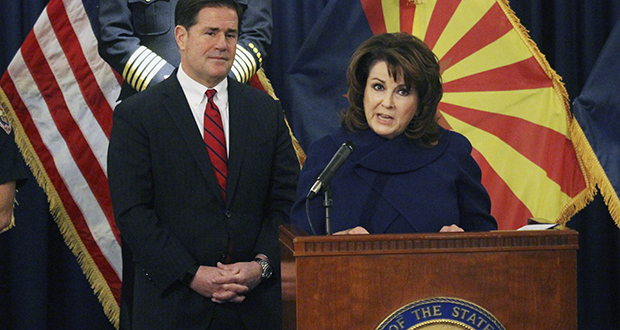
Vaccine passports, abortion bans and an oft-thwarted plan to get more money in lawmakers’ pockets were among the bills that made a late introduction as strike-everything amendments this week.
In the House, supporters of a less harsh criminal justice system used the striker process to potentially find a way around a Senate chairman who blocked their bills from making it to the full Senate. If the full House again approves a pitch for earned-release credits, the measure can now return to the full Senate for a final vote.
The Senate had a more adventurous final committee hearing. During a long and frequently intense hearing on March 31, Appropriations Chairman David Gowan entertained bills to ban vaccine passports, send doctors to jail for providing abortions and put more money in lawmakers’ pockets.

VACCINES
Sen. Kelly Townsend, R-Mesa, and Rep. Bret Roberts, R-Maricopa, got help from Kris Kobach, the former Kansas secretary of state and architect of controversial Arizona immigration law SB1070 in drafting a last-minute amendment to prohibit companies from declining service to unvaccinated customers and prevent employers from making vaccines a condition of employment. The bill would also prevent Arizona from allowing any version of a “vaccine passport” President Biden expressed interest in rolling out and that is being considered in European nations. The passports would allow fully vaccinated people to begin returning to something resembling pre-Covid life, such as showing proof of vaccination to attend a concert.
Townsend described that as creating a caste system, and Roberts compared refusing to let an unvaccinated person attend an event to racist store owners refusing service to Black Americans in the 1960s.
“If we can’t do it for skin color, we shouldn’t be able to do it for whether somebody took an experimental vaccine or not,” he said.
HB2190 passed the Senate Appropriations Committee on a 6-4 party-line vote on March 31.
ABORTION BAN
Republican Sens. Wendy Rogers, Sine Kerr and Kelly Townsend collaborated on the most far-reaching abortion legislation Arizona has seen in years — a bill that would ban all abortions after physicians can detect a fetal heartbeat. Doctors who performed abortions after that point could be charged with a Class 3 felony, and the bill also gave the would-be father of an aborted fetus the ability to sue the doctor.
Senators who voted for the bill March 31 acknowledged they intend for it to reach the Supreme Court and lead to a reversal of the Supreme Court’s landmark 1973 Roe v Wade decision — confirmed in multiple additional cases — that ensure a woman’s right to choose to have an abortion before the point of viability.
“I believe a 6-4 vote of this committee is good, but I believe a 6-3 vote by the United States Supreme Court is even better,” said Sen. David Livingston, R-Peoria.
The bill’s fate in the full Senate remains unclear, though this year’s Senate Republican caucus takes a significantly harder stance against abortion than prior ones. Sen. Michelle Ugenti-Rita, R-Scottsdale, said she needed to see significant changes to the language before she would be ready to vote for it on the floor.
“Every single word is going to matter,” Ugenti-Rita said. “When you take out a word like ‘knowingly,’ that matters. When you insert a word, that matters.”
PER DIEM
A Gowan plan to give lawmakers more cash passed Senate Appropriations with only Sen. Sean Bowie, D-Phoenix, opposed. The bill, which Gowan and Rep. David Cook, R-Globe, have tried versions of for three years running, would hike per diem payments for all lawmakers.
Under the bill, lawmakers who live in Maricopa County would get $56 daily, more than double the $25 they currently receive. Out-of-county lawmakers would receive closer to $200, the average annual federal per diem rate. They now get $60.
Gov. Doug Ducey vetoed a version of this bill in 2019, saying he didn’t want an increase for local lawmakers and that any higher rate should kick in after the following election, as happens with pay raises for elected officials. Gowan, who put an emergency clause on his bill to enable lawmakers to begin collecting higher allowances this year, countered that the election Ducey wanted to wait for already happened.
EARNED RELEASE
Among the few strikers in House Appropriations on March 30 was an amendment that supporters say is the last best chance to pass an expansion of prison earned release credits this year. SB1064, which the committee advanced on an 11-2 vote, would let drug offenders cut their sentences almost in half by taking part in drug treatment or work programs and let other nonviolent offenders cut their sentences by about one-third the same way.
“At the end of the day, this is about making sure we’re keeping violent people off the streets, we’re acknowledging victims in any sort of injurious situation, but also making sure we have a system that’s smart,” said sponsor Sen. J.D. Mesnard, R-Chandler.
Another bill that would have let inmates earn credits more quickly than Mesnard’s, HB2713, passed the House 47-11 in February but has languished without a hearing in the Senate. Rep. Walt Blackman, R-Snowflake, who sponsored the House version, spoke in favor of Mesnard’s proposal, as did Maricopa County Attorney Allister Adel.
“I feel strongly those who want to do better and be better should have the opportunity to do so,” Adel said.
Rep. John Kavanagh, R-Fountain Hills, who voted “no,” said he fears going back to the days of less consistent sentences that preceded the ‘80s and ‘90s, when most states enacted the tougher sentencing laws that are largely still in force today.
“I don’t think that this is really close to what I could support,” Kavanagh said. “I have real concerns about any bill that would allow a sentence to be cut pretty much in half.”
Tempers flare in House as committees hear controversial bills

Long-simmering tensions boiled over in the House Wednesday, as Democratic lawmakers and opponents of GOP-sponsored bills to tighten voting rules and let businesses avoid Proposition 208’s surcharge accused Republican committee chairman of trying to silence them.
Critics slammed this as part of a larger, years-long pattern of the Republican majority disrespecting and trying to silence members of the public, particularly women and people of color, who come to the Legislature to oppose their proposals.
At a news conference on Thursday Francisca Gil, with Our Voice Our Vote Arizona, talked about waiting almost seven hours to testify against a voting bill in 2020 and not being allowed to speak. Gil called their tactics “evil” and said things have gotten worse this year, suggesting this is connected to Republican losses in the last election, which saw President Biden narrowly carry the state and the election of a second Democratic U.S. senator.
“If they are not listening to Arizonans, who are they listening to?” she asked. “If they are not listening to the well being of Arizona they should not be holding seats in the Arizona Legislature.”
The head of the House Government and Elections Committee, who came in for criticism after Wednesday’s meeting when he tried to cut off a Democratic lawmaker’s explanation of her vote and at one point tried to have her recorded as not voting, responded that he allows robust debate in his committee and that people need to separate policy making from “the grandstanding which often happens in the media and on Twitter.”
“We debate issues vigorously, we challenge each other and that’s how we get to the truth,” Rep. John Kavanagh, R-Fountain Hills, said Thursday. “And after all the politics and the Twitter is done, we go back the next day and go back to doing the same type of debate as if nothing happened.”
Even before Wednesday, Government and Elections had already been one of the House’s most rancorous committees, as Republicans this year are pushing numerous laws that they say will safeguard against voter fraud, but Democrats say will make it harder to vote. The public testimony on SB1713, which as amended would require early voters to include their date of birth and either an Arizona driver’s license or voter registration number on the affidavit accompanying their ballot, started as Republicans quizzed at length Jeff Clark, the head of the Arizona State Association of Letter Carriers, with some asking why letter carriers would oppose a voter identification law and who his union endorsed in the last presidential election.
A little later, Kavanagh said only a few more people would be allowed to testify before the committee voted, prompting Rep. Athena Salman, D-Tempe, to protest that her caucus had legitimate questions about the bills and that the only people being “dilatory” were the Republicans who questioned Clark and that Democrats “sat silently and patiently as you interrogated a hardworking letter carrier who made sure we had a … safe election during a pandemic.” As the committee voted, the Democrats read testimony from some of the opponents of the bill who hadn’t been given time to speak.
When it was Salman’s turn, she criticized Kavanagh for limiting public testimony and accused him of violating the equality of members. Kavanagh tried to gavel her down repeatedly, saying she should confine her remarks to the pros and cons of the bill.
“I said explain your vote, Kavanagh said. “You are not explaining your vote. You are talking about procedural issues not germane to a vote explanation.”
After a bit more back-and-forth, Kavanagh said he would record Salman as not voting, and Salman and Rep. Kelli Butler, D-Paradise Valley, accused Kavanagh of committing a felony by trying to vote for another member.
“This bill in my opinion … would have the effect that Jim Crow restrictions had that this nation has seen previously, and Mr. Chair, I was well within my rights to point out all the people who were not allowed to testify in opposition to this bill,” Salman said.
Meanwhile, House Ways and Means was discussing SB1783, a bill to let some taxpayers choose between paying the individual income tax, which would potentially subject them to Proposition 208’s 3.5% surcharge if they make enough, or a new flat 4.5% small business income tax. This would, it is estimated, decrease the amount collected by the new voter-approved education funding surcharge by $263 million to $378 million yearly, according to an analysis prepared by Joint Legislative Budget Committee staff.
However, committee Chairwoman Rep. Shawnna Bolick, R-Phoenix, repeatedly tried to prevent the Democrats from bringing up Prop 208 as they asked questions about the bill, saying it was irrelevant since the bill didn’t mention Prop 208. She also cut off public testimony, leading Rep. Andrés Cano, D-Tucson, to accuse her of deviating from her previous promise to let three supporters and three opponents of the bill testify.
“Instead, we say, ‘don’t talk about Prop 208’ when the fiscal impact note specifically addresses this because the impact of the bill is going to mean $300 million at a minimum in a direct cut to our services,” Cano said. “What are you scared of by limiting the public? Why can’t you listen?”
Bolick accused Cano of acting like a preschooler, while the Republicans accused the Democrats on the committee of being rude to Bolick.
“Nothing we’ve been doing here has been respectful,” said Rep. Regina Cobb, R-Kingman, as she voted for the bill. “I’m saddened by your demeanor.”
House Minority Leader Reginald Bolding, D-Laveen, lodged a protest on the House floor Wednesday, saying what he witnessed Wednesday was one of the worst displays he had seen in his seven years in the Legislature.
“And I imagine every single person down here will have a different lens on what they see, which I respect, but what I can’t respect is what happened today,” Bolding said. “If you cannot handle the content and the speech that members are using when they’re discussing bills, don’t run the bills. We have bills that are attacking reproductive justice, bills that are attacking voting rights, bills that are attacking education. These are big topics we deserve to debate.”
Bolding said disagreement is healthy and to be expected but that the Republicans shouldn’t use their power to limit Democrats and the public’s ability to weigh in.
“What one member calls voter suppression, another may call security, and we have the ability to voice that, but to (silence) a member, that’s something we should never be doing,” Bolding said. “To tell the public ‘you can’t speak’ because they don’t like what you have to say, that’s something you should never be doing. We were all sent here to represent our constituents, our values, to use our voice. As members of the minority, our voice is our vote, and we have to have the ability to use it.”
Representatives of progressive groups that often testify in front of the Legislature gathered outside the House Thursday to say Wednesday’s actions were part of a years-long pattern of GOP chairmen limiting both public testimony and the speech of Democratic committee members and trying to silence members of the public they disagree with, particularly women and people of color.
“Yesterday’s events were … not the first time the public and members of the Legislature have watched as … (Kavanagh) belittled, disrespected and conducted committee meetings in authoritarian behavior styles,” said Alicia Contreras, the executive director of Corazón Arizona. “He never is shy about shouting and speaking over folks due to their race, gender or political stance, especially women, which we watched yesterday in horror.”
Kavanagh defended his conduct of the meeting, saying part of his job as chairman is to move through bills in a reasonable amount of time and that Salman should have stuck to the bill itself in her explanation.
“You know what I have a pattern of?” he said. “I let people have vigorous debate, and if someone says a ‘to the point,’ we stop the conversation and address the point. We don’t wait 10 minutes and let people forget what the point was. Everyone is ‘to the point’ debating and arguing, because it’s through vigorous debate that you arrive at the truth, and they (the Democrats) are just as quick to go ‘to the point’ as I am or another Republican is.”
Key criminal justice bills dormant in Senate

Although several measures aimed at cutting prison sentences and making other major changes to Arizona’s criminal justice system have passed the House this year, the big question is whether these bills will make it through the Senate or even get a hearing there.
Advocates for reducing Arizona’s incarceration rate – the fifth-highest in the nation in 2019 according to U.S. Department of Justice statistics – had some reason for hope when the 2021 legislative session started. Eddie Farnsworth, the former Senate Judiciary chairman who often opposed proposals to revamp sentencing, is out of the Legislature, having not run for re-election in 2020.
In the House this year, so-called reform bills ran not through the Judiciary Committee, but through a new Criminal Justice Reform Committee, chaired by Rep. Walt Blackman, R-Snowflake, a longtime advocate for criminal justice change.

Blackman’s committee advanced numerous bills, including ones to let more prisoners earn credits toward early release, create an independent ombudsman to oversee Arizona’s prison system, let judges assess shorter sentences than a statutory mandatory minimum in some cases and put new limits on civil asset forfeiture.
Most of these measures passed the House easily. A few, including HB2162, which would let some people convicted of low-level felonies have their convictions classified as misdemeanors, and HB2318, which would make some changes to “repetitive offender” sentencing, have made it through Senate Judiciary and appear to be on track to become law. However, three or four weeks after most of these measures have been transmitted to the Senate, some major criminal justice bills that passed the House haven’t been scheduled for a Senate hearing, leading activists to worry these efforts could stall yet again.
“It’s really unfortunate,” said Darrell Hill, policy director for the American Civil Liberties Union of Arizona. “I think the House did a great job of passing a wide array of criminal justice reform bills, and thus far no one in the Senate has indicated that they’re willing to join with this bipartisan consensus and pass criminal justice reform, so that’s really disappointing to us.”
Hill said his organization would like to see Senate President Karen Fann, R-Prescott, or Sen. Warren Petersen, R-Gilbert, chairman of the Senate Judiciary Committee, to make sure the bills get an up or down vote in committee.
The ACLU has been encouraging its supporters to reach out to Petersen and urge him to schedule a hearing on the bills. So has the American Friends Service Committee of Arizona, a Quaker organization that seeks to revamp the criminal justice system.
Petersen didn’t return calls and emails by press time. Blackman said he has been working with Petersen and is still hopeful the yet-to be scheduled bills will get heard.
“We’ve been talking and trying to work out some kinks in the bills and concerns he has and some of the members have,” Blackman said.
Blackman said he is “hoping we will come to an agreeable resolution to come across the finish line,” and added that he would particularly like to see HB2167 passed, which would create an independent ombudsman to monitor the state’s prison system. Blackman put out a statement in early March pointing to several recent scandalous issues involving the state’s prison system as evidence of the need for greater oversight. They included a sexual assault lawsuit, the state being fined $1.1 million in February for not complying with court orders to improve inmate health care and the state’s inmate management software not calculating some prisoners’ release dates correctly, potentially resulting in inmates being imprisoned longer than they should be.
“I believe that is the cornerstone of reform and if we can get that, we’ll be fine,” Blackman said March 17.
Opponents of HB2167 include the Arizona Police Association and the Fraternal Order of Police. Rep. John Kavanagh, R-Fountain Hills, who voted against the bill, said during a House Appropriations Committee meeting in February that he views it as creating a public office whose job is to advocate for political change on behalf of prison inmates, “which I do not believe is the role of government-funded employees.”
Kavanagh said the ombudsman would save lawyers who want to sue the state over prison conditions the trouble of researching things themselves, and predicted Gov. Doug Ducey will veto the bill if it reaches his desk.
“This is publicly paid advocacy against our corrections department,” Kavanagh said.
Caroline Isaacs, American Friends Service Committee of Arizona’s program director, said she has been working with numerous organizations, including some major conservative groups, to advance criminal justice change this year. She said she views HB2167 as particularly necessary given the recent scandals at the department.
“It’s hard to fathom why we would not be having a conversation over prison oversight right now,” Isaacs said.
Isaacs also said that HB2673, which would let judges sentence an offender to less than a required mandatory minimum if the judge determines adhering to the minimum would be unjust and the public won’t be endangered. She said the bill shouldn’t be controversial, noting that the idea has many conservative backers.
“That’s an ALEC bill,” she said, referring to the American Legislative Exchange Council, a nonprofit organization of conservative state legislators and private sector representatives who draft and push legislation. “That’s a Rand Paul bill.”
Rep. Joel John, R-Buckeye, who sponsored HB2673, said he was inspired to do so after he got to know a man who worked on his farm and spent several years in prison for petty crimes he committed after he became addicted to painkillers, which were originally prescribed for a work-related injury.
“There were people who spent less time in prison than he did for more serious offenses, and that didn’t seem right to me,” John said.
Opponents include Yavapai County Attorney Sheila Polk and Steve Twist, a longtime victims’ rights advocate who was assistant state attorney general during much of the period decades ago when lawmakers were adopting today’s tough sentencing laws. Both wrote to committee members saying mandatory sentences prevent unjust disparities in sentencing, according to a Capitol Media Services story about the hearing.
“Arizona adopted sentencing ranges to promote uniformity,” Polk wrote. “This bill takes us back to the days when who you are, where you live, and who your sentencing judge is will determine your sentence.”
Ducey spokesman C.J. Karamargin declined to comment on any of the bills, saying the governor has a longstanding policy of not weighing in on pending legislation. In the past, Ducey has been supportive of initiatives aimed at reducing recidivism, but has been skeptical of other criminal justice change efforts. He vetoed a 2019 bill to limit the use of Arizona’s “repeat offender” law to sentence people who don’t have prior criminal convictions. In this year’s State of the State Address, Ducey said he hoped to work with lawmakers on criminal justice change but didn’t offer any specifics.
“If there are other things that we can do that provide opportunities for people that better deal with mental health issues or addiction issues, I’m open-minded to that,” Ducey told the Arizona Mirror in January. “But … among the top priorities for me is public safety. And I’m not going to do anything that would lessen the amount of public safety and attention to law and order in the state or Arizona.”
Some criminal justice reform measures do seem to be moving through both chambers. Senate Judiciary was scheduled to hold hearings on March 18 on two of the House Criminal Justice Reform Committee’s bills — HB2171, to make some tweaks to marijuana laws in response to Proposition 207, and HB2165, which would allow some lower-level felons to serve part of their sentences on home arrest instead of in prison.
SB1250, which would let government and public health agencies and some private groups run needle exchange programs, passed the Senate 27-2 and on March 15 made it out of House Health and Human Services unanimously. Former Rep. Tony Rivero, R-Peoria, pushed the needle exchange idea for several years, and one of his bills to allow them passed the House last year but didn’t make it through the Senate.
Sen. Nancy Barto, R-Phoenix, who is sponsoring it this year, said she opposed needle exchange programs before but Rivero helped to change her mind.
“It took a learning process for me to kind of get there,” she said. “I finally began listening to Representative Rivero, who was intent on educating a lot of us who were really not open to this idea because we really thought we were encouraging drug use by having needle exchange programs available.”