Please ensure Javascript is enabled for purposes of website accessibility

Bill requiring local cops to notify ICE of an immigrant arrest advances

Key Points: 
  • ICE would be alerted as an arrest is taking place
  • Democrats express concerns the measure could trigger violence
  • Republicans say SB1055 will make Arizona streets safer

Republican lawmakers are moving to force state and local police to take a more active role in reporting people who are not in the country legally.

Legislation approved earlier this week by the Senate on a party-line vote would require any agency arresting a possible illegal immigrant to notify Immigration and Customs Enforcement. And that would be “immediately,” before any adjudication of guilt. That amounts to ICE being called to come to the location where an arrest is being made.

But Democrats fear that what’s in SB1055 would not just sweep up others but actually result in dangerous confrontations on the street with what Sen. Analise Ortiz, D-Phoenix, calls “a murderous force” of agents and what Sen. Lauren Kuby, D-Tempe, called a “lawless agency.”

That, in turn, brought a sharp retort from Sen. Jake Hoffman. The Queen Creek Republican read off a list of people killed by those not here legally, calling them “the actual murderous force.”

“Democrats in this chamber are arguing that those illegal alien criminals should be allowed to roam free on our streets,” Hoffman said. “Anyone who stands up for those people, you’re disgusting.”

Senate Majority Leader John Kavanagh said the concerns of foes are overblown.

“All it does is require cooperation between different levels of government, something that makes government effective,” said the Fountain Hills Republican. “People who are accused of being here illegally need to be brought to justice.”

That, he said, means bringing people before a hearing officer, saying they will receive “due process.”

“And whatever the result is, that’s what we do,” Kavanagh said. “And this facilitates it.”

Senate Minority Leader Priya Sundareshan said her problems with SB1055 begin with the fact that it is just the arrest that triggers a call to ICE.

“So there has been no evidence provided, jury trial provided, or anything that proves that anyone that might have been arrested is, in fact, guilty,” said the Tucson Democrat.

Ortiz said it’s also important to remember that any “arrest” would trigger that call to ICE to show up. And that, she said, even could include a citation for jaywalking, with cities like Phoenix now issuing them to offenders.

Hoffman said he sees it from a different perspective.

“This is once someone has been arrested, then, yes, we do want our law enforcement in Arizona to coordinate with ICE if they’re an illegal alien,” he said. “Even if you support illegal immigration, it’s absurd that you would not want the criminals who come over illegally removed from this country.”

But it’s the mechanics of how the measure would work, Ortiz said, that could create a hazardous situation.

It starts, she said, with that requirement for immediate notification of ICE. That, she said, means agents showing up at the arrest scene.

“Anyone in the surrounding community is then put in danger by masked, armed, Call of Duty ‘cosplayers’ who are eager to use their weapons,” she said. “We have seen that happen, whether it’s a gun, whether it is chemical irritants, whether it’s beating somebody to a pulp on the concrete.”

Hoffman, however, insisted that the legislation would create safer communities.

“The safest place for a transfer to occur is, statistically, when they’re already in custody,” he said.

“It’s Looney Tunes for anyone to think otherwise,” Hoffman said. “It poses the least risk to the rioters, activists who are protesting and getting in the way of and trying to run over ICE agents.”

He also said nothing in the legislation would overturn “longstanding professional practices of law enforcement” which say that transfers of arrested people should occur “at the time most safe to the public.”

And Hoffman lashed out at Ortiz and her description of federal immigration agents as a “murderous force.”

“The actual ‘murderous force’ are the dangerous illegal criminal aliens coming into the country,” he said.

But Kuby said the record suggests otherwise.

“They’re using illegal, excessive use of force, often against U.S. citizens who are denied due process,” she said, citing what she called were the “murders” of Alex Pretti and Renee Goode in Minneapolis.

“Killing people in the streets, this is what we are seeing,” Kuby said. “So, by empowering a lawless agency such as ICE this bill … would make our public less safe, not more, safe.”

She also cited the decision last month by the Tucson City Council which voted to limit immigration enforcement on city-owned and city-controlled property and buildings, to prevent agents from using them as a staging area for mass arrests. That decision, said Kuby, was “due to the glut of untrained, undisciplined federal agents who are terrorizing communities across our country.” 

Hoffman responded by saying that Kuby cited only two people in her complaints against ICE. And he argued that even in those cases their killings were justified.

He said Pretti “was armed and attempting to obstruct ICE operations,” though the multiple videos of his killing appear to tell a different story, with Pretti, licensed to carry a concealed weapon holding only a cell phone in his hand. And Hoffman said that Goode “was attempting to run over an ICE agent with their vehicle.”

“In the real world, that’s called attempted murder with a vehicle,” Hoffman said.

Then he listed a series of names of individuals who were killed by people not here legally, people he called “the actual murderous force.”

“And yet we’ve got people over here arguing that they should stay on our streets,” Hoffman said.

Ortiz said there’s another problem with the bill, saying it might deter some crime victims who are not here legally from calling police.

Consider, she said, a restaurant owner who was robbed but then sees the suspect. And if the suspect turns out to lack legal status, then it would trigger SB1055.

“ICE is then going to show up, which then puts the business owner in danger and anybody eating at the establishment in danger, people who are innocent and have nothing to do with the crime,” Ortiz said.

Ditto, she said, of domestic violence survivors.

“Oftentimes, what we’re seeing is that abusers will use your status as a way to scare you out of calling the police,” Ortiz said.

“This bill will only lead to increased instances of ICE either showing up at somebody’s home because they called the police needing help or a business in our community,” she said. “We know no one patronizing that business is going to be safe if ICE is called to deal with a potential crime.”

In some ways, what is in SB1055 is an extension of what lawmakers approved in 2010 as part of the controversial SB1070 from that year.

That measure was designed to give state and local police more power to detain those who are not in this country legally.

Many provisions were voided in a historic 2012 ruling by the U.S. Supreme Court.

The high court said the state lacks the authority to prosecute those seeking work in Arizona without being in this country legally and those failing to carry federally issued registration cards.

It also ruled that Arizona cannot allow warrantless arrests if there is “probable cause” that a person committed an offense that makes them removable from the country under federal law. The justices said all three provisions illegally conflict with – and are preempted by federal law.

However, the court said there was nothing inherently wrong with SB1070’s requirement that police make a reasonable attempt, “when practicable,” to check the immigration status of those they have stopped. That part of the law remains on the books.
Gov. Hobbs touts NCAA Final Four economic haul

Arizona generated $429 million in economic impact from hosting the Men’s Final Four in April according to a new report released Tuesday.

But Gov. Katie Hobbs said she is “really concerned” that it will be the last time Arizona gets to host a national sporting event of this caliber if voters approve what Republicans put on the ballot as the “Border Security Act.”

Proposition 314 would allow state and local police to arrest those who enter the country at other than a port of entry. It also would create criminal penalties for using false documents to seek public benefits or apply for a job.

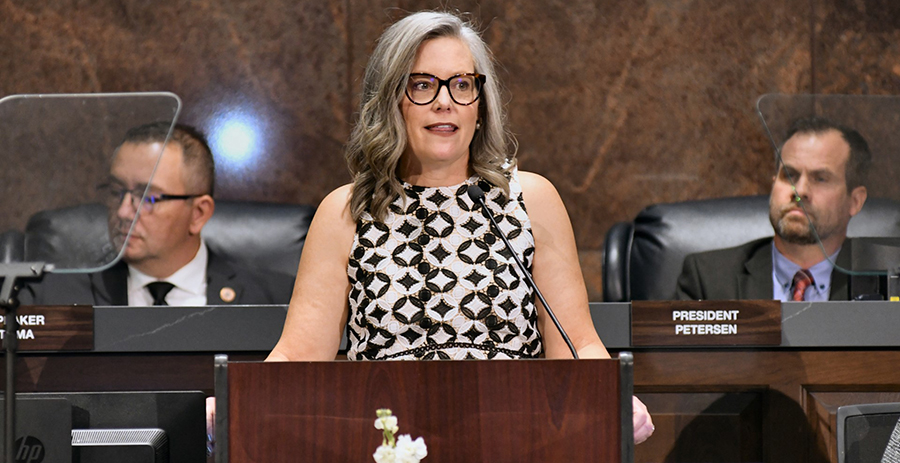
Gov. Katie Hobbs addresses state lawmakers Jan. 8, 2024, in her second State of the State address. Behind her are House Speaker Ben Toma and Senate President Warren Petersen. (Capitol Media Services photo by Howard Fischer)

And it would provide for a presumptive 10-year prison term on those who sell fentanyl if it results in the death of another person.

Hobbs said Tuesday she does not believe that the proposal would deal with the problem of people crossing the border illegally. She said at least part of the solution needs to come from Congress where Republicans refused to support what had been crafted as bipartisan border legislation.

But the new report also highlights another side of the issue: what economic effect Prop 314 could have on the state.

“This will put Arizona in the worst negative spotlight nationally that we can imagine,” the governor said.

There is some reason for her concern.

Arizona lost several national conventions and conferences after lawmakers here approved SB 1070 in 2010, a measure designed to give police more power to detain and question those they believed were not in the country legally. Parts of that were overturned by the U.S. Supreme Court though at least one provision remains: the so-called “papers, please” language that permits officers, if they have stopped someone for another reason, to inquire if there is “reasonable suspicion” that person is in the country illegally.

There also was a call to have Major League Baseball move its 2011 All-Star Game from Phoenix, though that did not materialize.

More recently, the NCAA, which puts on the Final Four, stripped North Carolina of its ability to hold championship games there in protests over state legislation restricting which bathrooms transgender individuals could use. That decision was reversed after the state repealed the law in 2017.

Looking forward, Prop 314 comes as Arizona is in the pipeline for future NCAA events, That includes plans for the Women’s Final Four in 2026.

Hobbs said that the $429 million economic impact figure for this year’s event is more than $100 million more than the last time the state hosted the event in 2017.

The report prepared by the Seidman Research Institute at Arizona State University estimated that nearly 115,000 out-of-state visitors came to Arizona over the three days of the tournament primarily for the event.

It also says more than 68,000 of these visitors had tickets to at least the Saturday semifinal games. They stayed an average of 3.9 nights and spent an average of $482 per person per day.

Hobbs said these kinds of events “put Arizona in the best possible national spotlight.”

And Prop 314?

“It’s a contrast to the harm that this proposition will cause if it’s passed,” the governor said.

Her comments about fallout from the measure drew an angry reaction from House Speaker Ben Toma who is the sponsor of what became Proposition 314.

“That suggestion is both absurd and indefensible,” the Peoria Republican told Capitol Media Services, saying it is a response to Arizonans being “fed up with the open-door policies” of the current Democratic administration in Washington.

“Proposition 314 presents voters with meaningful, commonsense reforms that will help protect our communities,” Toma continued. “Instead of resorting to fear-mongering, the governor should be supporting these efforts.”

The upcoming campaign is anticipated to be both high profile and divisive.

Lawmakers actually approved part of what is in the measure earlier this year: giving police the power to arrest border crossers. That bill, sponsored by Sen. Janae Shamp, R-Surprise, was modeled after Texas’ controversial SB 4.

That was vetoed by Hobbs.

I absolutely understand Arizonans’ frustration and put me on the top of that list of the federal government’s failure to secure our southern border and the feeling of wanting to take it into your own hands,” the governor said at the time, saying that bill is “not the answer to that problem.”

Undeterred, Toma recrafted it as a ballot measure, one that is not subject to a gubernatorial veto.

Lawmakers added in the provisions on public benefits and employment. They also tacked on a variant on another Hobbs-vetoed measure on harsher penalties for fentanyl sales.

It squeaked out of both the Republican controlled House and Senate with the bare minimum of votes needed to refer it to the ballot, all of them coming from Republicans.

The new plan is opposed by some business interests.

James O’Neill, political director of the American Business Immigration Coalition, said during the debate over the measure that its concerns reflect what happened in 2010.

“Everybody still remembers the reputational damage that 1070 did,” he said. “Everybody remembers the damage that it caused and so I think that’s why folks are ready, willing and poised to defeat this initiative.”

Other groups, including the Greater Phoenix Chamber of Commerce, the West Valley Chamber of Commerce Alliance and the Chandler Chamber of Commerce signed in opposing the measure.

The Arizona Chamber of Commerce, however, has taken a more nuanced stance.

Prior to a vote on sending the plan to the ballot, chamber President Danny Seiden issued a statement saying his group shares with lawmakers the “frustration with the lack of federal action on immigration and border enforcement.”

“We also recognize that lawmakers at the ballot box is fraught with the potential for unintended consequences,” he said. And Seiden pointed out that a constitutional amendment leaves lawmakers pretty much powerless to make changes if the measure is approved.

But the organization is going to sit out this fight.

“The chamber has not taken a position on 314 and does not plan to,” organization spokeswoman Annie Dockendorf said Tuesday.

She acknowledged Seiden had made some comments about the proposal. But Dockendorf also said it “morphed throughout the process.”

“This is a ballot measure we’re staying out of though,” she said.


Lawmakers set to vote on border legislation

State lawmakers have set the stage for final approval of legislation billed as providing increased border security. On Thursday, the Senate gave preliminary approval to HCR 2030, a multi-pronged proposal...

Get 24/7 political news coverage and access to events honoring top political professionals

Texas inspired border measure gets initial approval

A Senate committee approved a ballot referral on Wednesday that would allow local police to arrest people who enter the country illegally – despite concerns from Democrats that the move...

Get 24/7 political news coverage and access to events honoring top political professionals

Hobbs’ 1st veto comes on GOP border bill

Gov. Katie Hobbs late Monday quashed a bid by Republican legislators to allow state and local police to arrest those who have entered the country illegally. “This bill does not...

Get 24/7 political news coverage and access to events honoring top political professionals

New American Leaders fuels confidence in political hopefuls

When Anna Hernandez lost her younger brother, Alejandro, 26, to a Phoenix Police shooting in 2019, it prompted her to become more involved in community organizing, but she said she...

Get 24/7 political news coverage and access to events honoring top political professionals

Russell Pearce, author of SB1070, dies at 75 

In this April 19, 2010 file photo, Arizona state Sen. Russell Pearce, R-Mesa, speaks during a vote on SB1070 , a new immigration bill, in Phoenix....

Get 24/7 political news coverage and access to events honoring top political professionals

Bowers: ‘delicious’ irony group failed to recall him

Rusty Bowers A recall of House Speaker Rusty Bowers won’t make the ballot because the right-wing group behind it didn’t fill out the forms correctly.    The Patriot Party...

Get 24/7 political news coverage and access to events honoring top political professionals

Finchem recall effort fizzles

Wearing a face covering and sitting among socially-distanced plexiglass, Rep. Mark Finchem, R-Oro Valley, sits at his desk during the opening of the Arizona Legislature at...

Get 24/7 political news coverage and access to events honoring top political professionals

You don't have credit card details available. You will be redirected to update payment method page. Click OK to continue.