Sign In
 Free Newsletter

Ag-to-Urban will reshape Arizona’s agriculture industry, but farmers question if it’s worth it
Ellis Preston, Arizona Capitol Times//October 10, 2025//
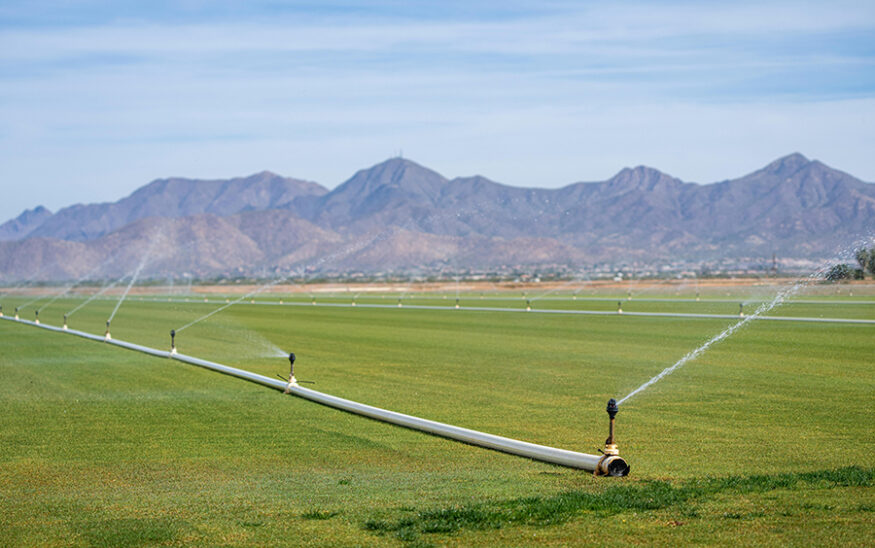
(Mark Stebnicki / Pexels)
Ag-to-Urban will reshape Arizona’s agriculture industry, but farmers question if it’s worth it
Ellis Preston, Arizona Capitol Times//October 10, 2025//


Key Points:
-
Ag-to-Urban went into effect on Sept. 26 after passing this year
-
Program is expected to save about 7.1 million acre-feet of water over the next 100 years in Phoenix
-
Some farmers are concerned about how Ag-to-Urban will affect the farming community
A new law aiming to save water through the sale of Arizona’s farmlands to housing developers has marked a new era of urbanization across Arizona — and farmers are beginning to worry.
Having gone into effect on Sept. 26, Ag-to-Urban introduced a new program allowing farmers with “Irrigation grandfathered rights” to trade in their water rights for Groundwater Savings Credits. Those credits can then be traded in for compensation when the land is sold, offering farmers a new path to retirement, and developers a new source of previously unavailable development land.
“When you kind of have faith that this is going to be a good thing, but you don’t know all of the steps involved, it gives a little bit of unease,” said Jadee Rohner, executive director of the Arizona Cotton Growers Association.
Rohner said that while some farmers may not approve of Arizona’s transition out of agriculture, Ag-to-Urban allows them to profit from the inevitable change, giving control over the situation.
“We do not want to see agriculture go away, but … if it’s going away, we need to make sure that producers are taken care of,” Rohner said.
As of 2024, roughly 34% of Arizona’s total acreage was farmland.
According to a 2022 census of agriculture report, there were over 1.9 million farms in the U.S. and 16,710 farms in Arizona —a number that decreased by over 12% between 2017 and 2022. Arizona accounted for just 0.8% of the U.S.’s farms in 2022.
Rohher said that among the agricultural community, Ag-to-Urban has become a divisive concept, as some farmers are relieved to earn money from unwanted land, whereas others are concerned about what the law means for the future of farming.
“Especially within those rural communities that have that deep appreciation for agriculture, they don’t necessarily want to see urbanization and development coming into some of their smaller communities, they’re pretty satisfied with the status quo,” Rohner said. “This bill can be viewed negatively in that sentiment, because they don’t want to see agriculture go away.”
A report from the American Farmland Trust, titled “Farms Under Threat,” predicts that based on recent trends, Arizona will “pave over, fragment, or compromise 444,500 acres of farmland” between 2016 and 2040. This is the equivalent of 1,100 farms and 1,700 jobs, according to the report.
Rohner said urbanization may affect Arizona’s rural towns, which profit the most from agriculture and have farming integrated into their culture.
“A lot of those smaller communities that are agricultural based have a deep appreciation for agriculture where their food comes from, the fiber that they utilize in their clothing and the food on their table,” Rohner said. “As we see, some of those economic drivers in those communities change, we see an influx of individuals that may not have that same affiliation and or appreciation, and that, in itself, is hard.”
Despite concerns about the future of rural farming communities, Rohner said she still supports Ag-to-Urban due to the amount of water it is expected to save and its initiative to provide producers with money for land conversion.
According to an estimated water savings report from the Arizona Department of Water Resources, it is expected that Ag-to-Urban will save about 7.1 million acre-feet of water over the next 100 years in Phoenix. The same report estimates that Pinal County will save 2.5 million acre-feet of water over the next 100 years with the program.
Another report from the USDA’s 2022 Census of Agriculture stated that in 2023, Arizona used 3.9 million acre-feet of water, equivalent to approximately 4.3 acre-feet of water per acre. According to the report, Arizona applied the most water per acre.
As a longtime farmer in Goodyear, Arizona, Ron Rayner said losing farmland to real estate and developments is not foreign to him or his community.
Rayner said if offered, he would be willing to participate in the Ag-to-Urban program.
Over the past year, Rayner said he has been working on a vertical farming project as a way to coexist with developments coming through his area.
“We’ve expended quite a bit of money, and we’re really still investigating. We believe that it can work,” Rayner said. “There’s no real roadmap to follow. There’s just a lot of people that got broke trying to do it.”
While the program is expected to expedite urbanization in farming communities, both producers and water experts have emphasized that they have faith in the program’s ability to save water and compensate farmers.
Patrick Bray, the executive vice president of Arizona Farm and Ranch Group, has been in the agriculture business for the majority of his life. He said that while he may grieve the loss of farmland, he appreciates the benefits that Ag-to-Urban can provide for members in his community who need the money for retirement.
“Our family farm is down to a few hundred acres. And so you know why the change is hard to see, especially when you’ve been out there on that land for decades, it pulls out the heartstrings,” Bray said. “But at the end of the day, it’s important that those people who don’t want to farm anymore … that, that option stays viable for them”
Bray said that he does not expect Ag-to-Urban to hinder or harm the farming community, but rather to improve the current agricultural industry for the betterment of both parties.
“The agriculture industry itself is very much thriving. It’s changing, but it’s thriving,” Bray said. “So while people may not see the fields like they used to, they still exist, it’s just in different places. And I will tell you, I believe that the ag industry is thriving, but it is going to be a generational change.”