Sign In
Upcoming Event
 Free Newsletter

New AHCCCS director says she is ready to tackle fraudulent billing
Jakob Thorington Arizona Capitol Times//November 14, 2025//
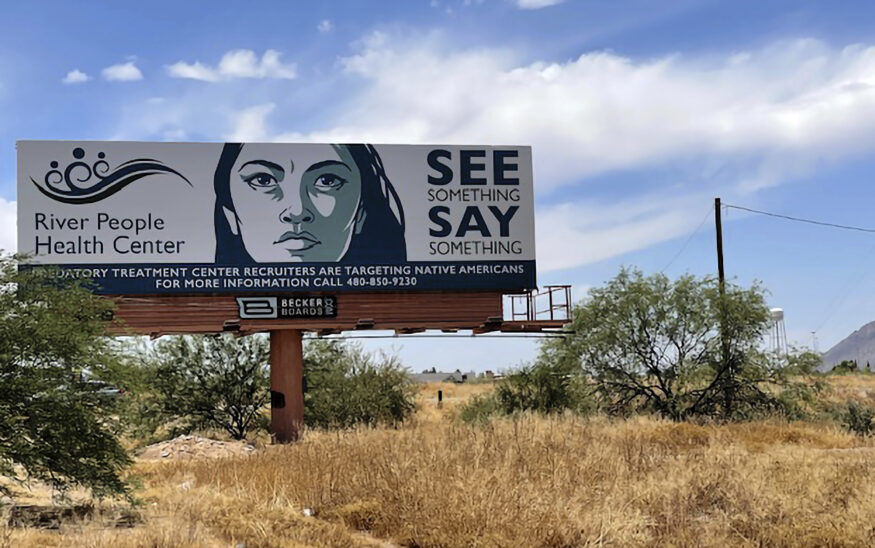
A billboard is seen in Scottsdale, Ariz., Saturday, June 10, 2023, near the health care facility of the Salt River Pima-Maricopa Indian Community, which has been affected by a gigantic Medicaid fraud scheme involving sober living homes that promised help to Native Americans seeking to kick alcohol and other additions. (AP Photo/Anita Snow, File)
New AHCCCS director says she is ready to tackle fraudulent billing
Jakob Thorington Arizona Capitol Times//November 14, 2025//


Key Points:
-
New Medicaid director vows to tackle fraudulent billing issues
-
Lawmakers scrutinize AHCCCS for alleged $650 million fraud scheme
-
Lawmakers seek to reduce administrative burden for ethical Medicaid providers
The new director of the state’s Medicaid program promised lawmakers that she will work to solve issues in fraudulent billing and a loss of access to health care with the long-scrutinized agency.
“The alarming situations of abuse, brokering and displacements of vulnerable individuals and sadly, even individuals who have died — It’s pretty overwhelming,” Ginny Roundtree, director of the Arizona Health Care Cost Containment System, told lawmakers at a Senate Health and Human Services Committee on Nov. 12. “The members that we serve are the most important. They’re the highest priority.”
Lawmakers have been examining AHCCCS for months to address growing reports of fraudulent claims tied to resident treatment facilities targeting Native American and homeless patients. That includes an alleged $650 million scheme with at least 41 substance abuse treatment clinics cited by the U.S. Department of Justice to have been committed by Jarar Ali, the owner of Pakistan-based ProMD Solutions.
Ali is alleged to have submitted $650 million in false and fraudulent claims to AHCCCS for addiction treatment services that were not provided, resulting in the agency paying $564 million. Senators on the Health and Human Services Committee say this kind of behavior became far too common, leading to nearly $2.8 billion in Medicaid billing fraud while 140,000 patients were disenrolled from the program and struggled to receive care.
“Arizona families and providers deserve honesty, transparency, and meaningful corrective action,” said Health Committee Chairwoman Sen. Carine Werner, R-Scottsdale.
The hearing was the third this year organized by Werner to examine how fraud has impacted AHCCCS and Arizona patients. It was also the first time a director of the agency spoke to the committee, after Gov. Katie Hobbs appointed Roundtree as the agency’s director on Oct. 6. AHCCCS had been operating with an interim director since April.
“Ginny is a dedicated leader with a deep understanding of the challenges and opportunities in health care,” Hobbs said of Roundtree’s appointment. “Her expertise and passion for serving our community prepared her to lead this critical agency. I’m confident she will help us protect and enhance vital health care for everyday Arizonans.”
Roundtree said she is looking to bring in outside resources who are knowledgeable about the billing claims process to help her staff address a backlog of claims and get health care providers paid.
“There’s a lot to do and I understand the urgency and priority,” Roundtree said.
Since Roundtree was appointed, health care providers are already reporting a better working relationship with AHCCCS, said Michelle Coldwell, director of public policy at the Arizona Council of Human Service Providers.
The council now has a working group with AHCCCS that meets regularly to discuss pre-authorization issues —the process of determining which health care services are covered by Medicaid prior to treatment. Coldwell said the council is planning to launch a behavioral health training catalyst program in partnership with AHCCCS by next spring.
“There’s still work to be done,” Coldwell said. “But the progress made over the last several months is encouraging.”
Some lawmakers have expressed concern about the AHCCCS pre-payment review process, in which the agency will withhold payments to health care providers to identify claims that might not be medically necessary or require additional information before the agency pays providers.
Sen. Hildy Anguis, R-Bullhead City, said the agency’s pre-payment review process with fraud claims can be overly long, taking up to a year in some cases, while the agency treats a provider as “guilty until proven innocent.”
“It ain’t working. It’s just not working,” Anguis said.
Werner said the Legislature will be looking at ways to reduce the administrative burden for ethical Medicaid providers while AHCCCS recalibrates its internal processes in its mission to reduce fraudulent billing after two providers serving more than a combined 5,700 patients had to close practices in Arizona this week alone.
“We are demanding a lot from providers without any alignment in reimbursements, causing an already fragile system to shutter,” Werner said.