Sign In
 Free Newsletter

Arizona Supreme Court rejects claim that retention election scheme is unconstitutional
Howard Fischer, Capitol Media Services//December 4, 2025//
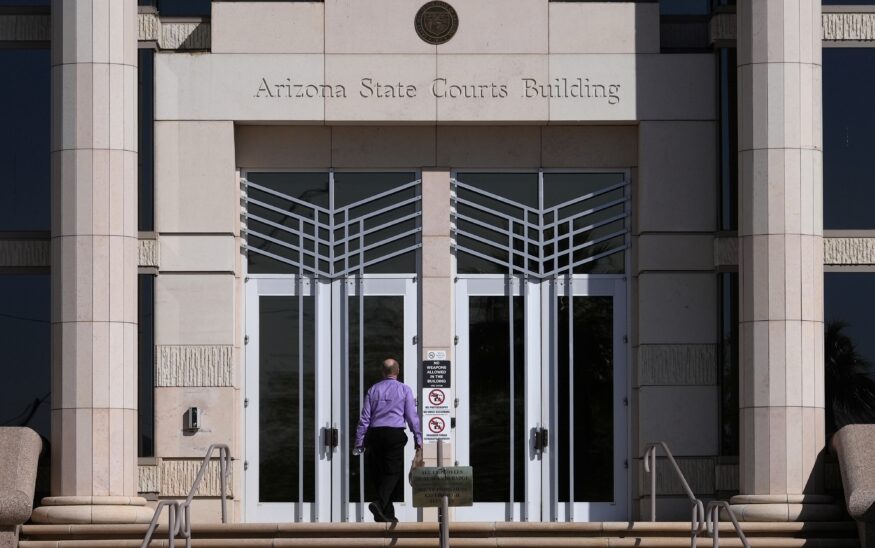
A man enters the Arizona Supreme Court building, Wednesday, April 10, 2024, in Phoenix. (AP Photo/Matt York, File)
Arizona Supreme Court rejects claim that retention election scheme is unconstitutional
Howard Fischer, Capitol Media Services//December 4, 2025//


Key Highlights:
- In a unanimous ruling justices reject arguments that selection system violates state’s guarantee of fair elections
- Court found that geographic voting districts do not disenfranchise any voter
- Legislature set up the system of appellate court divisions
PHOENIX — Arizonans have no constitutional right to vote on all the judges on the state Court of Appeals, even if they are deciding cases that directly affect them or the counties where they live, the Arizona Supreme Court has concluded.
In a unanimous ruling Thursday, the justices rejected arguments by the Goldwater Institute that the system, which dates back to the 1960s, violates state constitutional provisions guaranteeing free and equal elections.
Justice James Beene, writing for the court, acknowledged that the method of electing appellate judges allows only some people to vote for some judges, all based on where voters live. And he said it also is true that appellate court rulings could affect people who, because of where they live, have had no voice in deciding whether to elect the judges who rule on their cases.
But that, Beene said, doesn’t make it illegal. “Plaintiffs point to no constitutional provision that guarantees a right to vote for every Court of Appeals judge,” Beene said.
The justices separately rejected a challenge to the whole process of how the state is divided up —and, more to the point, who gets to vote for which appellate judges —violates the concept of one person, one vote. Beene said even the U.S. Supreme Court has said that principle does not apply to judicial elections.”Judges are not representatives,” he said.
Under a voter-approved system, appellate judges, like those on the Supreme Court, are chosen by the governor, who must choose from nominations of a special screening panel.
The names of those appointed then appear on the ballot every six years, with voters deciding whether to retain them in office or oust them. What’s at issue here is who gets to vote for which judges.
At the Supreme Court, all Arizona voters get to decide the fate of all justices. Not so at the appellate level. There are two divisions of the court: one covering eight counties and one covering seven. But the voting procedure is even more complex than that.
In Division 1, of the 19 judges, 10 are residents of Maricopa County, and only residents of that county decide their future. Five are from the remaining counties in the division: Yuma, La Paz, Mohave, Coconino and Yavapai. Navajo or Apache — and voted on only by residents of those counties; four are elected at large from all nine counties.
A similar situation exists in Division 2, with four judges elected from Pima County, two from Pinal, Cochise, Santa Cruz, Greenlee, Graham and Gila counties, and three at large.
That, in turn, affects who gets to vote on which judges.
For example, Beene said, Maricopa County residents might get to vote for up to 14 appellate judges while residents of the remaining Division 1 counties might get to vote for nine — or as few as five.
What that also means is that a three-judge appellate panel that happened to have no Yuma County judges might decide an issue affecting Yuma County residents. And that, according to Goldwater, is just part of the problem.
In challenging the system, the organization noted that the Supreme Court receives anywhere from 1,200 to 1,600 petitions to review appellate court decisions each year.
But the justices typically accept only between 50 and 75 for review. And that means the remaining appellate court decisions —the ones issued by judges who are not subject to review by all voters statewide and may never have been voted on by those affected — become the last word for litigants.
Scott Freeman, an attorney with Goldwater, said the problem goes beyond the individual litigants in any case. He said what also makes it unfair is that appellate judges can issue opinions that are “binding legal precedent” for the entire state. “The judges on this court are statewide officials,” he said.
“Arizonans cherish their right to vote on whether to retain judges,” Freeman continued. “Every voter should have a say as to whether these judges are retained, not just those in a particular region of the state.”
But arguments about cases being decided by judges for whom a resident could not vote did not impress the justices. Beene pointed out the Arizona Constitution itself allows retired judges — who are not elected by anyone — to hear cases. In fact, there have been several Supreme Court cases this year where retired judges have participated in arguments and been involved in reaching rulings. He also noted the constitution permits the chief justice to assign judges from one county to sit to hear cases in another county.
That, for example, is what happened in Cochise County after the 2022 election, when a lawsuit was filed over the supervisors’ failure to certify the election results. The case was assigned to Pima County Superior Court Judge Casey McGinley, who ordered the board to act despite the fact that no one in Cochise County had ever had a chance to vote for or against him.
“A retired or visiting judge serving as a Court of Appeals judge is not subject to retention and yet exercises statewide jurisdiction,” Beene wrote. “Thus, the Constitution does not require that every judge serving on the Court of Appeals must stand for retention before every voter.”
And Beene said it’s legally irrelevant that the Court of Appeals has statewide jurisdiction and its rulings can set new legal precedents. He said none of that supports the claim that all Arizonans have the right to vote in all appellate court elections.
“And plaintiffs do not provide any case law that supports this claim,” he said.”In sum, the electorate for Court of Appeals retention elections need not be statewide because there is no underlying right to vote in every Court of Appeals judge’s retention election,” Beene wrote. “And thus the mere creation of geographic voting districts does not disenfranchise any voter.”
While the Supreme Court ruling is the last word legally, there is another option for Goldwater: Ask the Legislature — which set up the system of appellate court divisions — to alter the system. In fact, there has been at least one effort to do just that.
On a party-line vote in 2023, the Republican-controlled Legislature approved a proposal by House Speaker Ben Toma, backed by Goldwater, to require all Court of Appeals judges to stand for retention on a statewide basis. No one testified against it.
But Gov. Katie Hobbs vetoed the proposal by the Peoria Republican, saying the proposed cure of HB 2757 — and, by extension, what the Goldwater Institute was seeking to do through this lawsuit — would be worse than the current situation.
“Allowing voters statewide to vote on whether to retain all Court of Appeals judges regardless of the judge’s division assignment, while retaining the division structure, would unfairly dilute the votes of those Arizonans most directly impacted by each division’s judges,” she wrote.