Sign In
 Free Newsletter

Q & A Erin Coyle: Arizona State University professor advocates for government transparency
Jordan Gerard, Arizona Capitol Times//December 20, 2025//
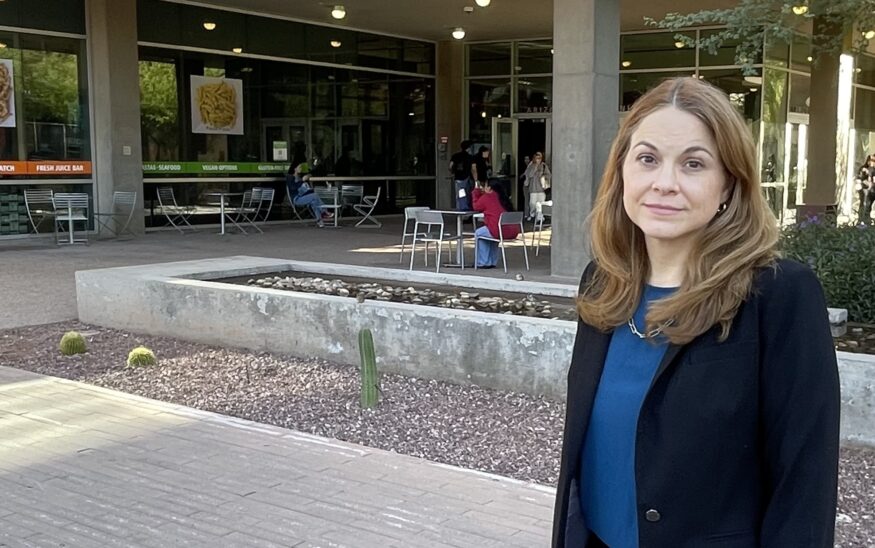
Erin Coyle is a media law and ethics professor at Arizona State University’s Walter Cronkite School of Journalism and Mass Communication. Photo by Jordan Gerard/Arizona Capitol Times
Q & A Erin Coyle: Arizona State University professor advocates for government transparency
Jordan Gerard, Arizona Capitol Times//December 20, 2025//


Erin Coyle is a media law and ethics professor at Arizona State University’s Walter Cronkite School of Journalism and Mass Communication. She worked as a city reporter in Dubuque, Iowa, and later earned a master’s degree and a doctorate in mass communication. She said her experience in journalism showed her the importance of media law and ethics.
“It’s been really an amazing journey getting to work with excellent people and excellent students and learning about legal systems in different states to provide a deeper understanding of how things may vary from place to place,” she told the Arizona Capitol Times.
This interview has been lightly edited for length and clarity. She does not speak on behalf of Arizona State University or the Cronkite School of Journalism and Mass Communication.
What drives your passion for media law and First Amendment law?
A lot of things. I deeply believe that this is a country where people have the right to seek information, to raise questions, to engage in discussions and debate. There are a lot of different laws that relate to those rights. Some of those rights can vary from state to state. I just found myself being fascinated with these questions and wanted to find more answers to help myself and to help other members of society understand what people’s rights are.
How harmful is it for elected officials to skirt accountability and transparency?
That is a challenging question. We live in a society where we assume that representatives are elected and members of society can make choices through their voting to help choose those representatives. But members of society also have rights related to free expression, to ask questions, to enter into discussions, to engage in debate, and to try to influence how representatives are or are not acting.
When we’re talking about those expression rights we’re talking primarily about First Amendment rights. But in the United States, when we start talking about rights to access information to be able to learn how representatives are or are not doing their jobs, when we’re focusing on transparency and government for members of the public to be informed, then we start talking primarily about legal rights that come through federal or state laws relating to accessing government-held information or accessing certain government proceedings.
The assumption is that having transparency, having access to this information helps people learn more about how the government is operating. Scholarship tells us that we assume that having access to this information is part of being able to hold representatives accountable, being able to learn how they’re doing their jobs helps people to be able to have informed discussions and debates and to cast informed votes.
So what happens when we don’t have that?
What gets really challenging is when we start thinking about the amount of information that government leaders have. Some of this information is highly sensitive and might not serve the public interest if it is released. We have a system in which government employees and government representatives have responsibilities to think carefully about this information and to determine whether releasing this information would help the public interest or harm the public interest. There is a fear associated with giving that responsibility related to the question you’re asking of what happens if people do not act in the public’s best interest. I think that’s a question that relates to human nature and that relates to questions about government secrecy. For generations, there have been questions about government secrecy, and when people in power use it to potentially hide wrongdoing.
Some of my scholarship has looked at news leaders’ advocacy for better access to government information. Some of the themes they have brought up are that this country exists in part because of concerns about tyrannical government. The form of government that we have is supposed to help people to be able to engage in self government through steps that should prevent tyrannical leadership in the country, at all levels, not only at the federal level. So one of the concerns is that if leaders find ways to hide government-held information, why are they hiding that information? So the question about “How is it harmful and how harmful is it?” Well, we don’t know exactly.
I don’t want to assume that people are trying to act in harmful ways, but I think there’s a fundamental issue here that if we have a breakdown in transparency, do we have a breakdown in accountability? If people can’t receive the information that they need to make decisions about government and to be able to participate in communications about government, that can be fundamentally harmful to our society.
Going into a new legislative session, should Arizona lawmakers give more consideration to accountability and transparency?
It’s always an important time to think about transparency in government. I think this is an especially important time to be thinking about it when there are concerns about levels of trust for institutions and what that can mean for the effectiveness of government. There have been trends around the country in recent years with amending public records laws in specific ways for striking balances of serving the public’s interest to learn about how government officials are doing their jobs in ways that are not clearly harmful to individuals who are members of communities. Those issues are always important for the legislature to be thinking about.
How can people demand transparency and accountability of their elected officials?
This is where exercising our freedom of expression rights becomes very important. We can make a phone call, we can send a letter, we can send an email, we can use social media to let our elected officials know that transparency is important. It is important for people to show that they care about the government, that they care about society, and for them to express their opinions about what is working and what is not working. That’s really fundamental in a society that depends on self government. We depend on having individuals express themselves, as well as depend on elected leaders to listen to members of society.
Do you think this topic will be more prominent in the upcoming legislative session?
I hope it will be. I hope legislators are thinking carefully about how to provide more transparency.