Sign In
Upcoming Event
 Free Newsletter

Joanne MacDonnell: pride, service and the Arizona Ombudsman’s Office
Jordan Gerard, Arizona Capitol Times//January 18, 2026//
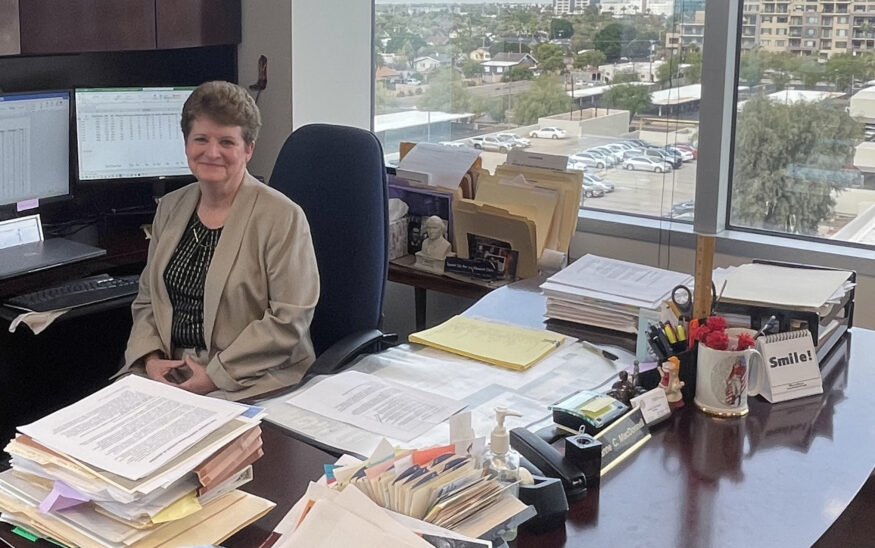
Joanne MacDonnell at the Arizona Ombudsman Citizens Aide Office. (Jordan Gerard / Arizona Capitol Time)
Joanne MacDonnell: pride, service and the Arizona Ombudsman’s Office
Jordan Gerard, Arizona Capitol Times//January 18, 2026//


If there’s one state agency that guides people through the jungle of state government, it’s the Arizona Ombudsman Citizens Aide Office. And if there’s one person at that office who’s taken the responsibility as a point of personal pride, it’s Joane MacDonnell.
Macdonell has served as the state’s ombudsman, an appointed role with a five-year duration, since her selection by Gov. Doug Ducey in 2022. As a fourth-generation Phoenician, she is no stranger to state government.
She watched her dad serve as a state senator and representative and even helped him as a campaign manager in 1981. Her mom was a teacher and MacDonnell has those characteristics instilled in her as well.
Barry Goldwater appointed her as a page at the Republican National Convention, and she helped Carl Kunasek when he ran for Senate President and eventually for the Arizona Corporation Commission. Later, she went to work as the Director of Corporations at the commission, shortly after it had just received a “horrible” rating from an audit. With her direction, the commission won “Agency Turnaround of the Year” in 1998.
After her time at the commission, she joined the Ombudsman Office as Deputy Ombudsman in 2005 and worked under the first two ombudsmans. The Ombudsman Office is the smallest state agency with just 12 employees and two interns. Requesting help from the Ombudsman Office is free.
MacDonnell and her husband Phil live in Phoenix and have two grown children and one grandchild.
This interview has been lightly edited for style and clarity.
What does the Ombudsman do?
We’re kind of like the scout team for the Legislature. We’re out there seeing what’s going on in government, that might be something they need to know about, because maybe the law says x and y, but it creates some unintended bad consequences, so we have to tell the citizen, “Well, it’s the law,” but then we can tell them (the Legislature) in our summaries that this is creating an unfortunate situation.
We classify it into three different areas. Everything starts as coaching. That’s what I meant about the librarian and air traffic control. Sometimes that’s just guiding people, sometimes they haven’t been to the Ombudsman Office and we’ll load them up. We’ve got a huge resource page.
We’ll help you so you can have an effective conversation with (a state) agency. We have a whole written guide on our website about how to file effective complaints. It never helps to use all caps and an exclamation point.
Assistance is when we know something’s off track. Other times it’s investigations. We can do an investigation informally, depending on the topic, sometimes within hours, depending on what agency it is, how fast we can get things turned around, how fast we can get critical information to us. We try to do it informally when we can, and work with the agencies.
The other way is when we decide the complainant’s allegations or part of their allegations, some aspects are true, and then we go to the agency and we go, “We think this, this, this, that, that, are accurate, what they’re alleging. We have some recommendations to fix this. Do you want to handle it and fix it with them and try and make it right?” Ninety-nine percent of the time, the agencies go “Okay, yeah, we’ll make it right. We’ll make it as right as we can.”
But sometimes they dig in, and those are usually the cases where they’re saying “No, we think we’re right because of this, and this and this. And we disagree because of this and this and this.” That’s when we’re backed into the corner of writing the formal reports.
How does your office function in a divided state government?
We’re strictly bipartisan, no politics, so we never work on campaigns. We’re kind of a safe place for every political persuasion because we don’t do politics. We help all the legislators with their constituents. If they’ve got a constituent that’s having trouble in government, it lets the legislators have some professional distance so they’re not appearing to poke around an agency and lean on an agency, but it gives (them) an independent group that can go in and take a look. They know that we’re just calling balls and strikes like an umpire.
I have never, ever had a legislator ask me to lean on an agency. It’s supposed to be just independent, sift through the facts, and not care who’s best friend was with who or which agency.
What is the best part of your job?
Helping people. Having a little bit of a counterweight to the very intimidating 800-pound gorilla that people are afraid of, which is the government. They often feel like, “Oh, I have to be a lawyer. I’ve got to be a lobbyist or I’ve got to be some big business person or some big nonprofit to be able to affect it.” You really don’t. You just have a good point and are on the right side. That I think is the best.
What is the most challenging aspect of your job or office?
If you ask me in a couple of years, I might say AI, but then I might love it too, so I’m not sure.
There’s a small group of anti-social people in the past year, we’ve had to contact police and the Department of Public Safety. Sometimes we’ve seen things of violent nature, sexual nature, totally antisocial, slurs, disparaging things, and not beyond the pale — we’ve been cussed out with the best of them. But just people who are really not good at what they’re sending and wanting to shock or behaving in such an antisocial way. That’s tough, especially if they go after one of your staff.
The second worst is the folks that just want what they want, and kind of “damn the torpedoes” and whether they’re in compliance with the law, whether they’re being reasonable, they don’t care, and they behave badly while doing it.
Your office serves as the middleman between state agencies and the public. What do you wish state agencies did better?
Everyone, including the agencies, could have a very discernible, “What to do with a dispute in our agency.” It would also be helpful if people looked at our website. We’ve got all these suggestions about how to be a more effective complainant, because if you’re taking the time to express your unhappiness, you want to be heard, and you want the highest likelihood of prevailing, if the facts are on your side.
Every agency should have its own diagnostic process and hopefully part of that is the internal ombudsman office. It should be on the same floor or very near to where the director is, because if they’re doing their job right, they should be spotting the issues as they arise.
I think it would be very helpful for the agencies if they look at their internal ombudsman as an opportunity to reverse engineer, “How did we get here?” I’m a firm believer in educating people. Most folks, if you extend them the kindness of a full explanation, they don’t have to guess.
My last recommendation would be, “Don’t live with a bad law.” That’s one of our jobs, to point out when you’re acting contrary to law, but you don’t have to live with it.