Sign In




 Free Newsletter
Judge to rule on Fondomonte’s groundwater use as public nuisance case unfolds
Kiera Riley, Arizona Capitol Times//February 7, 2026//
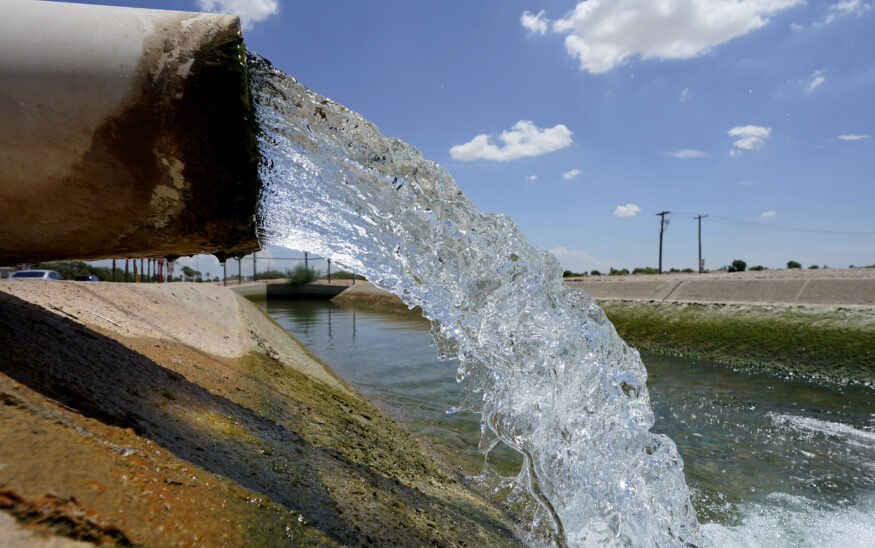
Water from the Colorado River diverted through the Central Arizona Project fills an irrigation canal on Aug. 18, 2022, in Maricopa, Ariz. (AP Photo/Matt York, File)
Judge to rule on Fondomonte’s groundwater use as public nuisance case unfolds
Kiera Riley, Arizona Capitol Times//February 7, 2026//


Key Points:
-
Fondomonte seeks to leave restrictions to state water resources agency
-
State argues need for court order to ensure targeted relief, usage constraints
-
Judge weighs whether administrative regulation negates public nuisance lawsuit
A Superior Court judge is weighing whether greater regulation in La Paz County undermines or intensifies the state’s legal claim over whether Fondomonte Arizona, a Saudi-owned alfalfa farm, is illegally pumping excessive groundwater.
Yet while Attorney General Kris Mayes pursues Fondomonte on public nuisance charges, the Arizona Department of Water Resources implemented a new active management area for groundwater in the Ranegras Plain Basin.
Now, ADWR is tasked with assessing current groundwater use, exempting existing users, blocking new irrigation and implementing water reporting and management plans to protect an area’s water supply — all of which could impact a decision on whether Fondomonte’s agricultural operations constitute a public nuisance.
Attorneys for Fondomonte argue that the court should defer to ADWR, given the agency’s authority over groundwater under state law, and clear the way for regulation and restrictions through the AMA.
“ADWR has the expertise and resources, not to mention statutory mandate, to handle these issues properly and independently,” Briana Campbell, attorney for Fondomonte, wrote.
But, Mayes claims that a prospective court order deeming Fondomonte’s groundwater pumping a public nuisance could be critical to ADWR’s assessment of whether the farm’s current practices are legal and thus exempt from any future regulation.
Additionally, she notes that regulation by ADWR would not provide targeted relief to impacted community members.
“Here, Fondomonte is not subject to any administrative action directed at its excessive water use. Nor does ADWR have authority to impose ‘liability’ on Fondomonte for harming the community,” Assistant Attorney General Clinten Garrett wrote.
In December 2024, after hosting town halls and fielding community input, Mayes filed a public nuisance lawsuit against Fondomonte Arizona, claiming the company’s “excessive” groundwater pumping had led to declining water levels, dry wells, land subsidence and worsening water quality.
Since then, Mayes and Fondomonte have continued to duke it out over whether the company’s water use is legal, and more recently, whether the attorney general has the authority to litigate the issue in the first place.
With litigation underway, ADWR began taking initial steps to gauge community interest in an active management area in the Ranegras Plain Basin.
And after a formal hearing, ADWR Director Tom Buschatzke greenlit the AMA in early January, finding significant declines in groundwater levels, aquifer outflows far exceeding inflows and worsening land subsidence.
Gov. Katie Hobbs formally announced the AMA during her State of the State Address.
“Why do we need another AMA? Because in the Ranegras Plain Groundwater Basin, the land is sinking and legislators are shirking their responsibility,” Hobbs said in her speech. “We can no longer sit idly by while our rural communities go without help. They deserve solutions and security, not another decade of inaction and uncertainty.”
Both Mayes and Fondomonte were well aware of the potential for an AMA, and after the formal decision, the two submitted supplemental briefs to the court on how the administrative action affects the lawsuit.
In the state’s brief, Garrett argues the AMA clears the way for incremental, long-term remedial action but does not allow for targeted findings on whether Fondomonte’s groundwater usage is legal and does not provide specific remedy to address alleged harm to the surrounding community.
And, more to the point, a court order finding a public nuisance could determine whether Fondomonte is entitled to “grandfathered” rights to pump water in the area at the same rate.
“Far from posing any conflict with the administrative action, this civil action’s disposition will therefore inform a critical administrative decision,” Garrett wrote.
Garrett also pointed out that the initial creation of a Management Plan by ADWR is on a two-year timeline, and the true impacts of regulation are a decades-long process, whereas a court finding could provide relief much sooner.
Mayes claimed active management areas and public nuisance to be “complementary,” and pointed to a recent settlement with dairy facility Riverview, LLP.
Though Mayes initially threatened public nuisance litigation, the company came to the table instead, and the two eventually reached a settlement agreement, all amid a similar AMA backdrop.
Per the terms, Riverview agreed to start two funds totalling $11 million to directly support water access for impacted residents, schools and water companies, agreed to stop using or transition 2,000 acres of farmland and adopted a line of water conservation practices.
“We were able to get a major water user to the table related to a public nuisance investigation to save a significant amount of groundwater before the Douglas and Willcox AMAs go into effect,” Mayes said.
Fondomonte, meanwhile, claims that ADWR will essentially undertake the same investigative process the state seeks through litigation. The company asks the court to stay the case and defer to ADWR.
And contrary to the state’s claim, Campbell asserts that ADWR will impose specific restrictions on Fondomonte. And though she notes Fondomonte does plan to seek a grandfathered right, Campbell notes the amount of water would still be limited and the state would eventually be entitled to challenge the designation.
“The Legislature created ADWR to assess basin-wide groundwater conditions to determine the causes of decline and subsidence, and to impose mandates tailored to those findings,” Campbell wrote. “Now that the ADWR has taken charge of the groundwater issues in the Basin, the Court should stay this lawsuit and let the agency do its work.”