Sign In
Upcoming Event
 Free Newsletter

Funding for Independent Correctional Oversight Office still uncertain
Kiera Riley Arizona Capitol Times//January 24, 2026//
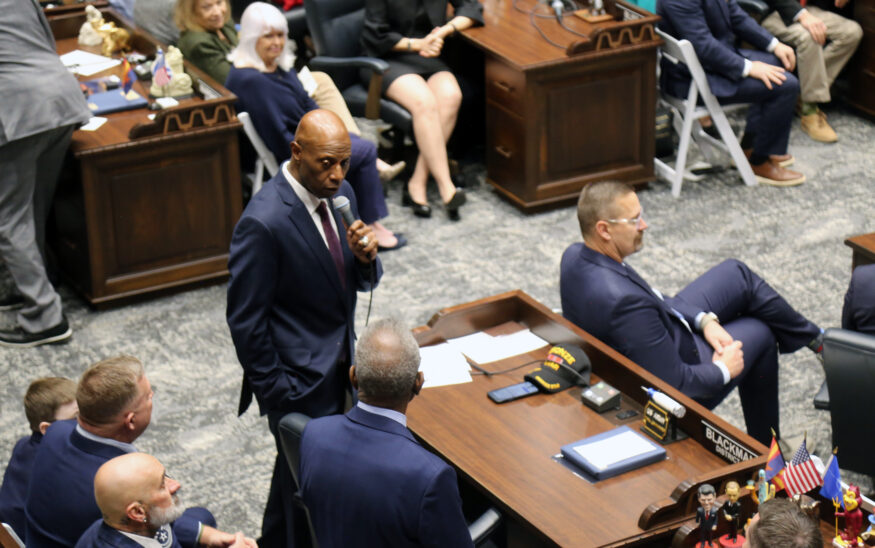
Rep. Walt Blackman, R-Snowflake, speaking on the floor of the Arizona House of Representatives on the opening day of the 2026 legislative session. Blackman has been a consistent legislative advocate for new prison oversight since the 2025 session. (Brock Blasdell / Arizona Capitol Times)
Funding for Independent Correctional Oversight Office still uncertain
Kiera Riley Arizona Capitol Times//January 24, 2026//


Key Points
-
No funding for prison oversight office in governor’s budget
-
Legislature starts push for $1.5 million to actualize oversight
-
Budget director claims Governor’s Office open to discussion
With an Independent Correctional Oversight Office created but still lacking funding, the Legislature continues to push for some form of appropriation. And though the office’s line item is strung with zeroes in the executive budget, the $1.5 million needed to fund and maintain a new oversight department could still be on the table in future negotiations, according to the governor’s budget director.
All the while, Gov. Katie Hobbs has her own ideas for state prison improvements, with proposals to expand body-worn cameras for corrections officers and to invest in salaries and retirement plans for correctional officers.
Senate Bill 1507, passed and signed last session, establishes the Independent Correctional Oversight Office.
The prospective office would be headed by an executive director appointed by the governor and confirmed by the Senate.
Under the director’s purview, the office would be charged with monitoring confinement conditions and compliance with state and federal laws, disseminating information about inmates’ rights, accepting and investigating complaints, establishing a reporting system and submitting annual reports to the Legislature.
As it stands, the office has no funding to get started, but lawmakers and proponents are working to change that.
On Jan. 20, Legislators unanimously passed Senate Bill 1032, which provides $1.5 million to get the office off the ground, through the Senate Appropriations, Transportation and Technology committees.
Sen. Shawnna Bolick, R-Phoenix, guided the oversight office legislation through to the governor’s desk last session and returned this session on a crusade to ensure the office is fully realized.
Bolick again staked out the aim for the office to serve as a place for inmates and employees to raise and alert on issues in the prison system and, hopefully, allow the state to correct them “before they spiral out of control.”
She noted the continued, consistent outreach from whistleblowers, inmates, families and corrections employees.
Donna Hamm, executive director of Middle Ground Prison Reform, said the organization had fielded “dozens” of emails, letters and phone calls with complaints within the past week.
“It’s safe to say we need this kind of oversight now more than ever,” Hamm said. “The Department of Corrections uses the word transparency a lot, but they don’t practice it.”
Bolick told the committee, “$1.5 million is a small appropriation, but I think it speaks volumes.”
Hobbs provided no additional funding for the office in her executive budget.
In a Joint Appropriations meeting on Jan. 20, Rep. Walt Blackman, R-Snowflake, who pushed an oversight proposal in the House, asked Ben Henderson, director of the Governor’s Office of Strategic Planning and Budgeting, where the $1.5 million was in the corrections budget.
“The governor was proud to sign that piece of legislation into law,” Henderson said. “We’d be happy to talk with you in budget negotiations about how to make sure there’s funding for that office.”
Blackman was not convinced.
“I’m asking now,” Blackman said. “Because what that means is you’re going to blow me off and we’re never going to see each other again.”
Henderson acknowledged the investment was not in the budget, but said the Governor’s Office was not opposed to having a conversation.
“I certainly don’t want to blow you off,” Henderson said.
Hobbs’ budget allocates $1.7 billion in total for corrections, with $118.3 million in one time funding to add over 615 full-time positions to comply with the injunction in the long-running class action lawsuit, Jensen v. Thornell.
And the executive budget includes a $24.4 million appropriation to the Correctional Officer Retention Package to ensure 7,000 correctional officers can sustain the 4% salary raise implemented last year, amid 1,050 separations from the department.
As for inmate and staff safety, Hobbs proposes $5.1 million in FY2027, $10.1 million in FY2028, and $15.2 million ongoing in FY2029 to expand the body-worn camera program piloted in the department between May and October 2025.