Sign In
Upcoming Event
 Free Newsletter

Mayes uses ‘public nuisance’ law to target proposed Surprise ICE facility
Kiera Riley Arizona Capitol Times//February 13, 2026//
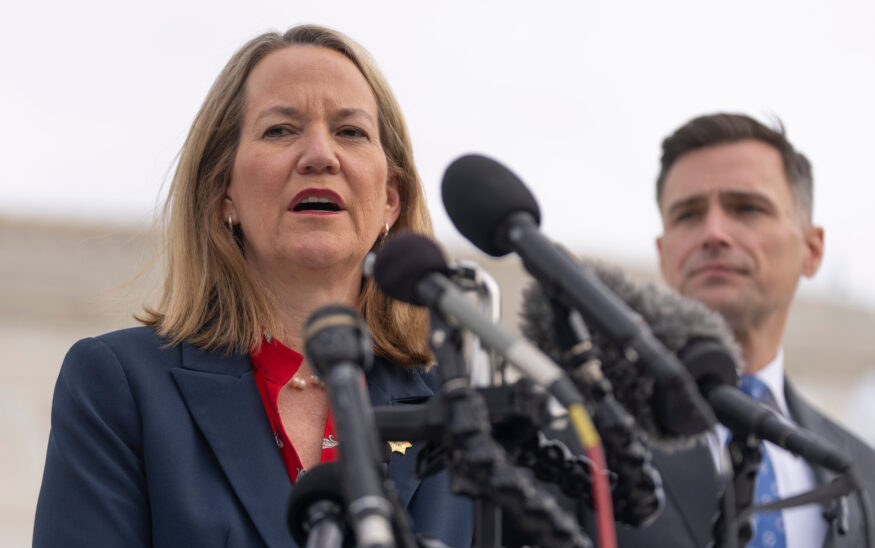
Arizona Attorney General Kris Mayes speaks to reporters as Oregon Attorney General Dan Rayfield listens outside the Supreme Court on Wednesday, Nov. 5, 2025, in Washington. (AP Photo / Mark Schiefelbein)
Mayes uses ‘public nuisance’ law to target proposed Surprise ICE facility
Kiera Riley Arizona Capitol Times//February 13, 2026//


Key Points:
-
Attorney general probes ICE facility under state public nuisance law
-
Joins federal lawmakers in concerns over impact to community
-
Federal compliance with state law still an open question
Attorney General Kris Mayes is probing Immigration and Customs Enforcement’s proposed 1,500-bed detention facility in Surprise for potential violations of public nuisance law.
In a letter to Department of Homeland Security Secretary Kristi Noem, Mayes asked for information on the facility’s potential impact on local schools, traffic, noise, water supply, waste disposal, medical care and workload for local first responders.
Mayes’ letter follows a line of information inquiries from members of Arizona’s congressional delegation. By adding to the pile, she equips her own inquiry with some legal teeth.
Unlike her predecessors, Mayes has taken a broad interpretation with public nuisance law, and has led the legal charge on a variety of public issues like excessive groundwater pumping, a proposed aluminum plant and now the “seven football field sized prison” ICE plans to “plop down in the middle of the city of Surprise.”
“Kristi Noem, in her own communications, noted that they work within state and federal regulations and laws, so she intends to work within state laws,” Mayes said. “And I would assume she’s not going to have a problem abiding by our nuisance law.”
Mayes’ letter, sent Feb. 9, begins by noting that the proposed processing and detention facility, located at Sweetwater Avenue and Dysart Road in Surprise, is in the middle of a residential area. And, despite being located in Surprise, Mayes pointed out the department had kept city officials and residents in the dark about the project.
In a statement, Surprise city officials said, “The City was not aware that there were efforts underway to purchase the building, was not notified of the transaction by any of the parties involved and has not been contacted by DHS or any federal agency about the intended use of the building.”
Mayes referenced a Surprise City Council meeting on Feb. 3 where more than 80 residents “spoke at length of the project’s harm to their community,” with overlapping concerns about potential impacts on schools, water, waste, trash, medical services, property values and economic development. She then framed the same concerns within the constructs of public nuisance law and sent a list of demands for more information.
Within the letter, Mayes asked for more details on how the federal agency plans to ensure that the construction and operations of the center do not interfere with the functions of nearby schools like Dysart High School.
She also raised questions about the number of vehicles, associated traffic, pollutants, dust and noise, complying with lighting requirements inside and outside the facility under city and county laws, the amount of water needed for construction and operations, and the plan for waste disposal.
Finally, she inquired about the presence of adequate medical care and the impacts to local municipal services, like fire, law enforcement and emergency response services.
The state’s public nuisance law empowers the attorney general to sue to enjoin or prevent any activity found to be “injurious to health, indecent, offensive to the senses or an obstruction to the free use of property that interferes with the comfortable enjoyment of life or property by an entire community or neighborhood or by a considerable number of persons.”
Mayes has relied on public nuisance law throughout her tenure, but only one claim remains alive in court.
The attorney general is currently in litigation with Fondomonte Arizona, a Saudi Arabian-affiliated alfalfa farm, for what she is calling excessive groundwater pumping.
A Maricopa County Superior Court judge is also now considering whether the implementation of an active management area for water regulation in the area negates or amplifies the need for public nuisance litigation, with a final ruling on Mayes’ claim still coming down the line.
Prior to Fondomonte, Mayes sued two companies planning to build a mine near a residential area under public nuisance law, claiming potential structural damage, excessive dust and noise and increased traffic. The suit was voluntarily dismissed after a neighbor purchased the disputed land.
Mayes also threatened to sue Riverview Dairy, LLC, a dairy farm, under the law for excessive groundwater pumping.
Though the issue never went to court, the attorney general and the company entered into a settlement in which Riverview agreed to pay $11 million to remedy lost and strained groundwater access.
Though Mayes said the ICE facility may well fit into state public nuisance law, whether the federal government will bow to state law remains a key concern.
In Surprise’s statement, officials said the federal government was not subject to local zoning regulations.
Mayes anticipated the same pushback, though she noted a statement on the DHS website in which it would comply with “federal, state, and local laws and regulations, in operation of DHS facilities.”
“We’ll see what they have to say,” Mayes said.
Mayes also asked for copies of responses to questions posed by U.S. Reps. Paul Gosar, Yassamin Ansar, Greg Stanton and Adelita Grijalva, Arizona members of Congress.
Gosar, a Republican, sent the first letter on Feb. 4. He started by clarifying he “strongly” supported ICE operations but noted that the impacts of immigration policy are “most acutely felt at the local level.”
“A detention facility of the reported size raises legitimate and reasonable questions for nearby residents, schools, first responders, and local governments. Concerns regarding infrastructure capacity, traffic, emergency services, environmental impacts, and public safety deserve serious consideration,” Gosar wrote. “These are not anti-illegal immigration concerns; they are common-sense expectations of transparency, planning, and accountability.”
Gosar and Mayes overlapped on inquiries about consultation with local governments, schools, law enforcement, traffic impacts and adequate medical services.
However Gosar did add his own questions to the mix concerning the facility’s population, oversight on operations, security measures, timelines for development and expansion, contingency plans for growth and future plans for communication and local consultation.
Mayes identified Gosar’s letter as the catalyst for her own.
“Quite frankly, when I read Congressman Gosar’s letter, it struck me that he was asking the kinds of questions that go into a possible nuisance lawsuit,” Mayes said.
In a Feb. 6 letter, Democrats Ansari, Stanton and Grijalva similarly asked about community impact, operational footprints and the department’s authority to purchase, acquire and convert the property. And most recently, U.S. Sens. Mark Kelly and Ruben Gallego added another letter to the pile on Feb. 10, with similar questions.
Mayes set a response deadline for Feb. 17, as did Gallego and Kelly. Gosar asked for a response by Feb. 18 and Ansari, Stanton and Grijalva set a Feb. 20 deadline.
The Department of Homeland Security and ICE did not respond to a request for comment.