Sign In


 Free Newsletter

Fentanyl overdose deaths on the rise again in Arizona
David Hanselman, Guest Commentary//February 18, 2026//
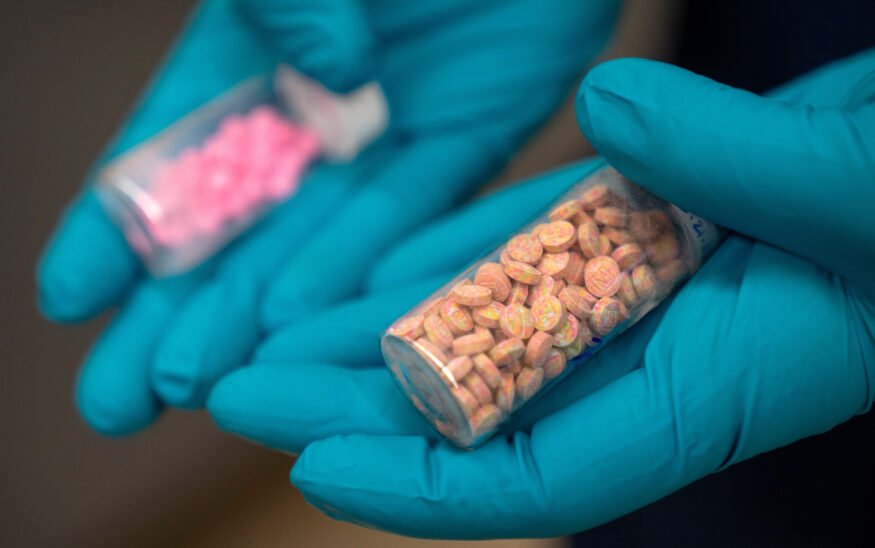
FILE - Jonathan Dumke, a senior forensic chemist with the Drug Enforcement Administration, holds vials of fentanyl pills at a DEA research laboratory on Tuesday, April 29, 2025, in Northern Virginia. (AP Photo/Mark Schiefelbein, file)
Fentanyl overdose deaths on the rise again in Arizona
David Hanselman, Guest Commentary//February 18, 2026//



For the first time in years, the United States is seeing meaningful progress in the war against fentanyl. According to provisional data released by the U.S. Centers for Disease Control and Prevention (CDC) this month, drug overdose deaths nationwide declined by more than 20% over the most recent 12-month period. Thousands of lives were saved, and that progress deserves recognition.
Unfortunately, Arizona is moving in the opposite direction.
While drug overdose deaths have been trending down nationally, Arizona saw a sharp uptick in the last year for which statistics are available.
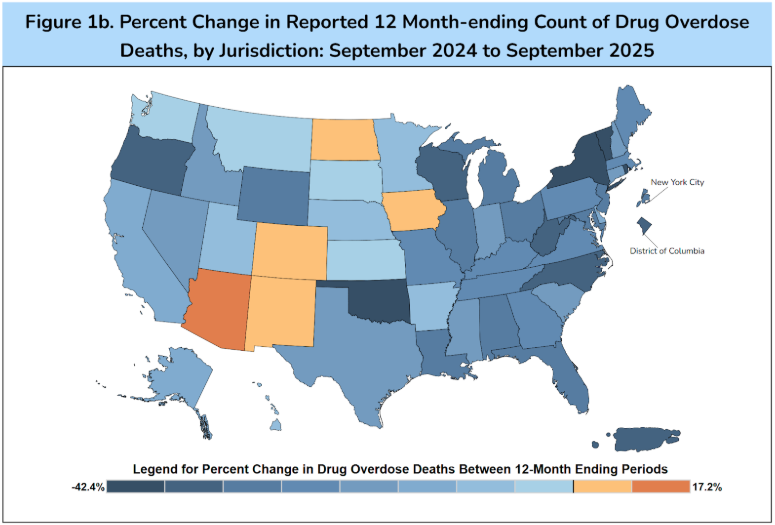
For the 12-month period ending September 2025, the data illustrates three troubling statistics: Arizona was one of only five states to record an increase in overdose deaths; it had the largest increase of any state; and while the country saw a 21% decline overall, Arizona experienced a 17% increase.
At a time when the rest of the country appears to be turning the corner on the fentanyl crisis, Arizona is falling further behind. The following charts show the trendline of reported overdoses due to synthetic opioids (fentanyl) in the United States (top) and Arizona (bottom):
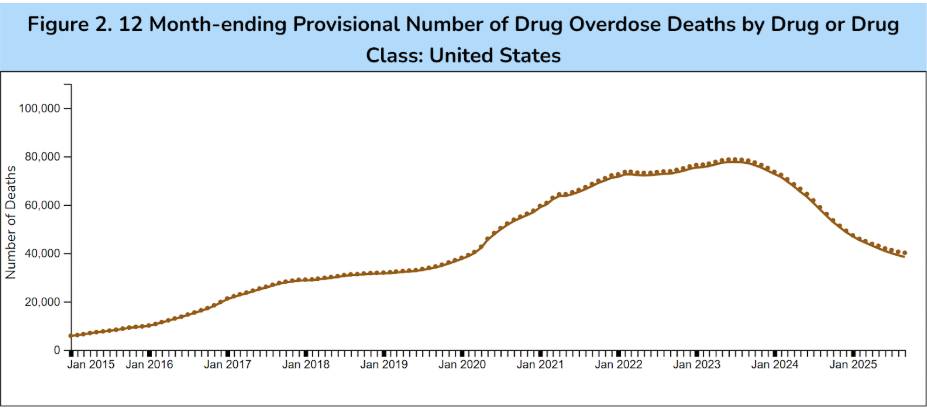
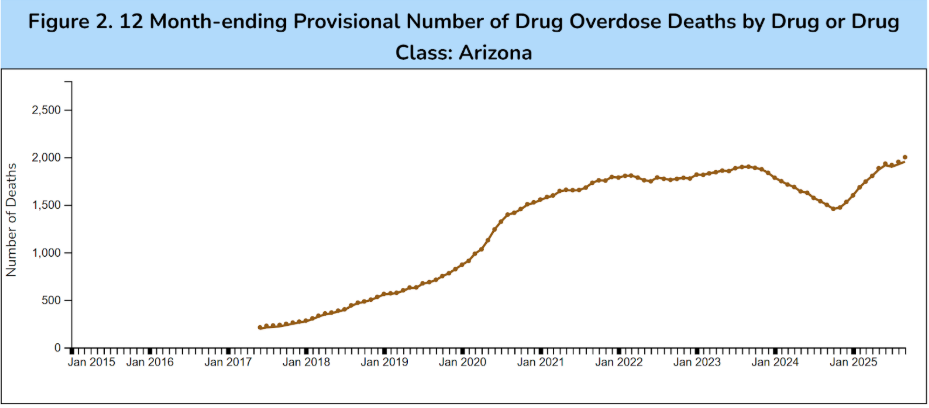
This data highlights a few troubling realities. While reported fentanyl overdose deaths decreased nationwide by 31% for the 12-month period ending September 2025, they increased by 30% in Arizona. Additionally, the number of reported fentanyl overdose deaths increased each month from October 2024 through September 2025, with only a small decline between June and July 2025. Finally, fentanyl overdose deaths in Arizona are currently as high as, if not higher than, they were during the height of the fentanyl crisis in 2021, 2022 and 2023.
To reverse this trend, it is important to look behind the statistics to try to understand why Arizona’s trend line is an outlier compared to other states. One answer may be geography. Because of Arizona’s proximity to the border with Mexico, law enforcement agencies in the state have seized roughly half of all fentanyl pills confiscated nationwide in each of the past three years. But geography alone would not explain why Arizona’s drug overdose rate surged over the last 16 months.
Another potential culprit is the increased distribution of fentanyl in powder form. The Phoenix Field Division of the U.S. Drug Enforcement Administration recently reported a 79% increase in fentanyl powder seizures in 2025 compared to 2024. Regardless of the reason for the recent increase in fentanyl overdose deaths, there is no question that drug cartels continue to use Arizona as a gateway to distribute illegal drugs across the country.
In recent years, lawmakers have taken incremental steps to increase criminal penalties for fentanyl trafficking. However, those penalties apply only in limited circumstances, such as completed sales or transportation in a vehicle of 200 grams of fentanyl. The result is a system where a courier transporting pills in a vehicle may face more severe punishment than a high-level trafficker stockpiling tens or hundreds of thousands of pills in a stash house. And in most circumstances, possession of fentanyl for sale is still punished less severely than possession of methamphetamine for sale, even though fentanyl accounts for two-thirds of all drug overdose deaths in Arizona.
For these reasons, I have advocated for bringing the sentencing ranges for fentanyl trafficking fully into line with those that apply to methamphetamine sales offenses. As I wrote in the Arizona Capitol Times last November, Arizona must stand firm against fentanyl traffickers. The latest CDC data reinforces that need.
In the current legislative session, lawmakers are debating two bills that would lower the quantity needed to trigger enhanced sentencing for completed sales of fentanyl. House Bill 2132 would reduce the quantity from 200 grams to 100 grams, a change intended to reach mid- to low-level drug dealers, while Senate Bill 1061 would lower it to 9 grams. Though they differ in scope, both bills reflect growing recognition that current law is inadequate and that Arizona must reexamine how it holds fentanyl traffickers accountable.
In considering these bills and other solutions, I urge legislators and Governor Hobbs to consider the new CDC data and confront the uncomfortable reality it reveals. At least here in Arizona, the fentanyl crisis is not over, and we need stronger sentencing for fentanyl trafficking now more than ever.
David Hanselman is a prosecutor in the Drug Trafficking Bureau at the Maricopa County Attorney’s Office. The views expressed in this article are the author’s and not those of MCAO.